Major GitHub Outage: Pull Requests, Git Operations, and Issues All Down
Three core GitHub services failed simultaneously, exposing systemic risks of centralized code hosting.
GitHub's Pull Requests, Git operations, and Issues all experienced simultaneous anomalies, blocking the full collaboration chain from code submission and review to task tracking. The incident garnered 258 points and 129 comments on Hacker News, reflecting the developer community's high concern about infrastructure stability. The article analyzes the compounding effect of three simultaneous failures: even with partial recovery, teams struggle to maintain a complete workflow. The deeper issue is the systemic risk of centralized code hosting—platform availability is directly equivalent to dependent organizations' R&D efficiency. The article suggests engineering teams shorten the actual impact on delivery by confirming remote status, retaining mirror push paths, and enabling backup task tracking, and notes that the information limits of status pages force enterprises to decide on their own whether to activate contingency plans.
An Outage That Gripped Developers Worldwide
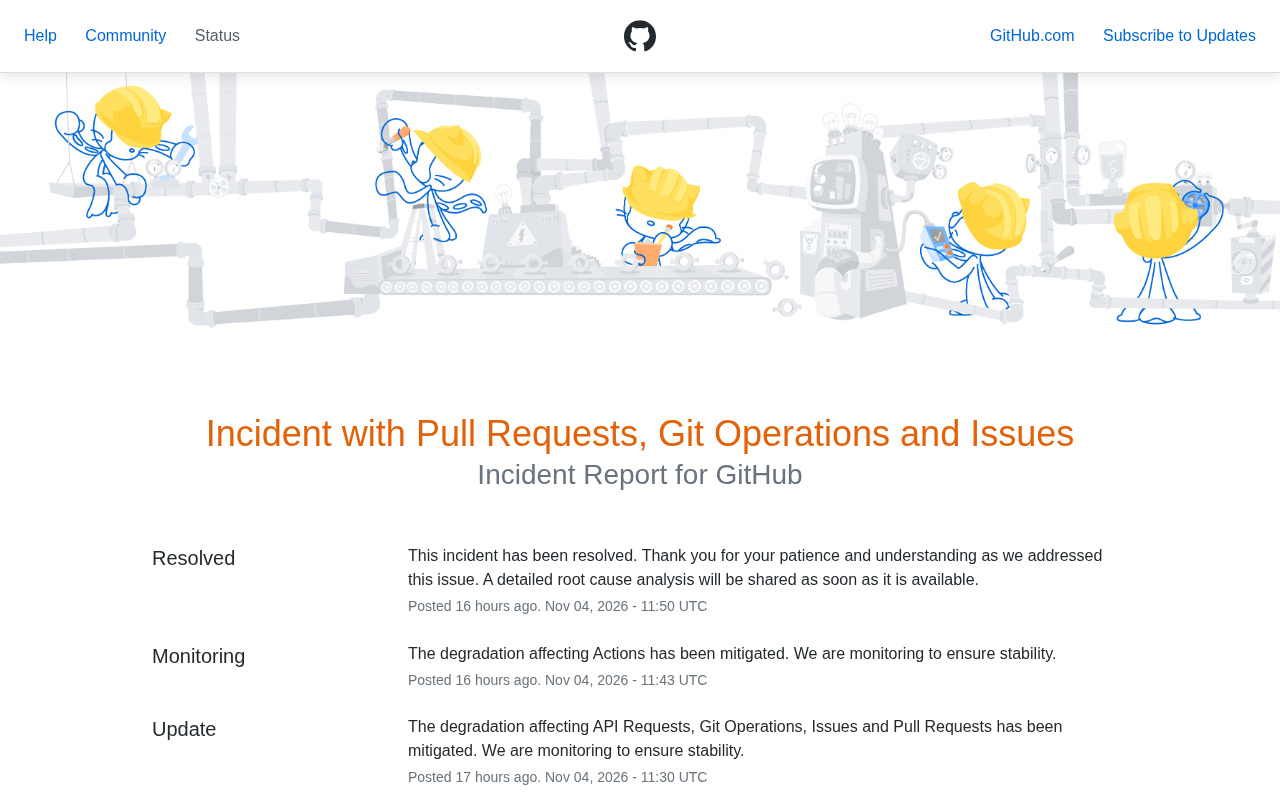
GitHub has once again become the focus of the developer community due to stability issues. According to an incident notice posted on GitHub's official status page, its core services—Pull Requests, Git operations, and Issues—experienced simultaneous anomalies, forcing many developers' daily collaboration workflows to grind to a halt. The incident quickly sparked discussion on Hacker News, with the related post garnering 258 points and 129 comments, underscoring its real-world impact on developer workflows.
Looking at the scope of the outage, the affected features are not peripheral modules but the three most fundamental links in GitHub's collaboration model: code submission and retrieval (Git operations), code review (Pull Requests), and task tracking (Issues). The simultaneous failure of all three means that the entire chain—from writing code and committing code to review and merge—could be blocked. For teams that rely on GitHub as their sole code hosting and collaboration platform, an outage of this magnitude is almost equivalent to a workflow standstill.
Impact: More Than Just "It Doesn't Work"
Cascading Effects on Developer Workflows
Git operation anomalies directly severed the synchronization channel between local and remote repositories. Developers could not push new commits, pull others' updates, or clone repositories, throwing branch management in parallel development into disarray. Pull Requests being unavailable blocked the code review and merge process, forcing teams to pause releases or temporarily switch to other ways of reviewing code. Issues failures affected task assignment and defect tracking, and in the fast pace of agile development, this robbed teams of visibility into their current work status.
The compounding effect of three simultaneous failures deserves attention: even if Git operations briefly recovered, teams still couldn't complete the full "commit—review—merge—track" loop if PRs and Issues remained unavailable. This coupling amplifies the blast radius of a single point of failure.
The Dependency Between Git Operations and Pull Requests
Git is a distributed version control system, and its "distributed" nature means that every developer's local machine holds the complete repository history. In theory, local commits, branch switching, and viewing history do not depend on a remote server. But modern team collaboration models are in practice highly dependent on a centralized remote repository (such as origin on GitHub). git push and git fetch require communication with the remote, and Pull Requests are a review mechanism built on top of the remote repository—essentially a request to merge one branch into a target branch. Therefore, Git operation anomalies cut off local-remote synchronization, and PR reviews stall as a result; even if the PR page itself is available, there's nothing to review if no new commits have been pushed. This dependency relationship explains why failures across all three services create a compounding effect.
Community Reaction and Discussion Volume
The 129 comments on Hacker News indicate that developers' concern about GitHub's stability has gone beyond mere technical curiosity. Common sentiments in the comments include worries about single-platform dependency, practical discussion of work arrangements during the outage, and scrutiny of GitHub's official communication transparency. 258 points is a mid-to-high level of attention in the tech community, reflecting the public nature of such infrastructure failures—it's not just a problem for GitHub as a company, but a shared event for the entire development ecosystem that depends on its services.
How Hacker News Ranking Works
Hacker News is a tech community operated by Y Combinator, and its content ranking is not simply based on upvotes but on an algorithm combining votes, time decay, and comment activity. A post receiving 258 points means a large number of users actively voted within a short period, which usually reflects that the topic is highly relevant to community members' core interests. 129 comments indicate a high depth of discussion, as comment counts often reveal controversy or resonance more than vote counts do. For infrastructure failures, Hacker News discussions often go beyond the incident itself, extending to broader topics such as architecture design, vendor lock-in, and operations culture—which is why such posts tend to attract mid-to-high attention.
From Status Page to Engineering Practice: Why Stability Keeps Coming Up
GitHub communicates incidents externally through its status page, which is itself part of operational transparency. But the information a status page can provide is usually limited to "which features are affected and what stage things are at." Root cause analysis, quantified impact scope, and preventive measures often require waiting for a postmortem. For enterprise users, this information cadence means that during an outage, teams must decide on their own whether to activate contingency plans.
More worth pondering is the systemic risk of centralized code hosting. When a large number of organizations host their code, review records, and task data all on the same platform, that platform's availability becomes directly equivalent to those organizations' R&D efficiency. This outage of PRs, Git operations, and Issues simultaneously happened to demonstrate the fragile side of this centralized dependency: it wasn't just one tool failing, but multiple critical nodes in the collaboration chain failing at the same time.
For engineering teams, feasible response strategies include: confirming the availability of remote repositories before critical release windows, retaining a push path to local or mirror repositories for emergency fixes, and enabling backup task-tracking methods when the collaboration platform is unavailable. These measures can't prevent platform outages, but they can shorten the actual impact on delivery cadence.
The Limits of Status Pages and Postmortems
A status page is a standard tool for SaaS services to communicate availability externally, typically using red/yellow/green to indicate the health of each functional component and publishing incident timelines. However, the design goal of a status page is to "communicate current status," not to "explain the cause." During an outage, engineering teams are often still diagnosing the problem and can't immediately provide a root cause; the status page can only reflect the "known impact scope." A postmortem is a detailed report published after the incident ends, typically including a timeline, root cause analysis, quantified impact, and improvement measures. Mature engineering organizations make postmortems public, but postmortems are inherently delayed—meaning that enterprises dependent on the platform can only make decisions based on limited information during the outage itself, unable to wait for an official full explanation.
Systemic Risks of Centralized Hosting and Fallback Plans
Centralized code hosting concentrates code, review records, task tracking, and CI/CD triggers—key R&D assets—on a single platform, bringing collaboration efficiency while also introducing systemic risk. When the platform is unavailable, automated pipelines that depend on its APIs and Webhooks fail in tandem, with an impact far beyond "can't access the web page." Common mitigation measures for engineering teams include: maintaining a read-only mirror repository (e.g., syncing to a self-hosted Git service via scheduled git clone --mirror) to ensure a push path remains for emergency fixes; decoupling critical release processes from platform status, such as adding a "confirm remote repository availability" step to release checklists; and preparing backup task-tracking methods (such as shared documents or local kanban boards) to prevent Issues failures from completely erasing work visibility. These measures are part of business continuity planning (BCP), and the goal is not to eliminate outages but to control their duration of impact.
Final Thoughts
The specific root cause and remediation details of this GitHub outage still need to be confirmed by official follow-up notices. But one thing is clear from the incident itself: modern software development's dependence on collaboration platforms has grown so deep that their stability can no longer be ignored. The simultaneous failure of PRs, Git operations, and Issues is not an isolated operational accident but a reminder of the widespread practice of "betting your workflow on a single platform." For developers, paying attention to status pages, understanding single points of dependency in your own workflow, and preparing lightweight fallback plans are actions far more valuable than waiting for the next outage.
Related articles

Gemini 4 Neon Released: A Balance Between Frontier Intelligence and Efficient Task Execution
Google DeepMind releases Gemini 4 Neon, focused on frontier intelligence and fast end-to-end task execution. This article breaks down its benchmark performance in coding, enterprise analysis, scientific reasoning, and cybersecurity, its four thinking levels, pricing, and safety alignment data.

Is AI the Culprit Behind Global Outages? The Trust Crisis Behind the NSA and FAA Failures
Fourth major failure in five days hits NSA classified network. Microsoft blames a software bug, FAA denies its new AI system, NSA says routine maintenance. Senator Warner suggests AI accelerates vulnerability discovery, leading to rushed fixes — while 39% of Americans already view AI negatively, exposing a deepening trust crisis.

Robot Developer Builds Custom B-rep Kernel with 3,487 Tests
A robot developer builds a custom B-rep geometry kernel with 3,487 tests, exploring why robotics needs dedicated CAD tools and the barriers to building one.