Make it RAIN: Find Paying Customers First, Then Talk About Automation

Make it RAIN helps technical founders find paying customers before automating unvalidated assumptions.
Make it RAIN is a new Product Hunt launch targeting technical founders who can build products fast but struggle to find paying customers. By simply pasting a product URL, users get a free "First Customer Path" including buyer hypotheses, paid pain points, price tests, and next conversation steps. Unlike traditional GTM tools that assume a validated value proposition, Make it RAIN stress-tests your offer first—a crucial correction for the vibe coding era where building is easy but validating demand remains the real challenge.
The Technical Founder's Pain Point: The Product Is Built, But Who Will Buy It?
Many technically-minded entrepreneurs have experienced this dilemma: with solid engineering skills, they can quickly ship a product, but when asked "who will pay for it," they often fall silent. They're accustomed to solving problems with an engineering mindset—automate first, scale first, build the pipeline first—yet at the most critical step of "validating willingness to pay," they choose guessing over validation.
This phenomenon has a classic description in the startup world—"Solution Looking for a Problem." Y Combinator co-founder Paul Graham has repeatedly pointed out that the number one reason startups fail isn't bad technology, but making something nobody wants. Engineers are trained to break problems down into executable technical tasks, but business validation requires an entirely different mindset: starting from market demand and testing hypotheses through conversations with potential customers, rather than looking for answers at the code level. This cognitive gap has produced countless products that are "technically perfect but commercially dead."
A new product recently launched on Product Hunt, Make it RAIN, targets precisely this repeatedly overlooked step. Product Hunt is one of the world's most influential new product launch platforms. Since its founding by Ryan Hoover in 2013, it has become the go-to venue for tech entrepreneurs to launch and validate early-stage products. The platform uses a daily ranking system where users determine product visibility through an upvote mechanism—a successful launch can bring thousands of early users to a product within 24 hours.
Make it RAIN's slogan hits the nail on the head: "Find who may pay before you automate a guess." This sentence alone serves as a powerful correction to the prevailing "build first, validate later" startup inertia.
Core Mechanism: A "First Customer Path"
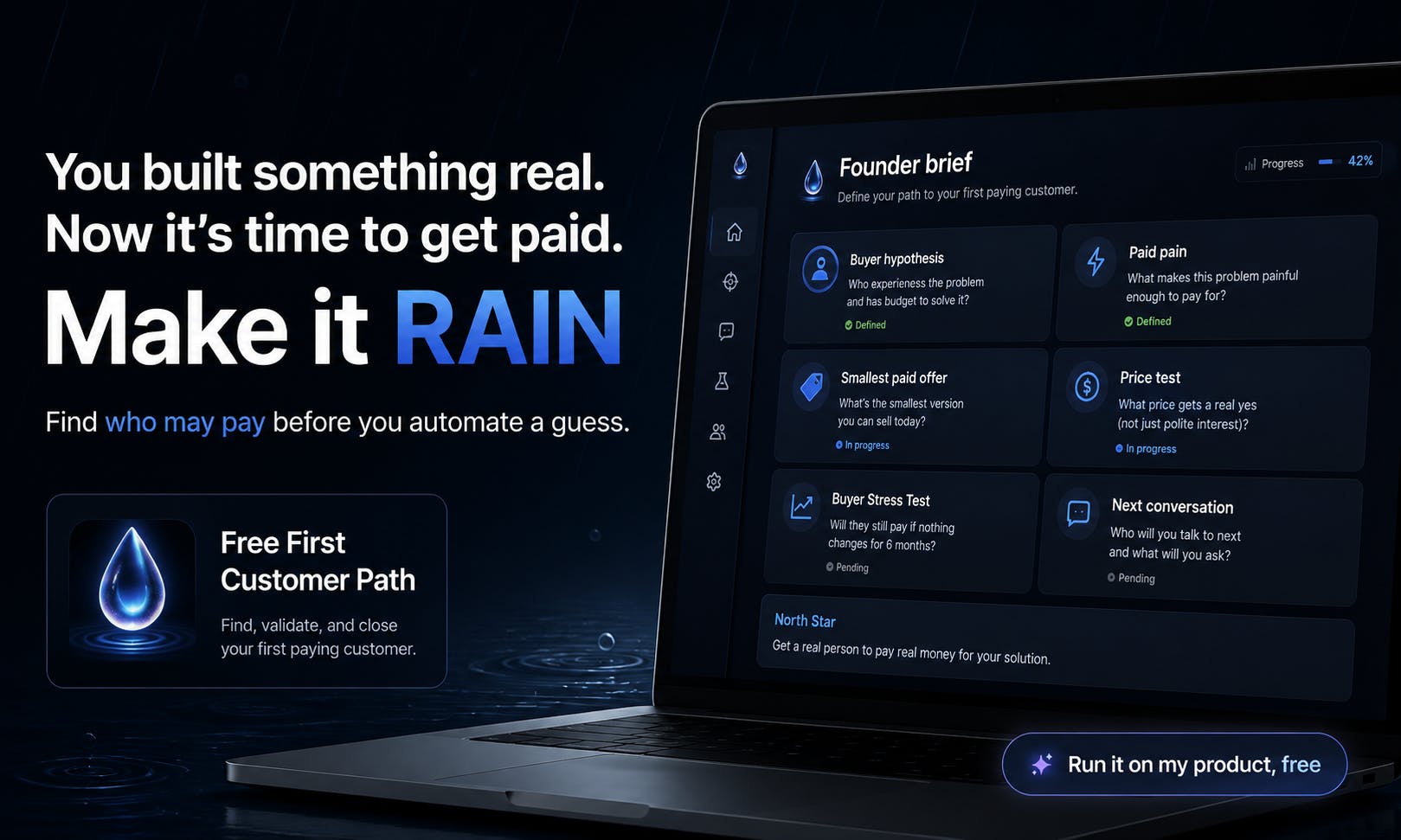
Make it RAIN's usage is extremely lightweight. Users simply paste a product URL to receive a free "First Customer Path." This isn't a generic market analysis report, but rather a set of directly actionable validation elements:
- Buyer hypothesis: Identify who is most likely to become your first paying customer
- Paid pain: Identify the real pain points customers are willing to pay to solve
- Smallest paid offer: Design the lowest-barrier paid entry point
- Price test: Validate whether your pricing holds up
- Buyer Stress Test: Stress-test the offer itself
- Next conversation: Clarify who to talk to next and how
The core value of this process is that it doesn't give you a "professional-looking" GTM (Go-To-Market) plan or a cold list of sales leads. Instead, before you invest more outreach resources, it stress-tests your business hypothesis first.
The Key Difference from Traditional GTM Tools
A Go-To-Market strategy refers to the complete path planning from product development completion to entering the market and acquiring first customers, typically encompassing target customer definition, value proposition, pricing strategy, channel selection, and sales playbook. Traditional GTM tools like Apollo.io, ZoomInfo, and Outreach primarily focus on the "scaling customer acquisition" phase—they assume you already know what you're selling and to whom, and help you efficiently reach more potential customers. But for early-stage entrepreneurs, the real challenge often lies further upstream: Does your value proposition itself hold up? Do your imagined target customers actually experience this pain point?
This is the fundamental dividing line between Make it RAIN and traditional tools. The market has no shortage of GTM planning tools and lead list generators, but most share a common flaw: they assume your value proposition is already validated and directly help you "amplify" it. Make it RAIN does the opposite—question first, amplify later.
The product explicitly states that unlike "another generic GTM plan or lead list," it stress-tests the offer itself before more outreach actions, and uses real buyer feedback to refine next steps. In other words, it re-embeds the "validation loop"—the step most easily skipped in startups—back into the workflow.
A Sobering Antidote for the "Vibe Coding" Era
Notably, among Make it RAIN's category tags, besides Sales and Marketing, there's an intriguing term—Vibe coding.
The concept of vibe coding was coined by Andrej Karpathy (former Tesla AI Director and OpenAI co-founder) in early 2024, describing a development approach where developers use AI coding assistants (like GitHub Copilot, Cursor, Claude, etc.) to rapidly generate working code through intuition and natural language descriptions. Developers no longer write code line by line but instead use conversational interaction to let AI handle most of the implementation, while they focus on direction and result verification. This approach compresses product prototype delivery from weeks to hours, but also raises a deeper question: when the cost of building approaches zero, the product itself is no longer a competitive moat—the truly scarce resource becomes "accurate judgment of market demand."
This is the real picture of today's AI-assisted coding wave: with AI tools, developers can quickly turn ideas into working products "by feel," at unprecedented delivery speeds. But speed is a double-edged sword. As building things gets easier, "building the right thing" becomes the new scarce capability. The vast majority of products "vibed" into existence in a few hours never lacked code—they lacked identifiable paying customers. Make it RAIN hits precisely this new gap in the AI era: helping technical founders who can build products rapidly but don't know who to sell them to, fill in the business validation lesson they missed.
Design Details That Reveal Product Philosophy
Two design decisions reflecting restraint can be read from the product description:
First, "No card"—no credit card required to use the free First Customer Path. This dramatically lowers the psychological barrier for technical founders to try it, following the typical PLG (Product-Led Growth) approach. PLG (Product-Led Growth) is a business model contrasted with Sales-Led Growth, with the core idea of letting the product itself be the primary driver for acquiring, activating, and retaining users. Typical examples include Slack, Notion, Figma, and Dropbox—users first use the product for free, then naturally convert to paying customers after experiencing value. Key PLG design principles include: extremely low onboarding friction (no sales intervention needed), rapid value demonstration (short Time-to-Value), and a natural upgrade path from free to paid. Make it RAIN's strategy of "no credit card needed to get the first report" is a direct embodiment of this principle.
Second, "Nothing sends without approval"—no outreach action is automatically sent without user approval. This is particularly important in today's landscape where automated outreach tools can easily "overstep and mass-send." In recent years, AI-driven automated outreach tools (like Instantly.ai, Lemlist, Smartlead, etc.) have dramatically reduced the cost of batch email outreach, but have also triggered a serious industry trust crisis. Many entrepreneurs, without validating their target customer profile, use these tools to send templated cold emails to tens of thousands of inboxes, leading to declining recipient trust, domains being flagged as spam, and even compliance risks under GDPR and CAN-SPAM regulations. This crude "blast first, filter later" approach essentially uses automation to amplify an unvalidated hypothesis. Make it RAIN keeps control firmly in the user's hands, avoiding the awkward scenario of "AI mass-emailing strangers on your behalf."
These two details together convey a clear product philosophy: Automation should serve validated judgments, not replace judgment itself.
Current Market Reception
As a newly launched product, Make it RAIN has currently achieved 14 upvotes and 5 comments on Product Hunt, ranking 11th—a moderately above-average performance. The product was built by Oliver Ellison. Judging by the data scale, it's still in the early validation stage—in a sense, this tool that helps others validate willingness to pay is itself walking the same validation path.
Ask the Right Question First, Then Talk About Automation
The true value of Make it RAIN may not lie in how precise the specific report it outputs is, but in the fundamental question it raises: Before you automate everything, are you sure someone will pay for this?
For technical founders riding the AI coding wave who can deliver products at unprecedented speed, this question is worth more than any tool. Products can be built quickly, but an honest answer to "who will buy" can never be skipped through automation.
Key Takeaways
Related articles

Python 3.15 New Feature: Is the sentinel Type Better Than None?
Python 3.15 adds the sentinel type, using named unique sentinel objects to replace None and bare object(), resolving confusion among missing values, explicit emptiness, and invalid input while avoiding type hint failures.

Deep Learning's Three Architectures and the Universal Approximation Theorem: A Complete Guide to MLPs, CNNs, and Transformers
Explaining the inductive bias differences among MLP, CNN, and Transformer, the existence meaning of the Universal Approximation Theorem (UAT), and the role of Taylor expansion in approximation analysis, while clearing up common misconceptions.

GitLab Emergency Patch Release: Analysis of Critical Security Fixes
GitLab releases critical patch 19.5.1, sparking 355 points of discussion on Hacker News. This article analyzes the background, upgrade steps for self-hosted instances, and verification points to help DevOps teams respond quickly to security updates.