Make the Most of Existing Logs: Fine-Tune a Small Model to Surpass Frontier Large Models
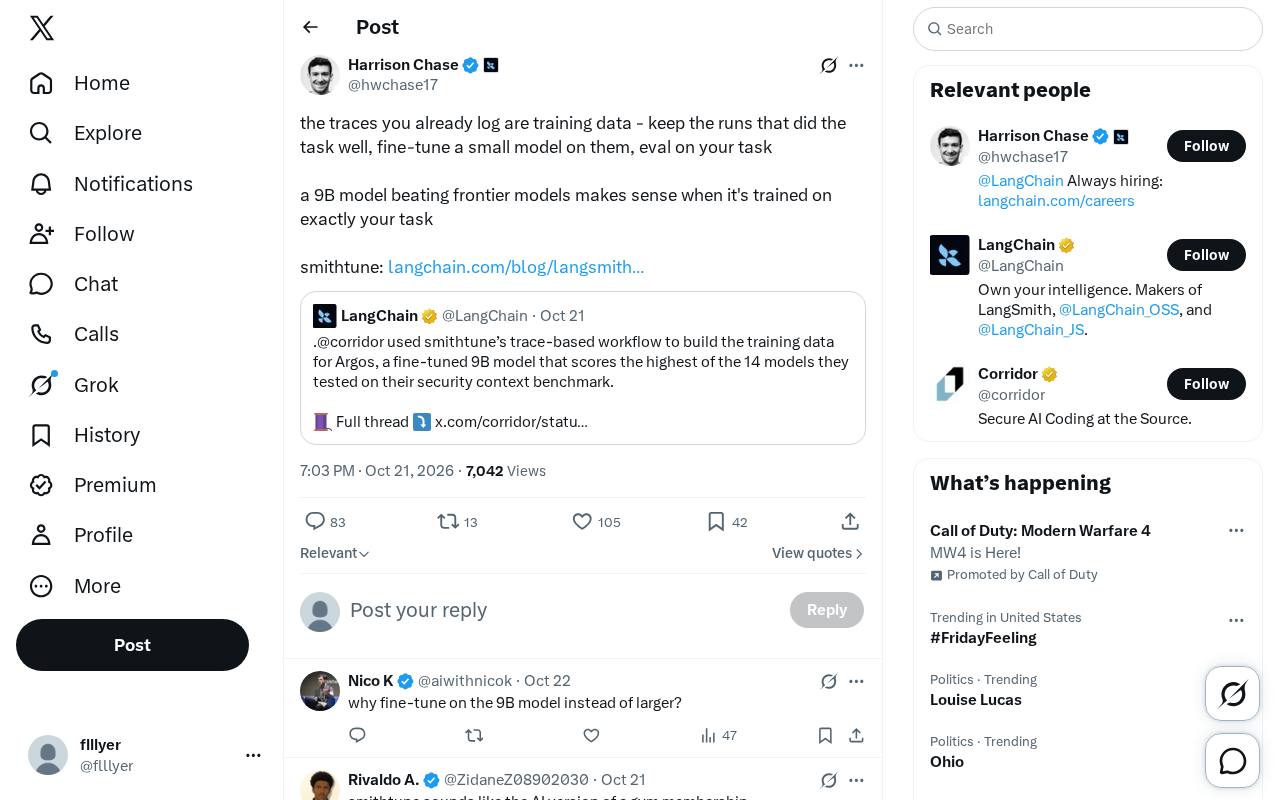
Fine-tune a 9B small model with successful run logs to surpass frontier large models on specific tasks.
The article points out that runtime logs (user inputs, model outputs, tool calls, etc.) recorded daily by AI application teams are not only debugging tools but also a goldmine of high-quality training data. The core idea is to filter logs of successfully completed tasks, build input-output pairs, fine-tune a 9B-level small model, and evaluate it on your own tasks. Because the data distribution is highly matched to the business, a small model can absolutely beat a general large model on vertical tasks, while also having an inference cost advantage. Implementation steps include defining success criteria, cleaning and pairing data, selecting models such as Llama/Mistral and using LoRA fine-tuning, and evaluating with real test sets. The article also mentions that the smithtune tool may simplify this process and emphasizes that this path puts the data flywheel into practice: large model cold start, small model iteration to reduce costs and increase efficiency.
Overlooked Training Data: Runtime Logs
When developing AI applications, most teams record a large volume of runtime logs (traces)—user inputs, model outputs, tool calls, error messages, and so on. This data is typically used for debugging and monitoring, but few realize that it is itself an untapped goldmine of training data.
A developer shared an idea on Twitter: keep the run records that successfully completed tasks, use them to fine-tune a small model, and then evaluate performance on your own task. He mentioned that a 9B-parameter small model beating frontier large models on a specific task is entirely reasonable—because it was trained specifically for your task. This view challenges the conventional wisdom that "bigger parameters are always better" and points to a more pragmatic engineering path.
The core logic is not complicated: your logs already contain a large number of "input-output" pairs, especially those run records that were recognized by users or successfully completed tasks. This data naturally fits your business scenario and is more targeted than any public dataset.
Why Small Models Can Win: Task Specificity
Frontier large models (such as GPT-4, Claude, etc.) excel at broad general capabilities, but on a specific, narrow task, their performance may not be better than a small model that has been specifically fine-tuned. The reasons are:
- Data distribution matching: Your log data comes from real business and covers various edge cases that actual users may encounter. Although general large models have massive training data, there is a mismatch between their distribution and your task distribution.
- Parameter count matching task complexity: For many vertical tasks, a 9B or even smaller model is already sufficient to express the required patterns. An overly large model may instead introduce unnecessary generalization noise.
- Inference cost: Small models have clear cost advantages in deployment and inference, especially in scenarios requiring high concurrency or low latency.
The developer's claim that "a 9B model beats frontier models" is not an exaggeration. In tasks such as text classification, information extraction, and structured output, there are already many precedents of small models fine-tuned on high-quality data surpassing general large models.
How to Implement: From Logs to Fine-Tuned Models
Turning logs into usable training data requires several key steps:
1. Filter High-Quality Run Records
Not all logs are worth learning from. You need to define the criteria for "doing well"—perhaps the user did not correct the output, the task was successfully completed, or the human evaluation score was high. Keep only those run records that are clearly successful to avoid noise contaminating the model.
2. Build Input-Output Pairs
Pair the user inputs in the logs with the final model outputs, and supplement intermediate steps (such as tool calls and reasoning chains) when necessary. This step requires cleaning the data, removing irrelevant system messages and duplicate content.
3. Choose a Suitable Small Model for Fine-Tuning
9B-level models (such as the Llama series, Mistral, etc.) are a good starting point. If the task is simpler, you can even try smaller models. For fine-tuning methods, you can choose full-parameter fine-tuning or efficient fine-tuning techniques such as LoRA.
LoRA (Low-Rank Adaptation) is a parameter-efficient fine-tuning technique. It does not change the original model weights, but injects trainable low-rank matrices into the attention layers of the Transformer, thereby achieving results close to full-parameter fine-tuning with very few trainable parameters (usually less than 1% of the original model). Its core principle is: assuming that the weight update brought by fine-tuning has low-rank characteristics, the update is approximated by the product of two small matrices A and B. LoRA's advantages are low memory usage, fast training speed, and pluggability (the adapter can be merged back into the original model during inference), making it very suitable for resource-constrained teams to quickly experiment on 9B-level models. In practice, it is often adjusted with two hyperparameters: rank and scaling factor (alpha). The rank is usually set to 8-64.
4. Evaluate on Your Task
Do not evaluate using general benchmarks, but use real test sets from your business. Fine-tuning is only successful if it performs better on the metrics you care about.
Task-specific evaluation emphasizes using test sets consistent with the business distribution, rather than general benchmarks such as MMLU and GSM8K. When building such a test set, you should hold out successful records from the logs that were not used in training (or manually annotate a batch of new samples) to ensure coverage of edge cases in real scenarios. Evaluation metrics need to align with business goals, for example, field-level accuracy for structured output tasks, F1 for information extraction, and confusion matrices for classification tasks. It is also recommended to set baseline comparisons (the original large model + prompt, the small model before fine-tuning) and pay attention to engineering metrics such as inference latency and cost. Only when it stably outperforms the baseline on the new test set does fine-tuning have value for deployment.
Tool Recommendation: smithtune
The developer also mentioned a tool called smithtune (link: https://t.co/RYcGRwzaye). Although the tweet did not elaborate, judging from the name and context, it may be a tool that helps convert log data into fine-tuning datasets, or a platform that simplifies the small model fine-tuning process. For teams wanting to try this approach, such tools can be followed to lower the engineering barrier.
Implications for AI Application Development
The value of this idea lies in putting the "data flywheel" into practice. When pursuing better results, many AI product teams' first reaction is to switch to a larger model or adjust prompts, but they overlook the high-quality log data already at hand from real users.
A more sustainable path is: first use a large model to launch quickly and collect real runtime logs; then filter successful cases and fine-tune a small model; finally replace the large model with the small model to reduce costs and improve results. This cycle can be continuously iterated, making the model better fit your task each time.
Of course, this does not mean large models are no longer important. Large models still play an irreplaceable role in the cold-start phase and complex general tasks. But once you have enough domain data, a small model + high-quality fine-tuning is likely a better solution.
Conclusion
"The logs you are already recording are training data"—this sentence deserves serious attention from every AI application developer. Rather than blindly pursuing larger models, it is better to first look at the data at hand and turn those successful run records into model capabilities. A 9B model beating frontier models on a specific task is not a miracle, but a victory of data strategy.
One-line Summary
Fine-tune a 9B small model with successful run logs to surpass frontier large models on specific tasks.
Paragraph Summary
The article points out that the runtime logs (user inputs, model outputs, tool calls, etc.) recorded daily by AI application teams are not only debugging tools but also a goldmine of high-quality training data. The core idea is to filter logs of successfully completed tasks, build input-output pairs, fine-tune a 9B-level small model, and evaluate it on your own tasks. Because the data distribution is highly matched to the business, a small model can absolutely beat a general large model on vertical tasks, while also having an inference cost advantage. Implementation steps include defining success criteria, cleaning and pairing data, selecting models such as Llama/Mistral and using LoRA fine-tuning, and evaluating with real test sets. The article also mentions that the smithtune tool may simplify this process and emphasizes that this path puts the data flywheel into practice: large model cold start, small model iteration to reduce costs and increase efficiency.
Related articles

A Single Prompt Triggers a Global PHP Security Storm: Is AI a Savior or a Hidden Risk?
A single AI prompt triggered a global PHP security crisis affecting Wikipedia and the Internet Archive. This article reviews the incident, analyzes the OpenAI-Amazon controversy, and explores the security paradox of lowered vulnerability discovery barriers in the AI era and developer response strategies.

When AI Is Taken Away: How Reliance on Shortcuts Undermines Your Problem-Solving Resilience
A study of 1,222 people found that after using AI to answer questions, once AI was removed, people gave up on more problems than a control group that never used AI. The article analyzes the impact of AI reliance on learning resilience and metacognition, and explores design implications for AI learning tools.

Carta and NewView Partner to Let Startup Employees Cash Out Equity Early
Carta and NewView Capital partner to simplify startup tender offers, helping employees sell equity early. Analysis of the mechanism, liquidity pain points, and impact.