MakerMap: Putting Global Makers and Their Projects on One Living Map

MakerMap aggregates 4,000+ indie makers into one searchable, interactive living map.
MakerMap is a social discovery platform for indie developers, designers, and entrepreneurs, bringing scattered makers and their projects together into one interactive living map with 4,000+ listings. It supports multi-dimensional search by niche, location, interests, and active projects, with live profiles and open self-registration. It ranked #4 on Product Hunt at launch. Its core value lies in structuring fragmented maker information to lower connection costs; its core challenge is keeping UGC data fresh and carving out differentiated ground against established platforms like Indie Hackers and Product Hunt.
A Dynamic Map Connecting the Maker World
Independent developers, designers, and entrepreneurs — the "maker" community — have long been scattered across social platforms, Discord servers, and personal blogs. Finding like-minded people or potential collaborators often comes down to luck. MakerMap is built to solve exactly that problem: it brings makers and the products they're building together onto a single, interactive "living map."
After launching on Product Hunt, the product earned the #4 spot for the day, collecting 111 upvotes and 8 comments. Developer Martijn Verbove summed up the vision in one line: "A growing map of the maker world."
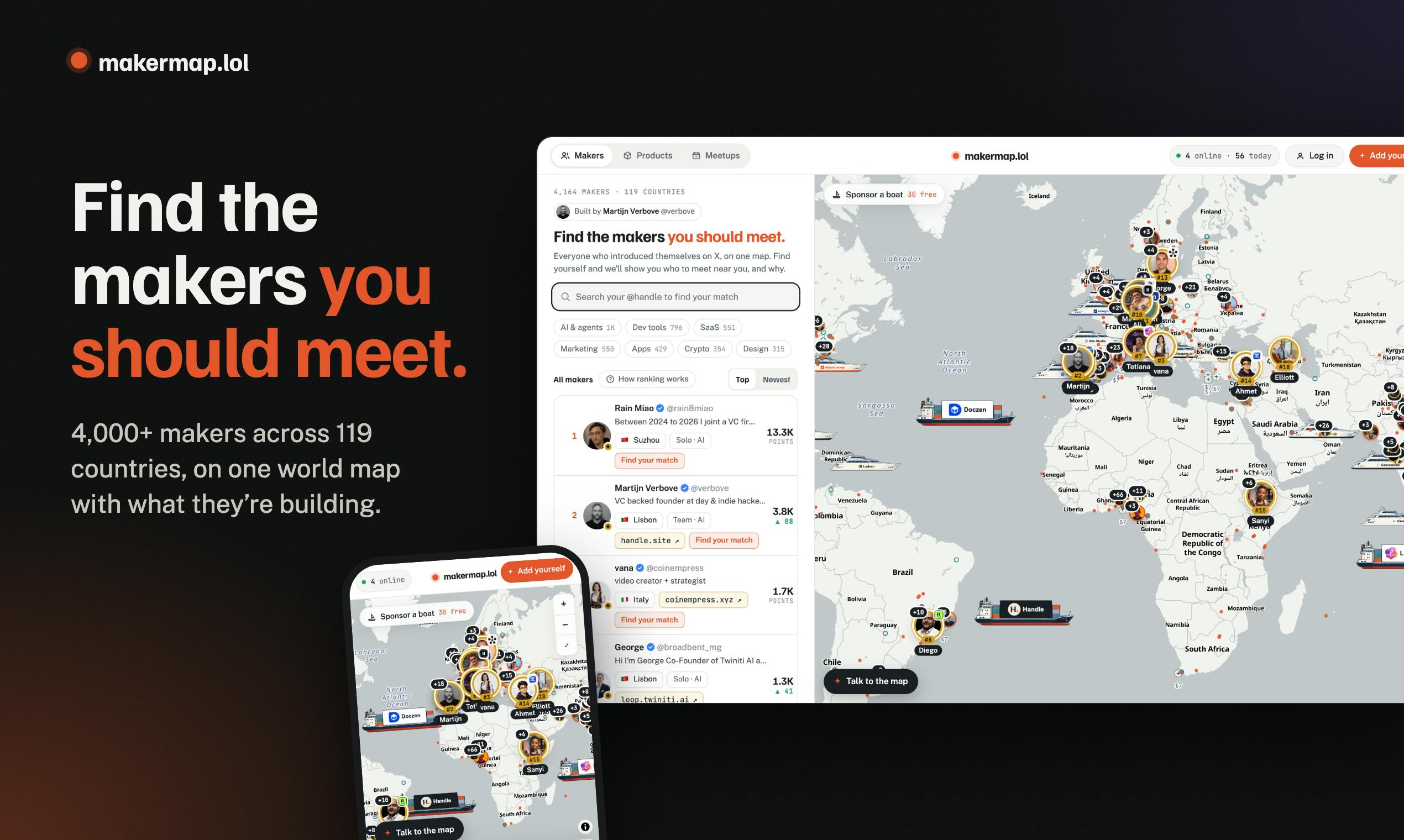
Core Features: Not Just a Directory, But an Explorable Network
MakerMap currently lists over 4,000 makers and their products. Unlike traditional directory-style websites, the platform puts emphasis on two dimensions: exploration and connection.
Multi-Dimensional Search
The platform lets you search for makers across several dimensions:
- Niche: Find people working in the same space as you
- Location: Discover makers nearby for potential in-person meetups
- Interests: Build connections around shared topics
- What they're building: See exactly what projects others are working on right now
This design makes MakerMap feel less like a cold static list and more like a social discovery tool that indexes both people and products.
Live Profiles and Open Registration
Every pin on the map is a "live profile" — a maker's profile that updates in real time. Users can browse others' work-in-progress, and they can also add themselves to the map, becoming part of the network. This UGC (user-generated content) model is what allows the map to keep "growing."
UGC (User-Generated Content) means the platform doesn't actively scrape or maintain data itself — it relies on users voluntarily submitting and updating their own information. The upside is extremely low marginal cost and content that naturally reflects real-world status. The downside is that data quality depends entirely on user engagement. For a "living map" like MakerMap, UGC is both the growth engine and the biggest risk factor. If users register and never return to update their profiles, those entries quickly become stale — and the "live" promise falls apart. Many community-style products (like AngelList's early founder directory) have faced this exact dilemma: sparse data during the cold-start phase, outdated data once mature, with peak value only in the narrow window when there are just enough active users.
Why This Type of Product Matters
The maker economy has expanded rapidly in recent years, with independent developers and small-team products proliferating everywhere — but discovery channels remain highly fragmented. X (Twitter), Reddit, and various Discord servers all attract large numbers of makers, yet none offer a structured, filterable entry point for finding them.
MakerMap structures the "who is where, building what" question into something searchable. In theory, this lowers the cost of connection between makers — whether someone is looking for a co-founder, seeking inspiration, or simply wanting to meet interesting people. The platform is categorized under Social Network, Social Media, and Maps, making it essentially a lightweight social discovery layer built specifically for the maker community.
A Sober Look: Moats and Cold-Start Challenges
The central challenge for this type of "aggregation + social" product lies in network effects. The 4,000+ listings are a solid starting point, but building a genuine value flywheel requires makers to actively keep their profiles updated and stay engaged. Once profiles go stale, a "live map" degrades into an outdated directory.
The need for maker discovery is real, but alternatives already exist — Product Hunt, Indie Hackers, X, and others. MakerMap will need to deliver a meaningfully differentiated experience around precise matching by location and interest to build its own loyal user base. Based on what's publicly available, the product is still in its early stages, and long-term retention remains to be seen.
Network effects refer to the phenomenon where a product becomes more valuable to each user as the total number of users grows. Social discovery platforms typically rely on "data network effects" — more users means richer search results and more accurate matches, which in turn attracts even more users, creating a positive flywheel. But this flywheel is notoriously hard to start: before reaching a critical user mass, the platform's value is limited, making it difficult to retain new users and easy to fall into the cold-start trap of "no one uses it because no one comes." MakerMap's current 4,000+ listings provide some foundation, but they still fall considerably short of Indie Hackers' hundreds of thousands of active members or Product Hunt's daily active user scale. Its differentiated geographic and interest-based filtering features are the key assets that can sustain unique value — and carry the platform through the cold-start period — before network scale catches up.
Wrap-Up
MakerMap offers a clear and concise value proposition: converging a scattered maker world into a searchable, explorable, and joinable map. For independent developers looking to expand their network, find like-minded peers, or discover potential collaborators, it's worth checking out. Whether it can grow from "an interesting tool" into "an indispensable community" will depend on how well the team manages user engagement and builds network effects going forward.
Related articles

JobRunner MCP Server: AI Agents Can Now Fix Failed Java Jobs
JobRunner launches an open-source MCP server enabling AI agents to view cluster status, diagnose failures, and recover Java jobs—incident response from any cloud coding environment or existing agent.

MLAI Digital Launches 9 Security Agents: MCP Server Safeguards the Full Lifecycle of Agentic AI
MLAI Digital launches Security MCP Server with nine built-in specialized security agents covering vulnerability discovery, attack simulation, prompt injection detection, API and infrastructure assessment, and accelerated remediation—embedding security validation across the full Agentic AI lifecycle from development to production.

Running Isaac Lab on H100 GPUs: Exploring Better Approaches
Exploring optimization methods for running Isaac Lab on NVIDIA H100 GPUs, including MIG configuration, mixed precision, TensorRT acceleration, and community experience to improve robotics simulation and reinforcement learning efficiency.