Making Any LLM Understand Video: Claude-real-video Technical Deep Dive

Claude-real-video converts video into structured text via keyframes and ASR, enabling any LLM to understand video content.
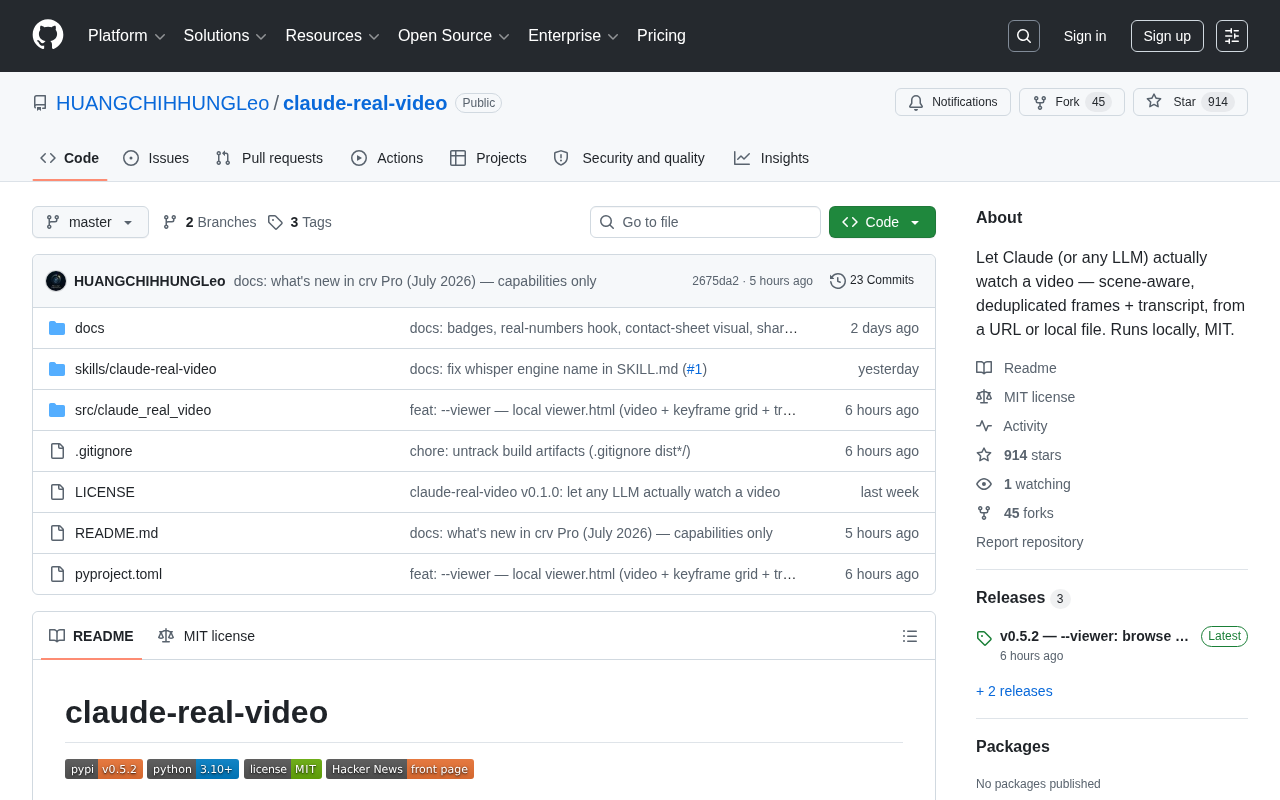
Claude-real-video is an open-source project that enables any LLM to "watch" video without native video understanding capabilities. It works by extracting keyframes via scene detection, generating text captions for those frames, transcribing audio with ASR, and aligning everything on a timeline. The result is structured text any long-context LLM can process — a pragmatic, modular alternative to expensive native video models.
Making Large Language Models Truly "See" the Dynamic World
Large language models (LLMs) excel at processing text, and multimodal models can understand static images — but video, with its temporal continuity and information density, has always been a tough nut to crack. The open-source project Claude-real-video, which recently sparked discussion on Hacker News (120 points, 37 comments), proposes a pragmatic and clever approach: enabling any LLM to "watch" video without requiring the model itself to have native video understanding capabilities.
The core value of this project lies not in training a massive video-specific model, but in using engineering ingenuity to transform video into a format that LLMs can directly consume. This "dimensionality reduction" approach offers a viable path for developers working with limited resources.
It's worth noting that large language models have undergone a profound evolution from pure text to multimodal capabilities. Early models like GPT-2 and BERT handled only text, while GPT-4V, Claude 3, and Gemini began supporting image inputs. This evolution represents a fundamental architectural shift rather than an incremental improvement — multimodal models require visual encoders (such as CLIP and ViT) to map images into a semantic space shared with text. CLIP (Contrastive Language-Image Pretraining), introduced by OpenAI in 2021, aligns image and text encoder outputs in the same vector space through contrastive learning on 400 million image-text pairs. ViT (Vision Transformer) divides images into fixed-size patches and extracts visual features using a Transformer architecture, treating patches similarly to tokens. This "vision-language alignment" process is typically achieved through large-scale image-text contrastive learning — essentially teaching the model that the word "cat" and an image of a cat point to the same concept semantically. However, the technical bar for video understanding is far higher than for static images: it requires the model to understand not just spatial information, but also motion, change, and causal relationships across the temporal dimension, causing exponential growth in parameter count and training data requirements. This technical gap gave rise to engineering-driven workarounds like Claude-real-video.
Core Principle: Decomposing Video into LLM-Readable Structured Information
From Continuous Frames to Discrete Semantics
Video is essentially a time-ordered sequence of image frames plus an audio track. Feeding every single frame to a model is both expensive and inefficient — a 1-minute video at 30fps yields 1,800 frames. The core of Claude-real-video lies in intelligent sampling and semantic extraction of video, broken into four main steps:
- Keyframe extraction: Uses scene-change detection to retain only information-rich keyframes, effectively filtering redundant content;
- Image captioning to text: Leverages vision models to generate text descriptions of keyframes, "translating" visual information into text that LLMs understand;
- Audio transcription: Converts speech to text via ASR (Automatic Speech Recognition);
- Timeline alignment: Connects frame descriptions and transcribed text with timestamps, helping the model understand the sequence and causality of events.
Keyframe extraction is not a new concept — it's a classic method in video compression and analysis. Traditional approaches include frame difference methods (computing mean squared pixel differences between adjacent frames), statistical detection based on color histogram changes, and compressed-domain shot boundary detection (using I-frame positions in MPEG/H.264 encoding). Deep learning approaches extract frame feature vectors using pre-trained CNNs, then use K-Means or hierarchical clustering to select the most representative centroid frames. More recently, CLIP-based semantic similarity computation has been introduced for keyframe selection — calculating cosine similarity between adjacent frames' CLIP embedding vectors and flagging a scene change when similarity drops below a threshold. This enables sampling at the semantic level rather than the pixel level, significantly improving semantic coverage and diversity over traditional pixel-difference methods. It's worth noting that choosing the sampling frequency is fundamentally an information-theoretic problem — the optimal strategy often requires adaptive adjustment based on the dynamic complexity of the video content. Sampling too sparsely misses key events; too densely creates text redundancy and may exhaust the model's context limit.
On audio transcription, modern ASR tools like OpenAI's open-source Whisper model have achieved near-human recognition accuracy. Whisper is an end-to-end model based on a Transformer Encoder-Decoder architecture, trained on 680,000 hours of multilingual, multi-scenario audio, unifying speech recognition, language identification, and timestamp prediction into a single multi-task learning framework. Its key innovation: audio is converted to a Mel Spectrogram before the encoder extracts acoustic features, while the decoder autoregressively generates text sequences and directly embeds timestamp information in the output via special tokens (e.g., <|0.00|>). This native timestamp support makes aligning audio content with video frames a relatively straightforward engineering task — simply match the time intervals of transcription segments with corresponding keyframe timestamps. However, in high-noise environments, dense specialized terminology (medical, legal fields), or non-standard accent scenarios, ASR word error rate (WER) can rise significantly, typically requiring domain fine-tuning or domain-specific vocabularies to reach usable accuracy. This is a non-trivial noise source in the entire pipeline — transcription errors cascade into all downstream reasoning.
Why It Supports "Any LLM"
The most appealing aspect of this approach is its model-agnostic nature. Since what ultimately gets passed to the LLM is structured text (frame descriptions + transcription + temporal information), any language model with long-context capability can theoretically serve as the "viewer" — whether Claude, GPT series, or various open-source models. The project's name includes "Claude" primarily because the Claude series excels at long-context processing, not because of any hard technical dependency.
Long context window capability is the technical foundation enabling this model-agnostic design. The context window is the core bottleneck constraining LLMs' ability to process long documents — early GPT-3 supported only 4K tokens, while the Claude 3 series has expanded to 200K tokens and Gemini 1.5 Pro reaches 1 million tokens. Key technical approaches to breaking this barrier include: positional encoding improvements (RoPE encodes positional information into attention calculations via rotational matrix complex multiplication, enabling natural generalization to sequence lengths unseen during training; ALiBi directly subtracts a distance-proportional bias from attention scores, implicitly modeling distance penalties without explicit positional encoding, with experiments showing superior extrapolation over traditional absolute positional encoding on very long sequences); sparse attention mechanisms (Longformer and BigBird reduce computational complexity from O(n²) to O(n) through a hybrid strategy of local sliding-window attention plus a few global tokens, at the cost of some global information modeling capacity); and engineering optimizations like KV Cache and FlashAttention that further reduce memory usage and inference latency. Despite these advances, research shows that models exhibit significant degradation in information retrieval from the middle of very long contexts — the phenomenon known in academia as "Lost in the Middle" — where models tend to prioritize the beginning and end of inputs, systematically forgetting middle-segment information. This is believed to stem from positional bias in the attention mechanism and the scarcity of long documents in training data. This imposes a hidden constraint on video-to-text solutions for long videos: even with a sufficiently large context window, video segment descriptions in the middle may be "selectively ignored" by the model.
Technical Trade-offs: Balancing Convenience and Precision
Core Advantages of the Approach
The biggest benefit of this architecture is controllable cost and low deployment barrier. Developers don't need to integrate expensive native video APIs or train their own multimodal models. By combining existing vision captioning models, ASR tools, and text LLMs, one can quickly build a video-understanding application — ideal for video summarization, content moderation, subtitle Q&A, and similar use cases.
Unavoidable Inherent Limitations
However, "textualization" of video inevitably involves information loss. Discussions in the Hacker News comments pointed out several key bottlenecks:
- Loss of fine-grained actions: Frame sampling and text descriptions struggle to capture fast, continuous action details, such as intricate plays in sports;
- Description quality becomes the bottleneck: The system's ceiling is limited by the accuracy of the image captioning model — if descriptions are wrong, the LLM's understanding goes off the rails accordingly;
- Limited temporal reasoning: Even with timestamp assistance, LLMs' causal and temporal reasoning remains less precise than native video models;
- Context pressure for long videos: The longer the video, the more text is generated, potentially hitting the model's context window limit.
For contrast, the evolution of native video understanding model architectures clearly reflects the shifting paradigms of deep learning research. The early C3D (2015) extended 2D convolutions to 3D, learning local spatiotemporal features directly on spatiotemporal cubes via sliding windows. I3D (Inflated 3D ConvNet) "inflated" 2D convolutional kernels pre-trained on ImageNet into 3D, retaining image pre-training knowledge while introducing temporal modeling, significantly reducing training costs. The video Transformer era is represented by TimeSformer and Video Swin Transformer — the former decouples temporal and spatial attention ("Divided Space-Time Attention"), first applying spatial attention within each frame then temporal attention across frames, keeping computation manageable. The latest generation of video-language models (such as Gemini 1.5, InternVL2, LLaVA-Video) are end-to-end pre-trained on massive video-text pairs, capable of capturing optical flow (the per-pixel motion vector field between frames), fine-grained action trajectories, and other visual signals that text struggles to describe, enabling open-domain video question answering. However, their inference costs remain one to two orders of magnitude higher than pure-text LLMs — training requires hundreds to thousands of GPUs running for weeks, and inference latency far exceeds text models — limiting widespread adoption in lightweight scenarios. The two technical approaches therefore each have their appropriate application domain; they are not zero-sum competitors.
These discussions reflect a broad community consensus: such solutions are "good enough but not optimal" — a pragmatic compromise, not the ultimate answer.
Use Cases and Practical Recommendations
Recommended Scenarios
The "video-to-text + LLM" approach is well-suited for the following needs:
- Video content summarization: Quickly extracting the key points from a video;
- Searchable video libraries: Converting video to text for indexing and natural language retrieval;
- Education and meeting records: Transforming lecture or meeting recordings into interactive Q&A knowledge bases;
- Accessibility assistance: Automatically generating text descriptions of video content for visually impaired users.
Scenarios Where It's Not Recommended
For tasks requiring precise understanding of dynamic details — such as autonomous driving perception, sports motion analysis, or fine-grained behavior recognition — native video understanding models remain the more reliable choice, and this type of solution should not be forced as a substitute.
Conclusion: A Case Study in Modular AI Engineering
At its core, Claude-real-video reflects an important trend in modern AI engineering: extending the capability boundaries of general-purpose models by combining specialized components. Rather than waiting for an all-powerful, fully-multimodal model to appear, combining mature modules for visual captioning, speech recognition, and text reasoning to build a "good enough" system and get it running is often the wiser path.
This modular, plug-and-play engineering philosophy aligns deeply with the academic concept of Neurosymbolic AI — a significant direction in artificial intelligence that seeks to combine the perceptual capabilities of deep learning with the interpretability of symbolic reasoning. Its core argument is that pure neural networks have inherent deficiencies in compositional generalization (the ability to recombine known concepts to understand new ones), causal reasoning, and sample efficiency; introducing structured symbolic intermediate representations can significantly improve a system's interpretability and generalization. Researchers like Josh Tenenbaum at MIT and Gary Marcus at NYU have long advocated this direction, arguing that simply scaling up neural networks cannot solve deep reasoning problems and that collaboration with symbolic systems is essential. The architecture of Claude-real-video is an engineering embodiment of this philosophy — visual information is converted into structured text (symbolic representation) for logical reasoning by the LLM, essentially a "perception → symbolization → reasoning" pipeline: the vision model handles the perception layer, structured timestamped text serves as the symbolic intermediate layer, and the LLM executes the reasoning layer. The widespread adoption of orchestration frameworks like LangChain and LlamaIndex has further operationalized this modular philosophy, enabling developers to combine capability modules like RAG (Retrieval-Augmented Generation), Tool Use, and Chain-of-Thought like building blocks. Another key advantage of this architecture is maintainability and evolvability: when a better component becomes available (e.g., upgrading the image captioning model from LLaVA to a more capable version), the entire system can replace that single module at low cost without retraining an end-to-end model. Clear module boundaries make system debugging, performance analysis, and capability iteration more intuitive and manageable — an enormously valuable property in engineering practice.
Despite its precision ceiling, as an open-source, lightweight, model-agnostic video understanding solution, Claude-real-video provides an engineering reference of significant value for the challenge of "making LLMs understand video" — reminding us that between cutting-edge research and practical deployment, there is often a shortcut paved with engineering wisdom.
Related articles

Chain of Thought Isn't Just for AI: How Humans Can Use CoT to Improve Thinking Quality
Chain of Thought isn't just a prompt trick for large models. Starting from a Hacker News discussion, this article analyzes why CoT works for human thinking too, breaks down actionable ways to transfer it, and highlights the key differences between human CoT and machine CoT.
Cloudflare Teams Up with OpenAI: Closi…
Cloudflare Teams Up with OpenAI: Closing the Loop from Vulnerability Discovery to Defense with AI
Cloudflare uses OpenAI Daybreak to investigate security vulnerabilities and generate reviewable remediation plans, while developers use Codex to boost coding efficiency and quality.

Orca Multi-Agent Orchestration in Practice: A Guide to Parallel Collaboration with Claude and Codex
Orca is Stable AI's free open-source agent workbench supporting 34 agents like Claude Code and Codex in parallel. Learn its Git worktree isolation, multi-model orchestration, and mobile management.