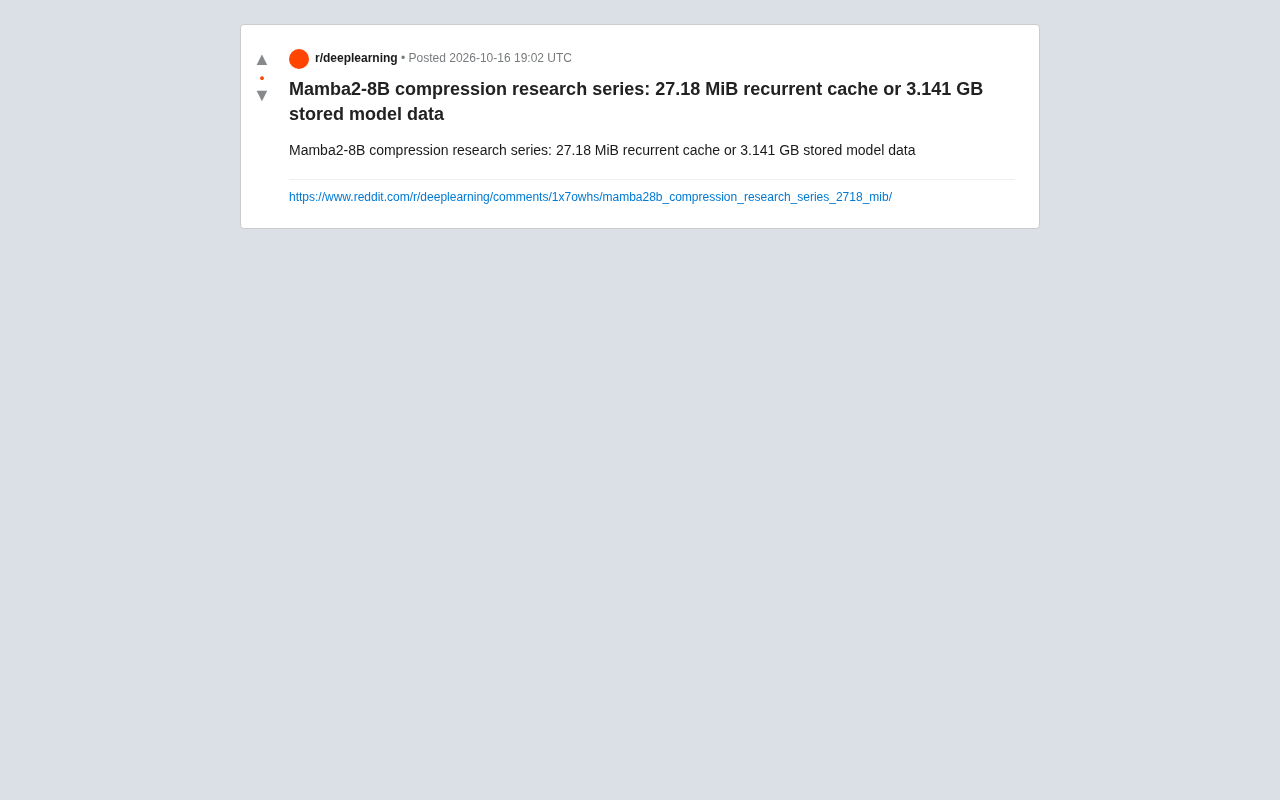
Mamba2-8B Compression Research: 27MB Cache and 3.14GB Model

Reddit research shows Mamba2-8B has only a 27.18 MiB recurrent cache and 3.141 GB full storage, highlighting SSM efficiency.
A Reddit study on Mamba2-8B compression has drawn attention: its recurrent cache is only 27.18 MiB, and full model storage is 3.141 GB, about 0.86% of the full model and far below the 16GB typical of Transformers of the same scale. As a state space model, Mamba2 has a constant state size that does not grow with sequence length, so the memory cost of long-context inference remains almost unchanged. The article compares recurrent cache and full storage use cases and notes that post-compression quality loss still needs validation.
Introduction: New Progress in Mamba2-8B Compression Research
A research series on Mamba2-8B model compression recently appeared on the Reddit community, sparking widespread discussion among AI researchers. The research explored two drastically different storage strategies: one requiring only 27.18 MiB of recurrent cache, and another involving 3.141 GB of full model data storage. This comparison reveals the enormous efficiency potential of State Space Models (SSMs).
As a next-generation sequence modeling architecture, Mamba2's core advantage lies in its linear time complexity and constant-size state representation. According to the original Reddit post, researchers further reduced the model's storage requirements through compression techniques, making the recurrent cache only about 0.86% the size of the full model.
What Does a 27.18 MiB Recurrent Cache Mean?
The Advantage of Constant State Size
A key feature of the Mamba2 architecture is that its state representation does not grow with sequence length. This stands in sharp contrast to Transformer's KV cache—which expands linearly when processing long sequences. A 27.18 MiB recurrent cache means that regardless of how long the context being processed, memory usage during inference remains constant.
For AI applications deployed on edge devices or in memory-constrained environments, this characteristic is extremely attractive. Traditional Transformer models often require tens of GB of VRAM in long-context scenarios, while Mamba2's constant cache opens up new possibilities.
KV cache is a mechanism in the Transformer architecture during autoregressive inference: to avoid redundant computation, the model caches the Key and Value matrices of all previous tokens. For a model with L layers, H attention heads, head dimension d, and sequence length n, the KV cache size is 2×L×H×d×n×precision bytes, growing linearly with sequence length. For example, a 7-billion-parameter model processing a 32K context may consume several GB of VRAM for the KV cache; when the context expands to a million tokens, the cache can balloon to tens or even hundreds of GB. This is precisely the root cause of the high cost of long-context Transformer inference. Mamba2 fundamentally avoids this linear growth by compressing historical information into a recursive state, so its cache size is independent of context length and depends only on state dimension and number of layers.
Specific Paths of Compression Techniques
Although the original post did not fully disclose all details of the compression algorithm, from the figure of 27.18 MiB it can be inferred that the researchers may have employed techniques such as quantization, pruning, or low-rank decomposition. Compressing an 8B-parameter model to such a small cache suggests that Mamba2's state space representation itself possesses a high degree of information compactness.
Quantization, pruning, and low-rank decomposition are three common model compression methods. Quantization maps floating-point parameters (such as FP16) to lower bit widths (such as INT8, INT4), trading precision loss for savings in storage and bandwidth; pruning removes weights or neurons that contribute little to the output, yielding sparse models; low-rank decomposition breaks large matrices into products of multiple smaller matrices, reducing parameter count and computation. The recursive state of a state space model is essentially a fixed-dimensional compressed representation, so applying low-rank approximation or quantization to it is often more natural than doing so to Transformer weights. 27.18 MiB is approximately 22.7 million bytes; if stored at 8 bits, that corresponds to about 22.7 million parameters, only 0.28% of an 8B model. This suggests the researchers likely combined multiple compression techniques and exploited the redundancy of the state representation.
Comparative Analysis of 3.141 GB Stored Model Data
Full Model Storage Strategy
In contrast to the 27.18 MiB recurrent cache, 3.141 GB represents the requirement for storing the complete model data. This number happens to be close to the approximation of pi (π), and the researchers may have deliberately chosen this parameter configuration to create an interesting numerical coincidence.
A storage requirement of 3.141 GB is already quite compact for an 8B-parameter model. For reference, Transformer models with the same parameter count typically require more than 16GB of storage space (calculated at FP16 precision). This indicates that the Mamba2 architecture has a natural advantage in parameter efficiency.
Applicable Scenarios for the Two Strategies
The recurrent cache is suitable for the inference phase—when the model needs to process a continuous input stream, it only needs to maintain a fixed-size state. Full model storage, on the other hand, is suitable for training, fine-tuning, or scenarios requiring full parameter access. By comparing these two strategies, the researchers are effectively demonstrating Mamba2's flexibility and efficiency boundaries across different deployment stages.
Implications for AI Inference Deployment
New Possibilities for Edge Computing
The 27.18 MiB cache size makes it possible for Mamba2-8B to run on high-end mobile devices or even embedded systems. Currently, most 8B-level models require cloud GPU support, and this compression research provides new ideas for localized inference.
Edge computing refers to performing computation on terminal devices close to the data source or user, rather than relying entirely on cloud data centers. Its core advantages are low latency, low bandwidth dependence, and better privacy protection. However, edge devices usually have limited memory and compute power: high-end phones have about 8-16GB of RAM, while embedded devices may have only a few hundred MB to a few GB. For current 8B-parameter models, even after 4-bit quantization, the weights still require about 4GB, and combined with runtime overhead, it is difficult to run smoothly on ordinary mobile devices. If the 27.18 MiB recurrent cache can be combined with a strategy of keeping only a small amount of weights resident, in theory it could greatly reduce peak memory requirements during inference, making 8B-level SSMs feasible on the edge. However, practical deployment still needs to consider issues such as weight loading, operator support, and energy consumption.
Cost Advantages for Long-Context Processing
In tasks requiring processing of ultra-long sequences (such as document understanding and code analysis), Transformer's KV cache quickly becomes a bottleneck. Mamba2's constant cache means that the cost of processing 1 million tokens is almost the same as processing 1,000 tokens. This characteristic is of great value for building efficient AI applications.
Questions Still to Be Validated
Although the compression data is impressive, the community still needs to pay attention to the quality loss of the compressed model. Can the 27.18 MiB cache maintain the inference quality of the original model? How does the 3.141 GB storage version differ in performance from the uncompressed version? The answers to these questions will determine the practical application value of this research.
Community Response and Research Outlook
This research attracted attention on Reddit, reflecting the AI community's ongoing interest in efficient model architectures. As a potential alternative to Transformers, Mamba2's balance between efficiency and performance is receiving increasing scrutiny.
Future research directions may include: further compressing the recurrent cache, exploring hybrid architectures (combining attention mechanisms with SSMs), and validating the practicality of compressed models in real application scenarios. For researchers and engineers concerned with model deployment efficiency, this series of studies is worth following continuously.
Mamba2 is an important iteration in the direction of State Space Models (SSMs). Building on Mamba, it introduces a more structured state space dual form, enabling more efficient combination of recursive computation and parallel scanning, and improving hardware utilization. Unlike Transformer's quadratic attention complexity, Mamba2 maintains linear time complexity and constant state size, giving it theoretical advantages in long-sequence scenarios. However, whether SSMs can fully match Transformers in tasks such as language modeling, reasoning, and retrieval remains a focus of debate in both academia and industry. The reason the compression research on Reddit has attracted attention is that it pushes architectural efficiency from theory toward deployable quantitative metrics, providing new engineering references for edge AI and long-context applications.
One-line Summary
A Reddit study shows Mamba2-8B's recurrent cache is only 27.18 MiB and full storage 3.141 GB, highlighting SSM efficiency advantages.
Paragraph Summary
A Reddit study on Mamba2-8B compression has drawn attention: its recurrent cache is only 27.18 MiB, and full model storage is 3.141 GB, about 0.86% of the full model and far below the 16GB typical of Transformers of the same scale. As a state space model, Mamba2 has a constant state size that does not grow with sequence length, so the memory cost of long-context inference remains almost unchanged, making it suitable for edge devices and ultra-long sequence tasks. The article compares the applicable scenarios of recurrent cache and full storage, noting that the former is used for inference and the latter for training and fine-tuning. It also reminds readers that quality loss after compression and performance differences from the uncompressed version still need validation. Future directions include further compression, hybrid architectures, and real-world validation.
Related articles

Chain of Thought Isn't Just for AI: How Humans Can Use CoT to Improve Thinking Quality
Chain of Thought isn't just a prompt trick for large models. Starting from a Hacker News discussion, this article analyzes why CoT works for human thinking too, breaks down actionable ways to transfer it, and highlights the key differences between human CoT and machine CoT.
Cloudflare Teams Up with OpenAI: Closi…
Cloudflare Teams Up with OpenAI: Closing the Loop from Vulnerability Discovery to Defense with AI
Cloudflare uses OpenAI Daybreak to investigate security vulnerabilities and generate reviewable remediation plans, while developers use Codex to boost coding efficiency and quality.

Orca Multi-Agent Orchestration in Practice: A Guide to Parallel Collaboration with Claude and Codex
Orca is Stable AI's free open-source agent workbench supporting 34 agents like Claude Code and Codex in parallel. Learn its Git worktree isolation, multi-model orchestration, and mobile management.