Manage Email for 50 Domains for $5 a Month: Plainmail Review
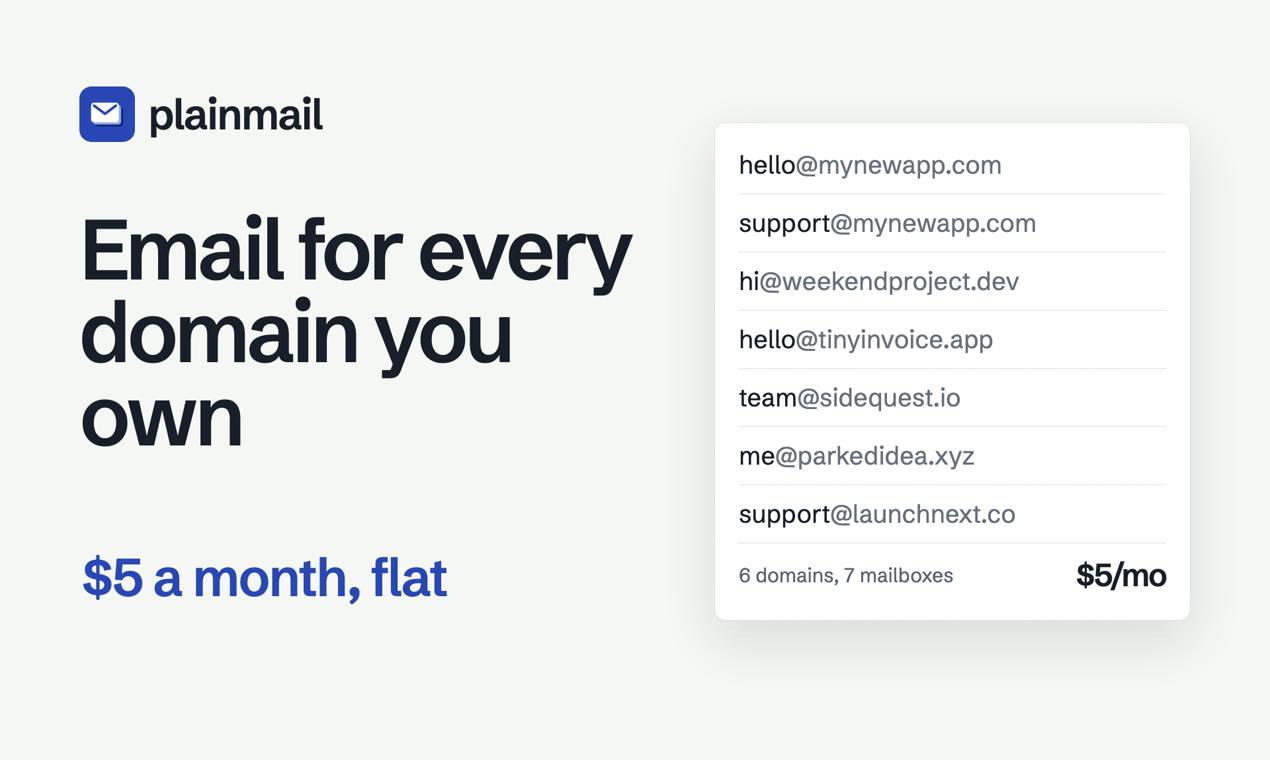
Plainmail offers automated email setup for multi-domain users at $5/month, with MCP and standard protocol support.
Plainmail is an email service for indie developers and multi-domain owners, charging a flat $5 per month for up to 50 domains, 100 mailboxes, and 25GB of storage. Its biggest differentiator is automating DNS configuration — writing and verifying MX, SPF, DKIM, and DMARC records directly on Cloudflare, Vercel, or Porkbun before creating the mailbox. Mailboxes are standard IMAP/SMTP accounts compatible with popular clients, and the product also offers an MCP server, CLI, and API for natural-language mailbox creation via AI assistants. It targets person-to-person email rather than bulk marketing and only supports three DNS providers.
For indie developers and anyone running multiple domains, email management has always been a hassle. Every time you register a new domain, there's another set of MX, SPF, DKIM, and DMARC records to configure, plus repeatedly creating accounts in the provider's backend. Plainmail aims to solve this with a minimalist approach: a flat $5 per month for up to 50 domains, 100 mailboxes, and 25GB of storage.
Product Positioning: Built for Person-to-Person Email
Plainmail's tagline is straightforward — "Real email on every domain you own, for a flat $5/month." Founder Joey Dafforn focuses on "person-to-person email" rather than bulk marketing mail. That means it's not trying to be an email marketing platform; the target user is someone who needs real mailbox identities but doesn't want to pay separately for each domain.
Looking at the pricing structure, $5 covers 50 domains and 100 mailboxes, which works out to an extremely low per-mailbox cost. For freelancers, small studios, or agencies holding multiple brand domains at once, this combination has real appeal.
Automatic DNS Configuration: Handing the Most Tedious Step to the Tool
The most time-consuming part of setting up email is the DNS records. Plainmail claims it writes MX, SPF, DKIM, and DMARC records directly to Cloudflare, Vercel, or Porkbun, verifies them after writing, and then creates the mailbox.
The value of this flow is in reducing manual backend switching. The traditional approach requires checking the provider's docs, copying record values, pasting them into the DNS panel, and waiting for propagation — any misstep breaks mail delivery. Plainmail compresses that sequence into a tool-driven flow, which significantly lowers the barrier for users unfamiliar with email protocol details.
One boundary worth noting: it only supports those three DNS providers. If your domain is hosted elsewhere, the auto-configuration advantage doesn't apply.
MX, SPF, DKIM, and DMARC are the DNS records required for a domain to send and receive email properly, each with a distinct role: MX (Mail Exchange) records tell other mail servers which host to deliver mail for that domain to; SPF (Sender Policy Framework) is a TXT record listing the server IPs authorized to send mail on behalf of the domain, which recipients use to judge whether the sender is forged; DKIM (DomainKeys Identified Mail) attaches a cryptographic signature to outgoing message headers and publishes the public key to DNS, letting recipients verify the message wasn't tampered with in transit; DMARC ties the SPF and DKIM verification results to the From domain in the message header and tells recipients what action to take when verification fails (such as junking or rejecting). All four records are required, and their values must precisely match the provider's requirements — any typo causes mail to be rejected or land in spam.
Standard IMAP/SMTP: No Client Lock-In
The mailboxes Plainmail creates are standard IMAP/SMTP accounts that can be dropped directly into Apple Mail, the Gmail app, Outlook, or Thunderbird. This matters a lot for user experience — no new interface to learn, and no migrating mail into some proprietary client.
The benefit of this approach is low switching cost. If you stop using Plainmail someday, your mail data can be exported via standard protocols and won't be trapped in a closed system. For developers who value data autonomy, this is a plus.
IMAP (Internet Message Access Protocol) and SMTP (Simple Message Transfer Protocol) are open standards that have been used in email for decades. SMTP handles submitting mail from the client and relaying it between servers; IMAP lets clients read and manage mailboxes from the server, where messages actually reside, so multiple devices see the same state. Because both are public protocols, any mail client that supports standard configuration can connect — users just enter the server address, port, and credentials. This contrasts with the proprietary sync interfaces of closed ecosystems like Gmail and Outlook, which often only allow their own clients or authorized apps to connect and make data migration more restrictive.
An Entry Point for AI and Automation: MCP, CLI, and API
Plainmail is categorized under "Artificial Intelligence," and the reason is that it offers an MCP server. Users can ask Claude to create a mailbox like hello@yourdomain, with the AI assistant directly triggering the mailbox creation flow. It also provides a CLI and API.
This reveals a product philosophy: mailbox configuration is shifting from "log into a web backend and click buttons" to "call it with natural language or scripts." For developers, the CLI and API suit bulk management of multiple domains; for ordinary users, MCP turns creating a mailbox into a single sentence. That said, MCP itself is a relatively new protocol, and its real-world stability needs more usage feedback to validate.
MCP (Model Context Protocol) is an open protocol introduced by Anthropic in late 2024 to let large language model applications connect to external tools and data sources in a standardized way. Think of it as a "USB port on the AI assistant side": a service implements an MCP server, declares which tools it offers (such as "create mailbox"), and MCP-compatible clients (like Claude Desktop) can discover and invoke those tools without writing a separate integration for each AI platform. Compared with traditional REST APIs, where developers write their own calling code, MCP lets natural language commands directly trigger actions. However, the protocol is still evolving rapidly, and client support and tool-call reliability vary — assess its stability before using it in production.
Who It's For, and Who It Isn't
Good-fit scenarios include: individuals or small teams holding multiple domains who need a separate mailbox identity for each brand; developers who want to manage DNS and email through one tool; and technical users who want to automate mailbox creation via scripts or AI assistants.
Poor-fit scenarios: users whose domains aren't hosted on Cloudflare, Vercel, or Porkbun; teams needing large-scale bulk sending or marketing automation; and enterprises with complex requirements around email archiving and compliance auditing. The product explicitly targets person-to-person email rather than bulk mail, which defines its capability boundaries.
Summary
Plainmail's core selling point isn't a long feature list — it's packaging the tedious task of "multi-domain email management" into a low-cost, automated flow. The flat $5 price, automatic DNS configuration, standard protocol support, and MCP interface combine into clear value for its target users. Whether it runs reliably over the long term depends on the success rate of auto-configuration across various domain environments and the maturity of the MCP integration. For developers with many domains, a tight budget, and a desire to try AI workflows, it's worth a look.
Background Notes
How Cloudflare, Vercel, and Porkbun differ in role: Cloudflare is a widely used DNS hosting and CDN provider, with many domains pointing their nameservers to it; Vercel is a frontend deployment platform where projects hosted there can also manage domain DNS; Porkbun is a domain registrar that also offers DNS resolution. Plainmail chose these three because they all offer programmable DNS management APIs, allowing the tool to write records automatically with user authorization. This also explains the boundary of its support scope — if a domain is hosted on GoDaddy, Alibaba Cloud DNS, or another platform without an integration, you can only copy record values manually, and the value of automation diminishes accordingly.
One-line Summary
Plainmail offers automated email setup for multi-domain users at $5/month, with MCP and standard protocol support.
Paragraph Summary
Plainmail is an email service for indie developers and multi-domain owners, charging a flat $5 per month for up to 50 domains, 100 mailboxes, and 25GB of storage, bringing the per-mailbox cost extremely low. Its biggest differentiator is automating the most tedious part — DNS configuration: it writes and verifies MX, SPF, DKIM, and DMARC records directly on Cloudflare, Vercel, or Porkbun, then creates the mailbox, cutting out manual backend switching. The mailboxes themselves are standard IMAP/SMTP accounts that work with Apple Mail, the Gmail app, Outlook, or Thunderbird, so switching costs are low. The product also offers an MCP server, CLI, and API, enabling natural-language mailbox creation via AI assistants like Claude. It's positioned for person-to-person email, not bulk marketing, and only supports three DNS providers.
Related articles

Training a PPO Agent for the Hidden-Information Card Game Cabo on a MacBook
A developer trained a self-play PPO agent for the hidden-information card game Cabo on a MacBook. The article covers training configuration, slot symmetry handling, emergent strategies, and plateau challenges.

Training PPO on a MacBook: A Browser-Based Cabo Card Game with Hidden Information
A Reddit developer trained a self-play PPO AI for the hidden-information card game Cabo on a MacBook and made it playable in the browser, offering insights for AI app development.
Jensen Huang's Internal Letter on Rumors: An Unpublicized PR Crisis?
A Hacker News post claims Nvidia CEO Jensen Huang sent staff a letter about an affair, but lacks the original text or official confirmation. This article examines the background, community discussion, and potential impact on investors and employees, urging caution with unverified information.