Manim Open-Source Math Animation Engine: The Visualization Powerhouse from 3Blue1Brown to Educators Worldwide

Manim is 3Blue1Brown's open-source Python engine for creating precise, code-driven mathematical animations.
Manim (Mathematical Animation Engine) is the open-source Python tool created by 3Blue1Brown's Grant Sanderson, now with nearly 90K GitHub stars. It enables code-driven creation of precise mathematical animations, leveraging Python's scientific computing ecosystem, LaTeX, and OpenGL. With two active versions—the official and community editions—Manim has become a go-to tool for educators and science communicators worldwide seeking to visualize complex concepts.
From 3Blue1Brown to a Global Developer Community
If you've ever watched those smooth, elegant math explainer videos on YouTube or Bilibili—dynamic demonstrations of matrix transformations in linear algebra, visualizations of curve approximation in calculus, or the rotating arrows of Fourier transforms—then you've very likely already seen Manim in action. This animation engine, developed by renowned math educator Grant Sanderson (known online as 3Blue1Brown), has now amassed nearly 90,000 stars on GitHub (89,938 Stars), with over 7,400 forks and 381 new stars per day, a testament to its sustained popularity in the developer community.
3Blue1Brown is one of the most influential math education channels on YouTube, founded by Grant Sanderson in 2015. The channel name comes from Grant's heterochromia—his right eye displays a distinctive 3/4 blue and 1/4 brown coloring. Grant graduated from Stanford University with a degree in mathematics and previously worked as a content creator at Khan Academy before independently developing his own channel. With over 6 million cumulative subscribers, his signature series include Essence of Linear Algebra, Essence of Calculus, and Neural Networks. His videos completely abandon the traditional blackboard-style teaching, instead using carefully designed animations to reveal the intuition behind mathematical concepts—a style that has profoundly influenced the direction of math education content creation worldwide.

Manim's name is short for "Mathematical Animation Engine." It was originally a tool Grant custom-built for his own educational videos, designed to transform abstract mathematical concepts into intuitive visual presentations. Take the Fourier transform as an example—this core tool in signal processing and mathematical analysis decomposes time-domain signals into a superposition of sinusoidal waves at different frequencies. 3Blue1Brown's Fourier transform video went viral precisely because it used the metaphor of a "winding machine" to convert abstract integral operations into the motion of rotating arrows on the complex plane—when the winding frequency matches a component in the signal, the center of mass shifting away from the origin becomes immediately apparent. Dynamic visualization of such complex mathematical concepts is the core mission Manim was designed to fulfill.
As 3Blue1Brown's influence grew, more and more people wanted to recreate those beautiful animation effects. Manim thus went open source and gradually evolved into a mature project maintained collectively by its community.
Manim's Core Philosophy: Code-Driven Mathematical Visualization
Unlike traditional animation software, Manim adopts an entirely code-based creative approach. It uses Python as its development language, meaning creators define every shape and animation behavior by writing scripts. While this approach may seem to have a higher barrier to entry at first glance, it provides unmatched flexibility and reproducibility for scenarios requiring precise control over mathematical objects.
Manim's choice of Python is no coincidence. Python has become the lingua franca of scientific computing, with a rich ecosystem of math libraries including NumPy (numerical computing), SciPy (scientific computing), Matplotlib (static plotting), and SymPy (symbolic mathematics). Under the hood, Manim relies heavily on NumPy for vector and matrix operations, uses Cairo or OpenGL for graphics rendering, and can call upon LaTeX engines to typeset mathematical formulas. This means users can seamlessly feed scientific computation results directly into the animation pipeline—for example, solving a differential equation with NumPy and then immediately animating the solution curve. This workflow is nearly impossible to achieve with other animation tools.
Precision and Programmability
In Manim, a circle, a curve, or a coordinate system are all programmable objects. You can precisely specify their position, color, and transformation processes, and even make a specific term in a formula smoothly move, morph, or disappear. This design centered on mathematical logic makes Manim particularly well-suited for representing concepts that require strict correspondences—such as demonstrating how an equation is derived step by step, or how one geometric figure continuously transforms into another.
Manim's architecture makes deep use of object-oriented programming paradigms. All visual elements inherit from the Mobject (Mathematical Object) base class, which defines universal properties and methods like position, color, and scale. Specific mathematical objects such as Circle, Arrow, Axes, and MathTex are all subclasses of Mobject. Animations are controlled by the Animation class and its subclasses (such as Transform, FadeIn, Write, etc.). The Scene class acts as both container and scheduler, managing object lifecycles and animation playback order. This design allows creators to build complex custom objects and animation effects through composition and inheritance, embodying the "everything is an object" programming philosophy.
Animation as Narrative: Bringing Formulas to Life
Manim's power lies not just in drawing, but in how it handles "transitions." The key to math education is often not the static result, but the process of change. Manim comes with a rich set of animation primitives that let creators express gradual transitions, translations, rotations, scaling, and other continuous transformations, turning dry formulas into rhythmic visual narratives.
The animated presentation of mathematical formulas relies on the LaTeX typesetting system—the de facto standard for academic mathematical typesetting, evolved from Donald Knuth's TeX engine. Manim calls a locally installed LaTeX compiler to render formula source code into SVG paths, then converts these paths into animatable Mobject objects. This means every mathematical symbol, every fraction bar, every integral sign is an independent, manipulable graphical element that can be individually colored, moved, or transformed. It's precisely this design that makes "formula derivation animations"—showing how both sides of an equation transform step by step—possible. This is also one of the most iconic visual effects in 3Blue1Brown's videos.
Manim Community Edition vs. the Original Version
An important fact for first-time Manim users to note: there are currently two major versions of Manim. One is the official version maintained by Grant himself (the 3b1b/manim repository), and the other is the Manim Community Edition (ManimCE), forked and independently maintained by the community.
This kind of divergence is a classic phenomenon in open-source ecosystems, with similar cases including the Node.js vs. io.js split (later merged), the OpenOffice vs. LibreOffice fork, and the FFmpeg vs. Libav parting of ways. Such forks typically occur when the project founder's personal needs diverge from the broader community's needs. In Manim's case, Grant needed a tool that could iterate quickly and serve his specific creative style, while the community needed stable APIs, comprehensive documentation, and backward compatibility.
The official version is more closely aligned with Grant's personal creative needs, updates at a relatively informal pace, and has less systematic documentation. The community edition, on the other hand, has invested heavily in stability, documentation completeness, and usability, making it more suitable for beginners and users seeking long-term use. ManimCE adopts more standardized semantic versioning, continuous integration testing, and structured documentation, making it more appropriate as a reliable software dependency. Therefore, while this article discusses the official repository with the highest star count, many creators in production environments choose the community edition as their starting point. This divergence itself reflects the classic tension in open-source projects between personal vision and community needs.
Who Uses Manim: Application Scenarios
Manim's application scenarios have expanded far beyond 3Blue1Brown alone. Today, educators, science communicators, and students worldwide use it to produce educational content. On the Chinese internet, Bilibili has seen a surge of high-quality math and physics explainer videos created with Manim; in the international community, it has become a key tool for STEM education content creation.
Manim's popularity is a microcosm of the global wave of STEM education content creation. With the rise of video platforms like YouTube and Bilibili, educational content creation has shifted from institution-led to individual creator-driven. Beyond 3Blue1Brown, channels like Veritasium, Numberphile, and MIT OpenCourseWare all demonstrate the enormous demand for high-quality visual educational content. Research shows that dynamic visualization can significantly improve learners' understanding of abstract concepts and memory retention. In China, Bilibili has become an important platform for informal learning, with the "knowledge" content creator community growing rapidly. Manim's open-source and free nature has made it the tool of choice for many Chinese science communicators.
Democratizing Education: Lowering the Barrier to Professional Animation Production
Manim's open-source nature has lowered the barrier to producing high-quality visual content. In the past, creating professional-grade mathematical animations required expensive software and specialized animation skills; now, anyone with a basic knowledge of Python can use Manim to create educational videos at near-professional quality. In a sense, this has driven the democratization of educational resources, giving more people the opportunity to clearly communicate the abstract concepts in their minds to others.
Getting Started with Manim: Barrier and Learning Path
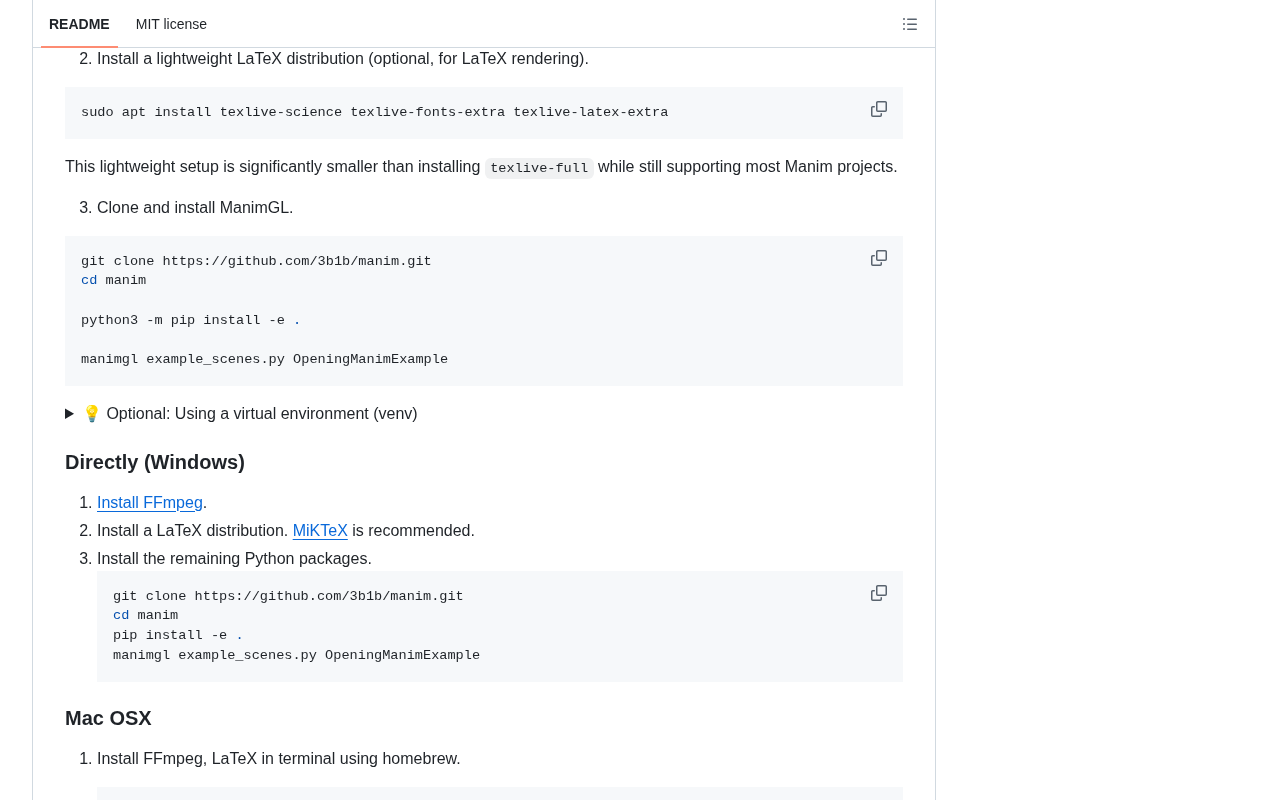
It must be acknowledged that Manim is not a plug-and-play tool. It requires users to have a foundation in Python programming, understand object-oriented concepts, and invest time in familiarizing themselves with its unique API design. For educators without programming experience, this learning curve can be quite steep. Furthermore, a complete Manim development environment also requires installing a LaTeX distribution (such as TeX Live or MiKTeX) and the FFmpeg video processing tool—configuring these dependencies alone can be a significant challenge for newcomers.
However, as the community has grown, there are now abundant tutorials, example code, and video guides available for reference. Many creators are also happy to share their project source code, fostering a healthy knowledge-sharing atmosphere. For those who truly want to invest in content creation long-term, this upfront investment is usually worthwhile—once mastered, Manim delivers precise control and creative efficiency that traditional animation tools can hardly match.
Conclusion
Manim's success is fundamentally a prime example of "tools serving expression." It was born from one science communicator's pursuit of better expressing the beauty of mathematics, and ultimately evolved into an open-source ecosystem benefiting educators worldwide. Behind those nearly 90,000 stars are countless people who want to explain complex concepts more clearly. For anyone involved in tech education, math communication, or looking to enhance their content visualization capabilities, Manim is worth investing serious time to explore. It reminds us that good tools don't just improve efficiency—they expand the boundaries of how we express our ideas.
Related articles

Chain of Thought Isn't Just for AI: How Humans Can Use CoT to Improve Thinking Quality
Chain of Thought isn't just a prompt trick for large models. Starting from a Hacker News discussion, this article analyzes why CoT works for human thinking too, breaks down actionable ways to transfer it, and highlights the key differences between human CoT and machine CoT.
Cloudflare Teams Up with OpenAI: Closi…
Cloudflare Teams Up with OpenAI: Closing the Loop from Vulnerability Discovery to Defense with AI
Cloudflare uses OpenAI Daybreak to investigate security vulnerabilities and generate reviewable remediation plans, while developers use Codex to boost coding efficiency and quality.

Orca Multi-Agent Orchestration in Practice: A Guide to Parallel Collaboration with Claude and Codex
Orca is Stable AI's free open-source agent workbench supporting 34 agents like Claude Code and Codex in parallel. Learn its Git worktree isolation, multi-model orchestration, and mobile management.