Manus AI Deep Dive: What Makes the AI Agent Meta Acquired for $2 Billion So Powerful

Meta paid $2B for Manus AI, marking AI's shift from conversational tools to execution agents.
Meta's $2 billion acquisition of Manus AI, built by a Chinese team, shook the industry. Unlike conversational AI like ChatGPT, Manus AI is a general-purpose agent that autonomously executes browser operations, writes code, and creates files through cloud virtual machines. Testing shows it can automatically complete PPT creation, full-stack website development, and channel operations data analysis—marking a paradigm shift from "you ask, I answer" to "you command, I execute."
Meta spent $2 billion to acquire Manus AI, built by a Chinese startup team, sending shockwaves through the entire AI industry. What exactly makes Manus AI so special? How does it fundamentally differ from the conversational AI tools we use daily—ChatGPT, Gemini, Doubao, and others?
This article takes you through in-depth testing across three real-world scenarios—PPT creation, website development, and channel operations analysis—to reveal the true capabilities and limitations of this general-purpose AI agent.
The Core Difference Between Manus AI and ChatGPT: From "Brain" to "Brain + Hands"
To understand Manus AI, you first need to grasp its fundamental difference from traditional conversational AI.
Tools like ChatGPT, Doubao, and Qwen are essentially a "brain"—you ask questions, they answer; you provide requirements, they output text. But the actual execution work—opening web pages, operating software, uploading files—all requires you to do it yourself.
Manus AI's positioning is entirely different: It's a general-purpose agent that gives the brain "hands." It can not only think and analyze but also operate a virtual machine in the cloud, automatically executing browser operations, writing code, creating files, and a whole series of tasks. From analysis and planning to execution, the entire pipeline is automated.
Here's an important industry context to understand: AI Agents are one of the hottest research directions in artificial intelligence today. Unlike traditional large language models (LLMs), AI agents possess the ability to perceive environments, make autonomous decisions, and execute actions. The industry typically categorizes them into three tiers:
- Tier 1: Conversational AI (like ChatGPT) — can only generate text
- Tier 2: Tool-calling AI — can invoke APIs to complete specific tasks
- Tier 3: General-purpose agents (like Manus AI) — can autonomously operate software, browse the web, and write and execute code in real computing environments
Leading companies like OpenAI, Google DeepMind, and Anthropic are all actively investing in this direction. Since 2024, AI Agents have become the industry's consensus pick for the next technology breakthrough.
The reason Manus AI can achieve this "hands-on" capability lies in its Cloud VM (Cloud Virtual Machine) architecture. A virtual machine essentially simulates a complete computer on a remote server, with its own independent operating system, browser, and file system. The AI agent operates within this isolated sandbox environment, capable of completing real computational tasks without directly affecting the security of the user's local device. This architectural design draws on mature containerization and virtualization technologies from the cloud computing field (such as Docker, KVM, etc.), enabling AI to operate graphical interfaces, click buttons, and enter text just like a human, while ensuring controllability and security.
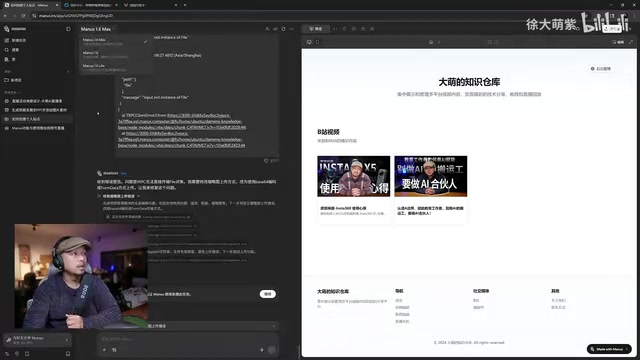
Manus AI offers different model tiers (such as 1.6, Max 1.6, etc.)—higher tiers provide more detailed analysis but take correspondingly longer. However, even the slowest mode is still several times more efficient than manual work.
Test 1: AI-Automated PPT Creation — Upload a Document, Get a Finished Product
The first test scenario was PPT creation. The tester directly uploaded a document with the instruction: "Analyze this document, generate a corresponding PPT, and add relevant image assets to each slide."
Manus AI's execution flow was remarkably clear:
- Text extraction: First read through the document content to extract core information
- Asset collection: Search the web for real images and text materials based on the content
- Image generation: Analyze what illustrations each PPT slide needs and call Nano Banana Pro to generate images
- Slide assembly: Package everything together into a complete PPT file
Throughout the process, a real-time view of a virtual computer's operations is displayed on the right side, where you can watch the AI executing tasks step by step. Even better, the generated PPT supports WYSIWYG direct editing—if you spot issues with text or images, you can modify them on the spot without switching to other tools. The accuracy of Chinese text generation was also quite high, without the common "smeared" look.
Test 2: AI Website Development — Full-Stack Delivery
The second test was more challenging: building a personal website from scratch. The tester provided a simple requirements document that included a knowledge repository module, recommended videos module, live streaming section, and other features, with the requirement that the website be responsive across mobile and PC.
To understand the breakthrough significance of this test, you need to understand basic Web development architecture. In Web development, the frontend handles the interface and interaction experience that users see (typically using HTML, CSS, JavaScript, etc.), while the backend handles data storage, business logic, and server communication (commonly using Node.js, Python, databases, etc.). A website with only a frontend is like a beautiful display window that can't actually process user data. Previous AI coding tools (like Cursor, Bolt, etc.) could mostly only generate frontend code. Backend development, involving database design, API interfaces, security authentication, and other complex components, has always been a pain point for AI automation.
Manus AI's execution process was equally impressive:
- Requirements analysis and refinement: Compiled natural language requirements into a technical plan
- Frontend development: Automatically wrote frontend code
- Backend development: This was the most critical breakthrough—it didn't just create frontend pages but also automatically generated a backend database supporting CRUD operations
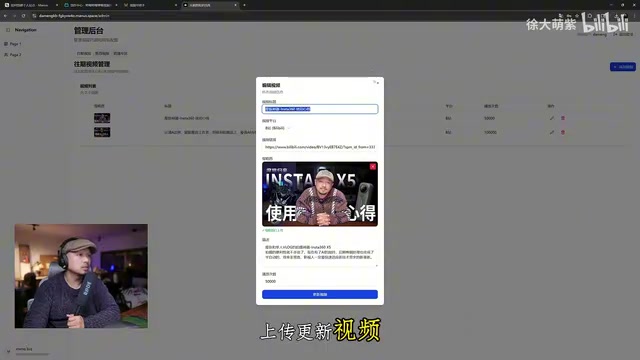
This is highly significant. Three months ago, many people were saying "frontend engineers are going to lose their jobs," but at that time AI could only produce good-looking frontend pages—without backend support, they were just empty shells. Manus AI can deliver a truly usable complete website, including a backend management system, video upload functionality, and thumbnail management. The fact that Manus AI can simultaneously complete both frontend and backend development with full CRUD functionality means it delivers a truly runnable complete application—this is an important milestone in the field of AI-assisted development.
During testing, issues emerged such as thumbnails failing to upload and video display formats not meeting expectations, requiring multiple rounds of conversation to correct. But the final product genuinely reached a level ready for direct deployment, with the entire process taking about ten minutes.
Test 3: Channel Operations Analysis — AI Automatically Controls Browser to Collect Data
The most groundbreaking test was having Manus AI analyze video channel data and develop an operations plan. The tester wrote requirements in a Notion document, including: analyzing Bilibili and WeChat Channels backend data, building a personal brand, developing follower growth strategies, identifying monetization opportunities, and designing a six-month operations roadmap.
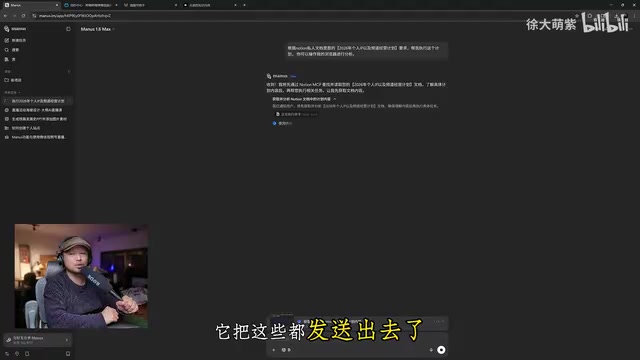
This showcased one of Manus AI's killer features—Connectors. Through authorization, Manus AI can directly control the user's browser, automatically opening the WeChat Channels assistant backend and Bilibili Creator Center, capturing real-time follower data, view counts, audience profiles, and other information.
The connector feature is essentially an AI-powered upgrade of traditional Robotic Process Automation (RPA) technology. Traditional RPA tools (like UiPath, Automation Anywhere) require manually pre-written fixed operation scripts and can only handle structured repetitive tasks. After gaining browser control through authorization, Manus AI's connectors can dynamically understand page structures based on natural language instructions, autonomously determine click paths, and intelligently extract required data. This capability relies on multimodal large models' visual understanding of webpage screenshots (known as Computer Use technology). Anthropic was first to release a similar Claude Computer Use feature in 2024, and Google also launched Project Mariner. Manus AI productized this capability and integrated it into a complete task execution pipeline, giving it genuine practical value.
Throughout the process, the AI's operating speed far exceeded human capability: rapidly switching pages, clicking various data panels, and capturing key information. The tester admitted: "It reads web pages much faster than we do—that's why it's so efficient."
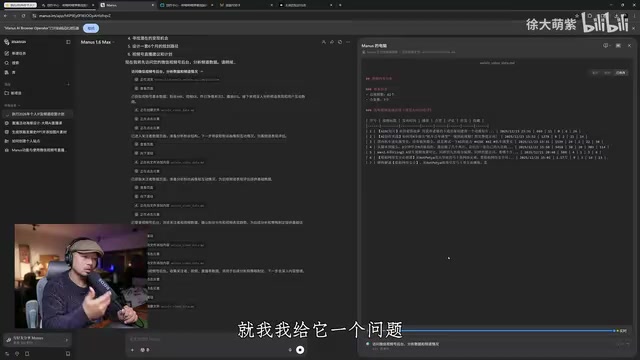
Ultimately, Manus AI produced a comprehensive operations analysis report covering:
- Current status diagnosis: Follower counts (WeChat 448, Bilibili 370), video count (68), average daily views (~5,000)
- Core findings: Content style analysis, audience profiling
- Monetization strategy: Content flywheel growth model
- Implementation path: Specific topic directions, viral content ideas, daily execution plan
After generating the report, Manus AI also provides follow-up suggestions, creating a continuous consulting experience. This fully automated pipeline from data collection to analysis to strategy output is something traditional conversational AI simply cannot achieve.
Why Manus AI Is Worth $2 Billion
Through testing these three scenarios, Manus AI's core value is crystal clear:
It fundamentally changes the collaboration model between humans and AI. Traditional AI is "you ask, I answer"—you need to manually organize data, copy and paste, and switch back and forth between multiple tools. Manus AI is "you command, I execute"—you only need to provide the goal, and it autonomously completes the entire process from information gathering and analysis to execution.
Meta's $2 billion acquisition of Manus AI reflects deep strategic considerations. While Meta possesses the open-source Llama model series and is competitive at the foundational model layer, it has fallen behind OpenAI and Google at the AI application layer—especially in agent productization. Acquiring Manus AI allows Meta to rapidly gain a mature Agent execution framework and engineering capabilities, bridging the last mile from model to product. Furthermore, the Manus AI team comes from China, with core members who previously accumulated extensive engineering experience in the AI field. This deal also reflects the intensifying global AI talent competition—Silicon Valley giants are using high-value acquisitions to bring the world's top AI teams into their ecosystems.
The commercial potential of this capability is enormous:
- Individual users: It can handle PPT creation, website development, data analysis, operations planning, and virtually all computer-based work
- Enterprise applications: Large volumes of repetitive knowledge work can be automated, significantly reducing labor costs
Of course, Manus AI currently has notable limitations: it charges on a credit-based system with no free tier, complex tasks take considerable time (ten minutes to longer), and it's currently limited to desktop operations. But as a pioneer of general-purpose agents, it demonstrates the enormous potential of AI evolving from a "conversational tool" to an "execution assistant"—and that's perhaps exactly why Meta was willing to pay $2 billion for it.
The AI Application Paradigm Is Shifting
Manus AI represents not just a product, but an important shift in the AI application paradigm. When AI no longer just answers questions but can understand goals, formulate plans, operate tools, and deliver results, the term "AI assistant" finally lives up to its name.
From a broader perspective, this shift is redefining the software industry's value chain. In the past, software's value lay in providing tools to help people work more efficiently. In the era of AI agents, software's value will shift toward directly delivering work outcomes. This means the future competitive focus will no longer be about who has a prettier interface or richer features, but whose AI can more accurately understand intent and more reliably complete tasks.
For everyday users, as long as your work is primarily done on a computer, these general-purpose AI agents are worth following closely. In the future, products like Manus AI may well become standard tools on everyone's desktop.
Key Takeaways
- Manus AI is a general-purpose agent. Its core difference from traditional conversational AI is its ability to automatically execute tasks through cloud virtual machines, achieving end-to-end automation from analysis and planning to execution
- Testing shows Manus AI can complete PPT creation, full-stack website development (including frontend and backend), poster design, and many other tasks, with WYSIWYG editing support
- Through its connector feature, Manus AI can directly control the user's browser to access backend data, automatically completing data collection and analysis, dramatically saving manual processing time
- Manus AI charges on a credit-based system with no free tier; complex tasks take approximately ten minutes; currently limited to desktop operations
- Meta's $2 billion acquisition of Manus AI reflects the AI industry's evolution from conversational tools to execution-oriented agents
Related articles
 Product Reviews
The Programmer's Desk Setup Guide: Building a Workspace That Feels Like Home
Discover how programmers build productive, comfortable workspaces. From multi-monitor setups to ergonomic design, explore the desk philosophy that drives focus and flow.
 Product Reviews
Qoder vs Cursor Real-World Comparison: Which $20/Month AI IDE Is Better?
Hands-on comparison of Qoder vs Cursor AI IDEs: Agent autonomy, human interaction count, and architecture decisions. Qoder needed only 2 interactions vs Cursor's 8.
 Product Reviews
Cursor Cloud Agent Demo: Eliminating Bottlenecks Across the Entire Software Development Lifecycle
Deep analysis of Cursor's Cloud Agent demo showing how cloud VMs, automated test artifacts, and a full-chain control plane systematically eliminate human bottlenecks across the software development lifecycle.