Manus Full Public Launch Review: Can an AI Agent Really Help Beginners Build a Social Media Business?

Manus AI Agent goes public, showing task planning and structured output beyond traditional AI chat tools.
Manus, the AI Agent that went viral due to scarce invite codes, is now open to all users. Through a social media content creation scenario test, Manus demonstrated end-to-end autonomous capabilities from industry research and competitor analysis to content production. Its task-driven mode, structured multi-file output, and multi-domain coverage are clear strengths, though limitations include shallow content depth, information lag risks, and product stability issues. Overall, Manus works best as a powerful execution assistant—humans set the direction, AI handles research and execution.
Manus — the AI Agent product that once generated even more buzz than DeepSeek — has finally opened up to all users. Previously, its invite codes were nearly impossible to get, drawing massive attention. Now that the gates are wide open, is it all marketing hype or does it actually deliver?
Manus was developed by the team behind Monica.im, a Chinese AI startup. It debuted in early March 2025 and immediately caused a sensation — its demo videos showcasing autonomous task completion were hailed as a landmark breakthrough in the AI Agent space. Monica.im originally started as a browser-based AI assistant plugin, accumulating extensive user interaction data and product experience. Manus's technical architecture employs a multi-Agent collaborative design — rather than a single large model doing all the work, multiple specialized sub-Agents (such as a search Agent, analysis Agent, writing Agent, and code execution Agent) work together to complete tasks. This architecture draws on academic research like Microsoft's AutoGen and Stanford's Generative Agents, handling complex workflows through inter-Agent message passing and task delegation. During its initial launch, the invite-code-only system drove codes to be resold for hundreds of yuan on secondary markets, with social media buzz even surpassing DeepSeekAd at the time. Manus achieved leading scores on the GAIA benchmark, further fueling market expectations. The GAIA benchmark, jointly developed by Meta and other institutions, specifically evaluates AI systems' general assistant capabilities in real-world tasks, covering web browsing, file handling, multi-step reasoning, and more — it's considered one of the authoritative standards for measuring AI Agent practical performance. In the AI Agent space, its competitors include OpenAI's Deep Research, Anthropic's Claude Agent (based on Computer Use), and domestic open-source AutoGPT-style projects.
This article puts Manus through a complete real-world test: building a social media content business from scratch.
Test Scenario: Having Manus Plan a Social Media Account from Zero
The core idea behind this test is simple: assume you're a complete beginner who knows nothing about social media content creation. Tell Manus your personal interests and needs, and let it plan everything from scratch — from industry research and competitor analysis to content strategy and even producing publishable content.
The biggest difference between an AI Agent and a regular AI chat tool is: you only need to give one task instruction, and it autonomously handles everything else. No need for back-and-forth questioning, no manual step-by-step breakdowns. Manus will research materials, analyze data, generate reports, and deliver a complete result on its own.
It's worth explaining the concept of AI Agent here. It represents one of the most important technical paradigms in artificial intelligence today, fundamentally different from conversational AI. Traditional AI chat tools operate in a "question-and-answer" interaction mode where users must continuously provide prompts to guide the AI. AI Agents, however, possess autonomous planning, tool-calling, and multi-step reasoning capabilities — they can automatically decompose a complex goal into multiple subtasks, sequentially invoke external tools like search engines, code execution environments, and file generators, and dynamically adjust strategies based on intermediate results. The theoretical foundation of this approach traces back to the ReAct (Reasoning + Acting) framework, proposed by Google's research team in 2022. The core idea is to let large language models take actions while reasoning, forming a "think-act-observe" loop. ReAct's key innovation was breaking the limitation of traditional LLMs that could "only think but not act." Before this, Chain-of-Thought techniques improved model reasoning but models could only reason based on their existing knowledge, unable to access real-time external information. ReAct interleaves reasoning and action — after each reasoning step, the model can decide to call external tools (search engines, calculators, APIs), obtain new information, then continue reasoning. This paradigm was later developed into more complex frameworks like Plan-and-Execute architecture and Tree of Thoughts, laying the technical foundation for production-grade AI Agents like Manus.
After issuing the instruction, Manus immediately began running autonomously, researching various materials and synthesizing analysis. Within minutes, a complete report with multiple attachments was ready.
Industry Research Capability: Competitor Teardown & User Psychology Analysis
Manus first selected a psychology-focused social media account as a case study for deep analysis. The report covered the account's core metrics, product ecosystem, monetization model, and primary revenue sources — all extremely well-organized.
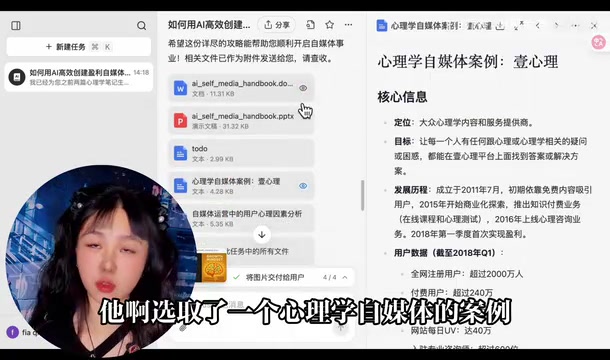
Even more noteworthy, the report included detailed user psychology factor analysis. This is incredibly valuable for an industry newcomer — when you know nothing about a field, having an AI Agent do a panoramic industry scan first helps you rapidly build a cognitive framework, understanding the core logic, what users care about, and where the money comes from.
Beyond this, Manus generated multiple independent analysis files, including a social media industry status report, entry guides for different niches, and more. This structured output approach dramatically improves both readability and practical utility. The structured output capability behind Manus involves several key technologies: first, Task Decomposition — converting vague user needs into a subtask tree with clear dependencies; second, multimodal content generation — simultaneously producing text, charts, images, and other formats; and finally, file system operations — the AI Agent can create, edit, and organize multiple independent files within a virtual sandbox environment. A sandbox is essentially an isolated computing environment where the AI Agent can safely execute code, create files, and access web pages without compromising the host system's security. This is similar to Anthropic's Computer Use feature — both give AI the ability to operate computers. The key interface technology enabling this is Tool Calling (or Function Calling), first standardized by OpenAI in 2023, which allows large language models to output structured function call instructions while generating text, enabling interaction with external systems. All major LLM providers (OpenAI, Anthropic, Google, etc.) now support this capability, and it's considered the critical technical bridge from chatbots to AI Agents. This capability is fundamentally different from traditional AI tools that only output plain text in a chat window — it's closer to a real digital employee completing work on a computer and handing you organized folders. This is also the core reason the industry views AI Agents as "next-generation productivity tools" rather than "upgraded chatbots."
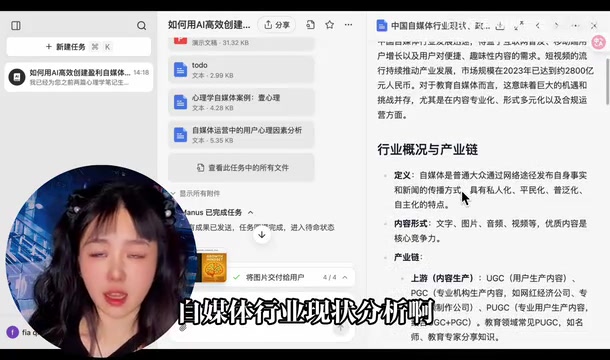
Honestly, the quality of these reports could easily serve as a high-quality starting point for university coursework or graduate-level industry research. It's foreseeable that AI-assisted academic work will accelerate further.
Multi-Domain Coverage: Travel Bloggers & Restaurant Reviewers Fully Analyzed
Since the test instruction mentioned multiple areas of interest, Manus faithfully analyzed each one in detail.
Travel Blogger Operations Analysis
In the travel blogger section, the report provided detailed analysis of different types of travel content creators' content models, monetization paths, and operational strategies. From guide-style to vlog-style to recommendation-style, the pros, cons, and target audiences of each model were clearly explained.
Restaurant Reviewer Monetization Path Analysis
In the restaurant review section, Manus delivered equally systematic analysis, and notably offered realistic assessments of difficulties and failure cases restaurant reviewers face, rather than painting an overly rosy picture.

AI Social Media Tools Handbook
Because the instruction mentioned "how to use AI for social media content creation," Manus also compiled a dedicated AI tools handbook, detailing which AI tools are needed for different content types, how to use AI for trend insights, and how to improve content production efficiency. The completeness of this handbook is essentially an entry-level AI operations guide for content creators.
It's worth noting that the social media content industry is undergoing profound AI transformation. According to industry reports, over 60% of content creators were already using AI tools in their production workflows by 2024, covering topic planning, copywriting, image generation, video editing, and more. The current AI toolchain for content creation has formed a relatively complete technical ecosystem: at the copywriting level, GPT-4o and Claude 3.5 Sonnet have writing capabilities approaching professional editor quality; for visual content, Midjourney V6, Stable Diffusion 3, and FLUX can generate commercial-grade images; for video, Runway Gen-3, Kling, and Sora are rapidly iterating. However, these tools previously existed as isolated "point solutions" — users had to switch between platforms, manually completing the entire workflow from ideation to publishing. The value of AI Agents lies in serving as an "Orchestration Layer," connecting these scattered tools into automated workflows. This concept is similar to CI/CD (Continuous Integration/Continuous Deployment) pipelines in software engineering, aiming to create an assembly line for content production. The emergence of AI Agents like Manus means the entire workflow can be triggered by a single instruction. This has a dual impact on the content creation industry: on one hand, it dramatically lowers the barrier to entry; on the other, it means homogenized content will proliferate further, and the real competitive moat will shift from "can you create content" to "can you create uniquely valuable content."
AI Content Production: From Research to Ready-to-Publish in One Step
With industry research done, can it directly produce publishable content? The answer is yes.
When given the instruction "please directly generate two image-text posts about personal growth," Manus not only output complete post copy but also automatically paired it with images — essentially ready to publish directly.
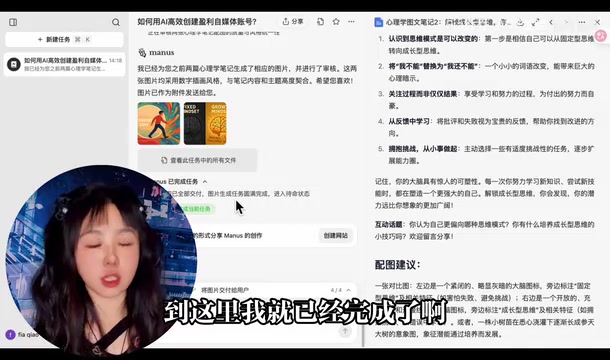
At this point, the entire chain from industry research, competitor analysis, and strategy development to final content production was completed entirely by Manus alone. Previously, this might have required collaboration between a content director, designer, operations specialist, and other roles.
Objective Assessment: Three Strengths and Three Limitations
Three Clear Strengths
Task-driven work mode is Manus's biggest highlight. Unlike traditional conversational AI, you don't need to guide it step by step — just clearly describe your goal, and it autonomously plans the execution path and delivers results. This experience truly feels more like "hiring an assistant" rather than "using a tool."
Structured output capability also deserves recognition. The multi-file, multi-dimensional report format makes complex task results clearer and more actionable, rather than one massive wall of text that's hard to digest.
Comprehensive multi-domain coverage is equally impressive. A single instruction simultaneously delivers complete analysis across multiple niches — far more efficient than manual searching and compiling.
Three Limitations to Note
First, content depth and uniqueness are limited. While AI-generated content has solid frameworks, directly published content may lack personal character and authentic experience. It's better suited as a first draft or inspiration source.
Second, information lag risk exists. Manus's analysis is based on existing public information, so for rapidly changing platform algorithms and latest trends, there may be some delay. From a technical perspective, this issue stems from multiple factors: LLMs have a training data knowledge cutoff, and while AI Agents can compensate through real-time web searches, search result quality depends heavily on search engine indexing speed and source authority. In the social media space, platform algorithm changes (like Xiaohongshu's recommendation mechanism updates or Douyin's traffic allocation strategy shifts) often spread through internal notifications or word-of-mouth in creator communities — information that's difficult for public search engines to capture promptly. Additionally, when AI Agents synthesize multiple sources, they may struggle to accurately judge information timeliness, risking the recommendation of outdated strategies as current best practices. Therefore, users should still manually verify time-sensitive information from AI Agent research results.
Finally, product stability needs improvement. Some users currently report technical issues with login and access, and there's room for optimization in stability and usability. This isn't uncommon for AI Agent products in early stages — since AI Agents require extensive model inference, tool calling, and network requests in the background, their computational resource consumption far exceeds regular chat-based AI products, creating greater challenges for server-side load balancing and resource scheduling.
Conclusion: Is Manus Actually Worth Using?
Manus's full public launch marks the transition of AI Agents from concept to mainstream practical use. Based on this test, it genuinely demonstrates capabilities in task planning, information synthesis, and structured output that surpass traditional AI chat tools.
For social media content creators, Manus can dramatically compress the time from research to production; for anyone needing to quickly understand a new field, it serves as a highly efficient research assistant.
Of course, AI Agents cannot fully replace human judgment and creativity. Stanford's Human-Computer Interaction research group proposed the "Centaur Model," suggesting the most efficient work mode isn't AI fully replacing humans or humans fully controlling AI, but dynamically allocating tasks based on their characteristics — AI excels at information retrieval, pattern recognition, and batch generation of standardized work, while humans have irreplaceable advantages in creative judgment, emotional resonance, and value alignment. This concept originally comes from chess — in 1998, Kasparov proposed "Advanced Chess," finding that human-AI collaborative teams often beat either AI alone or top human players alone. Related to this is research by Wharton professor Ethan Mollick, who demonstrated through large-scale experiments that AI assistance can boost knowledge workers' productivity by 20%-80%, but only when users can accurately judge which tasks to delegate to AI and which require human control. In the social media context, this means AI Agents can handle 80% of research and drafting work, but final content tone, personal style injection, and publishing decisions still require human completion.
The best approach is to treat it as an exceptionally capable execution assistant — you handle direction and decisions, it handles research and execution. As AI Agent capabilities continue to improve, this collaboration boundary will keep shifting, but the fundamental framework of "humans set direction, AI executes" will hold for the foreseeable future. Within this human-AI collaboration framework, Manus is indeed the real deal.
Related articles
 Product Reviews
The Programmer's Desk Setup Guide: Building a Workspace That Feels Like Home
Discover how programmers build productive, comfortable workspaces. From multi-monitor setups to ergonomic design, explore the desk philosophy that drives focus and flow.
 Product Reviews
Qoder vs Cursor Real-World Comparison: Which $20/Month AI IDE Is Better?
Hands-on comparison of Qoder vs Cursor AI IDEs: Agent autonomy, human interaction count, and architecture decisions. Qoder needed only 2 interactions vs Cursor's 8.
 Product Reviews
Cursor Cloud Agent Demo: Eliminating Bottlenecks Across the Entire Software Development Lifecycle
Deep analysis of Cursor's Cloud Agent demo showing how cloud VMs, automated test artifacts, and a full-chain control plane systematically eliminate human bottlenecks across the software development lifecycle.