Manus Hands-On Review: One Prompt to Build a Snake Game — What AI Agents Can Really Do

Hands-on review of Manus AI Agent: one prompt builds a Snake game end-to-end, no code required.
This hands-on review of Manus demonstrates its end-to-end autonomous execution — generating a Snake game and a physics teaching animation website from a single natural-language prompt. Unlike ChatGPT, Manus autonomously invokes a full tool chain from requirements to deployment and supports cloud-based async execution. The article also honestly addresses its limitations in complex projects, code security, and large-scale stability, positioning it as a prototyping tool rather than a production solution.
Following DeepSeek, the AI Agent space has a new heavyweight contender — Manus. The platform recently announced a strategic partnership with Alibaba, sending its buzz even higher. Billed as a tool that can "execute tasks fully autonomously," how does it actually perform? This article shares a hands-on evaluation of Manus's real-world capabilities.
AI Agents are one of the most closely watched directions in artificial intelligence today. Unlike traditional conversational AI, an AI Agent can perceive its environment, make autonomous decisions, and take actions. Its core architecture typically includes a large language model (LLM) as the "brain," tool use as the "hands," a memory system as the "experience base," and a planning module as the "strategy engine."
The concept of AI Agents dates back to the early days of AI research, but practical utility only arrived after the LLM capability breakthroughs of 2023. Stanford's "Generative Agents" experiment and the viral success of AutoGPT marked the moment Agents moved from academic concept to mainstream awareness. The core technical challenges today remain "hallucination control" and "long-horizon planning" — models tend to drift from their goals or accumulate errors across multi-step tasks. To address these issues, the industry has developed several architectural patterns, including ReAct (interleaved reasoning and acting), Plan-and-Execute, and Tree of Thoughts. Between 2024 and 2025, OpenAI launched Operator and Computer Use Agent, Anthropic released Claude's Tool Use capabilities, and Google reinforced Agent functionality through Gemini 2.0. In China, alongside Manus, ByteDance's Coze and Baidu's Qianfan AgentBuilder are also actively staking their claims. The industry broadly predicts that Agents will become the second commercial wave of large language models, following chatbots. Manus is one of the standout products riding that wave.
Registration and Onboarding: Manus Invite Codes and Sign-Up Flow
Manus currently operates on an invite-code system — users need an activation code before they can get started. The registration process itself is straightforward: visit the official website, click "Get Started," enter your invite code, and link your email.
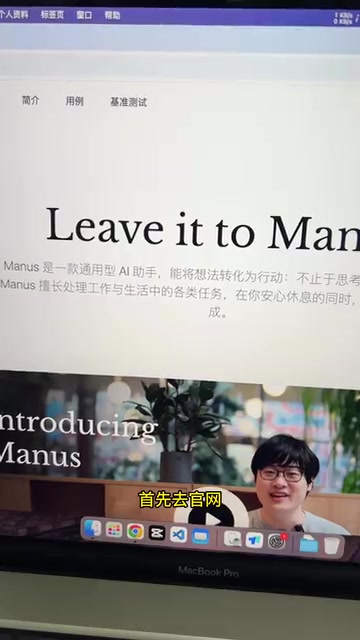
Invite-code mechanics have a long history in tech product launches. From Gmail in 2004 (which generated enormous social buzz through its invite system) to Clubhouse and Bluesky in recent years, this controlled-growth strategy both prevents servers from being overwhelmed instantly and creates viral word-of-mouth through scarcity. For a compute-intensive product like an AI Agent, each user's task execution consumes significant GPU resources and API calls — a single complete Agent task can involve dozens of LLM inference rounds, multiple web scrapes, and code executions, making its compute cost far higher than an ordinary chat conversation. Controlling user scale is therefore critical to maintaining service quality.
The invite-code system manages the pace of user growth to protect service quality, while simultaneously creating a sense of scarcity that amplifies product hype. With the Alibaba partnership now in place, broader access is expected to roll out gradually.
Test One: One Prompt to Generate a Snake Game
The first test was straightforward — ask Manus to build "a Snake game I can play right now."
The result was impressive: I entered a single natural-language instruction with no technical specifications, design requirements, or code snippets. Manus then automatically completed the following steps:
- Requirements analysis: Understanding the core gameplay and interaction logic of Snake
- Research: Searching the web for relevant technical approaches and implementation paths
- Game design: Determining the UI layout, controls, and scoring rules
- Code generation: Writing complete HTML + JavaScript game code
- Deployment: Publishing the game as a directly accessible online version

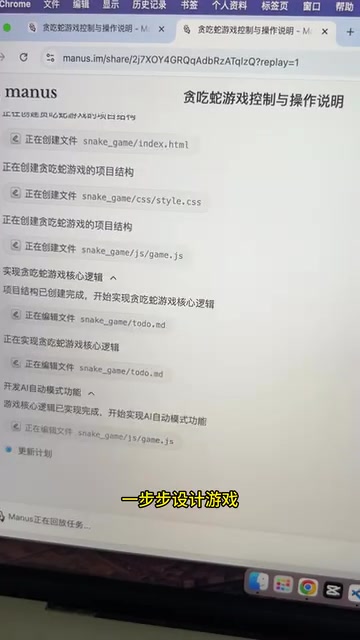
Several key technologies are at work here. First is code generation: LLMs trained on massive code corpora can understand programming logic and produce executable code. The leap in code generation began with OpenAI's Codex model (the engine behind GitHub Copilot), trained on billions of lines of open-source code to translate natural language descriptions into runnable programs. Today's frontier models — GPT-4, Claude 3.5, DeepSeekAd-Coder — achieve pass rates above 90% on code generation benchmarks like HumanEval and MBPP, providing a solid foundation for autonomous Agent programming. Second is task decomposition: the Agent breaks a vague natural-language request into multiple executable sub-tasks, much like a project manager splitting a large initiative into milestones and concrete work items. Third is tool chain orchestration: the Agent automatically invokes a browser, code editor, terminal, deployment service, and other tools, chaining them into a complete workflow.
This capability is technically known as the ReAct (Reasoning + Acting) paradigm, proposed by Google Research in 2022. Its core idea is to have the model alternate between reasoning and acting: the model first thinks about the current state and next steps (Reasoning), then executes a specific action (Acting), then observes the result (Observation), and adjusts its strategy accordingly. This "think-act-observe" loop enables Agents to handle complex multi-step, multi-tool tasks rather than generating all output in one shot. Related to this is Function Calling — LLMs interact with external tools through structured function-call interfaces, outputting JSON-formatted instructions that the system parses to invoke the corresponding tool function and return results to the model. This is the technical foundation that lets Agents control browsers, execute code, and call APIs. OpenAI first released Function Calling as a standard API capability in June 2023, and major model providers quickly followed, making it a foundational infrastructure for Agent development.
The bottom line: Manus genuinely delivered a working game with zero code and zero configuration. For users without a programming background, the experience is striking — work that would have taken a developer hours was done with a single sentence.
How Is Manus Different from ChatGPT and Other AI Coding Assistants?
It's worth clarifying the key difference between Manus and conversational AI tools like ChatGPT or Claude. ChatGPT can help you write code, but it only hands you the code — setting up the environment, running and debugging it, and deploying it are all still on you.
Manus, as an AI Agent, takes a fundamentally different approach: it can autonomously invoke a tool chain and run the entire workflow from start to finish. You just wait for the result. This is the essential difference that autonomous execution capability makes — not just writing code, but actually getting things done.
Architecturally, traditional conversational AI is fundamentally an input-output text generation system whose capability boundary ends at producing text content. AI Agents add an execution layer on top: they can control a browser (Browser Use — programmatically navigating pages, filling forms, and extracting information), execute shell commands, read and write the file system, and call third-party APIs. This architectural difference is analogous to the distinction between a "consultant" and an "employee" — the consultant gives you advice; the employee gets the work done. In technical implementation, Agents typically use an Agent Loop — continuously observing execution results, judging whether the goal has been reached, and deciding the next action until the task is complete or a maximum iteration count is hit. Each iteration in this loop contains three phases: perception (capturing current environment state, such as webpage content, code execution results, or file system changes), decision (the LLM analyzes the state and selects the next action), and execution (invoking the appropriate tool). This is why Manus can autonomously complete the full pipeline from understanding requirements to delivering a product without any human intervention.
Test Two: Generating a Physics Teaching Animation Website
The second test was closer to a real-world use case — generate "an animated demonstration website for the lever principle in middle school physics."
Manus again delivered quickly, producing a complete webpage with animated demonstrations. The practical value here is clear:
- Teacher prep efficiency: Create interactive teaching demos without learning front-end development
- Knowledge visualization: Abstract physics concepts become intuitive through animation
- Rapid iteration: Not happy with the result? Just tell Manus what to change in plain language
The potential for AI Agent tools to empower the education sector is substantial. AI in education is undergoing an important shift from "supporting learning" to "supporting teaching content production." Previous educational AI focused mainly on student-facing scenarios — smart question banks, adaptive learning path recommendations, AI essay grading. Tools like Manus directly empower teachers to produce content. Interactive teaching animations traditionally required specialized tools like Flash (discontinued at the end of 2020), Hype, or Adobe Animate — tools with steep learning curves and long production cycles. A high-quality physics experiment animation could take a professional team days or even weeks. AI Agents let teachers describe a teaching scenario in natural language and automatically generate modern web animations built on HTML5 Canvas, CSS3 animations, and JavaScript interactions. These are cross-platform compatible (accessible on phones, tablets, and computers) and can be modified and iterated instantly. This is especially meaningful for regions with limited educational resources — a rural teacher with no technical background can now produce interactive teaching materials of the same quality as elite urban schools, which in some ways helps narrow the digital divide in education.
Creating a teaching animation used to require specialized courseware software and some technical skill. With a zero-code development tool like Manus, the barrier is essentially zero. Whether it's physics, chemistry, or math — if you can describe what you want, Manus can build it.
Cloud-Based Autonomous Execution: A True "Unattended" Experience
Manus has another standout feature worth highlighting on its own — cloud-based asynchronous execution. After you submit a task, even if you close your computer or disconnect from the internet, Manus continues running in the cloud until the task is complete.

From a technical perspective, cloud-based asynchronous execution relies on server-side task queues and containerization. When a user submits a task, Manus places it in a message queue (such as Kafka or RabbitMQ) to be processed asynchronously by backend worker nodes. The core value of message queues is load leveling — when many users submit tasks simultaneously, the queue buffers requests and prevents the backend from being overwhelmed. Each task runs in an isolated sandbox environment (typically a Docker container or lightweight virtual machine), ensuring tasks don't interfere with each other and providing security isolation for code execution — even if a user's task generates malicious code or an infinite loop, it won't affect other users' tasks or the host system. Task status is synced to the user's frontend via WebSocket (a bidirectional communication protocol that supports server-initiated push) or polling, so users can monitor progress in real time. This architecture isn't new in cloud computing — CI/CD pipelines (like GitHub Actions and Jenkins) and big data processing platforms (like Apache Spark) have used similar patterns for years — but applying it to a consumer-facing AI Agent product is a noteworthy product design innovation, hiding complex distributed system architecture behind a clean user interface.
This means you can queue up a batch of tasks before bed and check the results in the morning. This mode of working is fundamentally different from traditional human-computer interaction — it's more like hiring a digital employee who's online 24 hours a day, rather than using a tool that demands your constant attention.
For scenarios requiring batch task processing — simultaneously generating multiple web prototypes or producing a set of teaching materials — the advantages of cloud-based asynchronous execution become even more pronounced.
A Sober Assessment: What Are Manus's Current Limitations?
While Manus's demo results are genuinely impressive, a rational assessment is still warranted:
- Strong on simple tasks, unproven on complex projects: A Snake game and a single-page demo site are relatively simple tasks. How Manus handles complex enterprise-level development requirements — multi-module coordination, database design, user authentication, concurrency — remains to be seen.
- Auto-generated code quality is uncertain: The security and maintainability of fully auto-generated code has not been deeply evaluated.
- Stability at scale is unknown: Whether response speed and reliability can be maintained once invite codes are removed is still an open question.
- The Alibaba partnership's real-world impact is TBD: The specific form of the strategic partnership and its practical effect on ordinary users will take time to play out.
The code quality issue deserves further elaboration. The quality of AI-generated code is a persistent concern in the industry. Research suggests that code produced by developers using AI coding assistants contains a significantly higher proportion of security vulnerabilities than code written without AI assistance. Common issues include SQL injection (attackers manipulating databases through malicious SQL statements), cross-site scripting (XSS, attackers injecting malicious scripts into web pages to steal user information), hardcoded credentials (embedding API keys, database passwords, and other sensitive information directly in source code), insecure deserialization, and other OWASP Top 10 risks. Auto-generated code also tends to lack robust error handling (programs may crash rather than degrade gracefully under unexpected conditions), logging (making it hard to diagnose issues), and unit tests (leaving correctness under edge cases unverified). Maintainability is another concern — as a project grows, code without clear architecture and documentation becomes extremely difficult to modify and extend. For rapid prototyping and personal projects, these issues have limited impact; but for production environments or scenarios involving user data, professional code review and security auditing are essential. For now, positioning Manus as a "prototyping tool" rather than a "production tool" is the more prudent choice.
Overall, Manus is currently best suited for rapid prototyping, small utility development, and content generation — it's still a significant distance from replacing a professional development team.
Conclusion: Is Manus Worth Your Attention?
Manus represents an important step in AI Agents moving from concept to practical utility. Its core value isn't that it "can write code" — it's the end-to-end autonomous task execution capability: from understanding requirements to delivering results, with no human intervention required throughout.
For everyday users, zero-code development tools like Manus are rapidly lowering the barrier to digital content creation — a single sentence can produce a webpage, a mini-game, or a teaching animation. For professional developers, it's a powerful tool for rapid prototyping and quick delivery, saving considerable time on repetitive work.
Whatever your stance on AI Agents, this wave has already arrived in a very real way. Getting familiar with it sooner rather than later is the best way to stay ahead of the curve.
Related articles
 Product Reviews
The Programmer's Desk Setup Guide: Building a Workspace That Feels Like Home
Discover how programmers build productive, comfortable workspaces. From multi-monitor setups to ergonomic design, explore the desk philosophy that drives focus and flow.
 Product Reviews
Qoder vs Cursor Real-World Comparison: Which $20/Month AI IDE Is Better?
Hands-on comparison of Qoder vs Cursor AI IDEs: Agent autonomy, human interaction count, and architecture decisions. Qoder needed only 2 interactions vs Cursor's 8.
 Product Reviews
Cursor Cloud Agent Demo: Eliminating Bottlenecks Across the Entire Software Development Lifecycle
Deep analysis of Cursor's Cloud Agent demo showing how cloud VMs, automated test artifacts, and a full-chain control plane systematically eliminate human bottlenecks across the software development lifecycle.