Manus Users Seek Alternatives: Cost-Effective Options for Research, Creation, and Website Building

Manus users seeking alternatives reflect the challenge of balancing reliability, cost, and multi-scenario coverage in general AI agents.
A long-time Manus user posted on Reddit seeking alternative tools due to recent issues, with core needs covering research, content creation, and website building at controllable cost. The article argues that general AI agents lack stability in open-ended tasks, the three task types have significantly different AI requirements, and combining specialized tools may be more pragmatic. Common migration paths include combining specialized tools, switching to other general agents, or waiting for Manus to iterate. When choosing alternatives, evaluate from task completion rate, controllability, and total cost of ownership rather than blindly pursuing an "all-around champion."
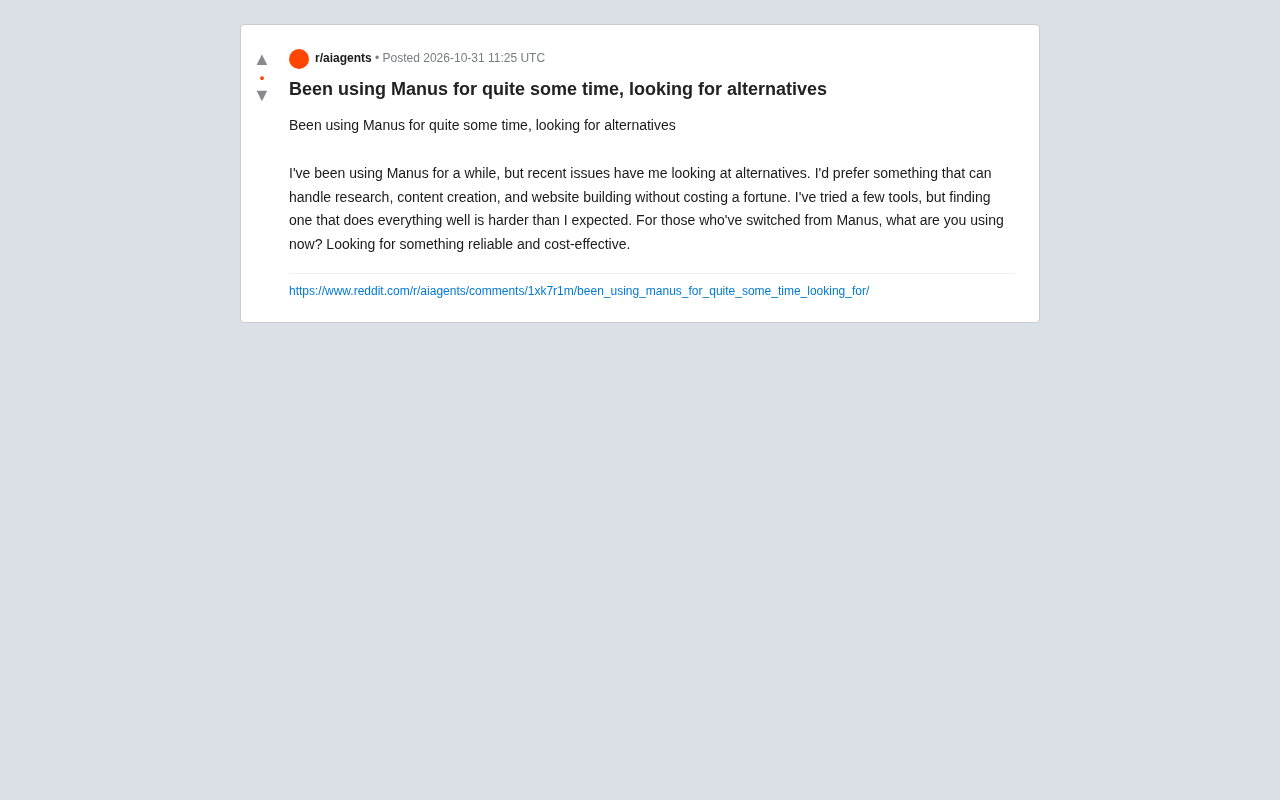
A long-time Manus user recently posted on Reddit, saying he's looking for alternative tools due to "recent issues." His needs are clear: he wants something that can handle research, content creation, and website building all at once, without costing too much. He's tried several tools but found that "finding one product that does everything well" is harder than expected.
Why Does the User Want to Leave Manus?
The original post doesn't specify what the "recent issues" are, but given Manus's product positioning—a general-purpose AI agent capable of research, report writing, and web page creation—the user's pain points likely center on stability, task completion quality, or pricing. The user emphasizes "reliability" and "cost-effectiveness," suggesting the current solution may have disappointed him on one of these fronts.
Since its launch, Manus has attracted users with its image as an AI agent that "can actually do things"—it can autonomously plan steps, call tools, and generate deliverables. But that's also the challenge of general-purpose agents: the more open-ended the task, the higher the uncertainty of results. For research, creation, and website building scenarios that require stable output, users often turn to more specialized or controllable tools after deep usage.
A General AI Agent refers to an AI system that can autonomously plan, call tools, and execute multi-step tasks. Unlike conversational models that only generate text, it emphasizes "actually doing things." Manus is one of the representatives of this product category, and its architecture typically includes task decomposition, tool invocation (such as browsers, code executors), and result integration modules. This design performs impressively in demos, but in actual use it faces the problem of error accumulation in long-chain tasks—small errors at each step can be amplified, causing the final deliverable to require extensive rework. Additionally, general agents are often priced based on task complexity or number of invocations, making long-term high-frequency use costly—which is the deeper reason users pair "reliability" with "cost-effectiveness."
Research, Creation, Website Building: Different Solutions for Three Needs
This user wants "one tool that does it all," but the reality is that these three types of tasks have very different requirements for AI.
Research tasks require information retrieval, fact-checking, and structured summarization capabilities. General agents can browse the web and aggregate information, but in-depth research often requires access to academic databases or specialized search APIs, and places high demands on citation traceability accuracy.
Content creation requires stylistic consistency and long-form coherence. Agent-based tools excel at generating first drafts, but in terms of brand tone control and collaborative revision experience, dedicated writing tools may be more comfortable to use.
Website building involves code generation, page layout, and deployment. Manus can generate static pages, but complex interactions and responsive design require more professional website building platforms or AI coding assistants.
The fact that the user "tried several tools" and is still unsatisfied precisely demonstrates that "all-in-one" products struggle to reach specialist-level performance in every area.
The core difference between specialized tools and general agents lies in design goals: specialized tools optimize prompts, workflows, and output formats for specific tasks—for example, research tools have built-in citation management and multi-source cross-validation, writing tools strengthen style control and version collaboration, and website building tools integrate code generation with real-time preview. While general agents are flexible, they lack deep optimization for single scenarios and tend to expose shortcomings in tasks requiring high accuracy or complex interactions. Therefore, when users shift from general agents to combinations of specialized tools, they are essentially replacing "fully automatic" with "semi-automatic + human oversight" in exchange for higher task completion rates and controllability.
Alternative Directions in Community Feedback
Although replies to the original post aren't presented in the source material, based on common discussions in AI tool communities, users migrating from Manus typically consider several paths:
- Using specialized tools in combination: Using Perplexity or similar research tools for information gathering, Claude or ChatGPT for content creation, and AI website building tools (such as v0, Bolt, etc.) to generate pages. This "assembled" approach is flexible and offers better experience in each area, but requires users to manage the workflow themselves.
- Switching to other general agents: Such as open-source options like AgentGPT and AutoGPT, or ChatGPT's Agent mode. However, reliability issues with general agents are widespread, and migration may not solve the fundamental pain points.
- Waiting for Manus to iterate: Some users choose to wait and see whether the official team can resolve stability and pricing issues.
Interestingly, the original poster lists "cost" alongside "reliability" as core demands, suggesting he may be willing to pay for stability but wants price to match value. For independent developers or small teams, stacking dozens of dollars in monthly subscriptions is a significant burden.
AI website building tools like v0 and Bolt belong to the subcategory of "AI coding assistants." They generate front-end code through natural language and support real-time preview and iterative modification. Compared to general agents, they focus more on page layout, responsive design, and component reuse. These tools are typically based on fine-tuned large language models or specialized code generation models, and produce high-quality output in scenarios such as generating landing pages and simple web applications. However, their limitation is weak capability in complex backend logic and database integration—they're suitable for rapid prototyping and static sites, forming a complementary rather than fully substitutive relationship with Manus's "full-process agent" positioning.
Evaluation Framework for Choosing Alternatives
If you're facing a similar choice, you can evaluate from three dimensions:
- Task completion rate: In your core scenarios (such as writing research reports, generating landing pages), what proportion of the time is the tool's output usable on the first try? General agent failures often aren't about being completely unable to do the task, but about requiring extensive rework.
- Controllability: Can you intervene in intermediate steps, adjust output formats, and connect your own data? For website building and research, process controllability is more important than full automation.
- Total cost of ownership: Not just subscription fees, but also learning costs, rework time, and the friction of switching between multiple tools. An expensive but hassle-free tool may be more cost-effective than a cheap one that constantly makes errors.
This Reddit user's confusion is representative: the AI agent market has many products, but options that can stably cover multiple scenarios are limited. Rather than searching for an "all-around champion," it's better to first identify your most frequent, non-negotiable scenarios, and then build a tool combination around them.
Total Cost of Ownership (TCO) in AI tool selection is often simplified to subscription fees, but actually includes learning curves, process integration, rework time, and the cognitive burden of switching between multiple tools. For independent developers or small teams, the combined subscriptions of multiple specialized tools may exceed the cost of a single general agent, but if the rework rate is significantly reduced, the overall cost may actually be better. When evaluating, it's recommended to use "effective output per hour" as the benchmark rather than simply comparing monthly fees, while also considering data interoperability and automation orchestration capabilities between tools to reduce the friction of manual switching.
Conclusion
The debate over Manus alternatives reflects a阶段性 dilemma for AI agent products: capability demonstrations are impressive, but long-term daily use places harsher demands on reliability and cost. For the demand of research, creation, and website building all in one, combining specialized tools may be more pragmatic in the short term than betting on a single agent. The community's real migration experiences are worth continued attention—after all, whether a tool is good or not, the comings and goings of long-term users are the most direct vote.
Related articles

AI Weekly: Claude Code Backdoor Incident and AI Giants' Capital Game
AI security this week: Cursor marketplace seeded with a Claude Code backdoor affecting Mac and Windows developers. Meanwhile, Amazon AI capex hits $75.9B, Google AI search revenue lags traditional search, Anthropic launches Ultra subscription, and OpenAI commits to robots.txt training signals while publicly defending fair use.

Malicious Claude Code Extension Infiltrates Cursor: Version 2.1.313 Self-Check and Cleanup Guide
A malicious Claude Code build 2.1.313 appeared in the Cursor extension marketplace for about 11 hours, affecting up to 5,000 users. StepSecurity disclosed that it stole system information, git email, and environment variable names, and attempted to implant SSH keys and reverse tunnels. This article covers the incident, malicious behavior, and complete self-check and cleanup steps.

15 Essential Prompts for Vibe Coding: Keep AI from Wrecking Your Code
Vibe Coding often tempts AI to break your code. These 15 prompts—from PRD, architecture, and database to testing and debugging—chain each output as the source of truth, turning AI coding from casual chat into a controllable engineering process.