Manus vs Tiangong vs Liaobots: AI Subtitle Translation Real-World Scoring Comparison

Three AI Agents tested on subtitle translation—none achieve out-of-the-box reliability
The author tested Manus, Tiangong, and Liaobots on the same English technical presentation subtitles. Results show each has trade-offs: Manus excels at workflow automation but lacks error correction, Tiangong produces fluent Chinese but inconsistent terminology, and Liaobots offers model flexibility but has a steep learning curve. All three fall short on colloquial processing, ASR error correction, and terminology consistency—a hybrid AI-first-draft plus human-review workflow is recommended.
Are AI Agents Actually Reliable for Subtitle Translation? Three Tools Put to the Test
Since the AI Agent concept exploded in popularity, all kinds of tools claim they can automatically handle complex tasks. An AI Agent refers to an AI system capable of autonomously perceiving its environment, formulating plans, and executing multi-step tasks—unlike traditional single-turn Q&A AI, Agents possess capabilities such as task decomposition, tool invocation, memory management, and self-reflection. Since 2023, with the explosion of open-source projects like AutoGPT and BabyAGI, and major companies rolling out Agent platforms one after another, this concept has quickly become the core narrative of the AI application layer. The typical Agent architecture includes a Planning module, Memory module, Tool Use module, and Action module, all working together to complete complex end-to-end tasks.
But subtitle translation—while seemingly simple—is incredibly hard to do well. It demands an extremely high level of contextual understanding, making it a perfect litmus test for evaluating AI Agents' real capabilities.
This time, I put Manus, Tiangong, and Liaobots—three mainstream AI Agents—through a real-world test, running the same English technical presentation subtitles through their translation pipelines to see how they actually perform in AI subtitle translation scenarios.
Test Material: English Subtitles from an AI Technical Presentation
The test material is a segment from an English technical presentation about AI visual programming. The speaker demonstrates how to use large language models like ChatGPT to write visualization code, involving the development of interactive visualization tools for the Self-Attention Mechanism.
The self-attention mechanism is a core component of the Transformer architecture, proposed by Google in the 2017 paper Attention Is All You Need. Its basic principle allows every element in a sequence to "attend" to all other elements in the sequence, dynamically allocating attention weights by computing similarity scores between three sets of vectors: Query, Key, and Value. Relational Self-Attention builds on this by introducing positional relationship encoding, enabling the model to capture not only content similarity but also structural relationships between elements. This mechanism is the foundational building block of all modern large language models, including GPT and BERT.
This type of content contains both heavy technical terminology and colloquial expressions, posing a significant challenge to automated subtitle translation tools' comprehension abilities.
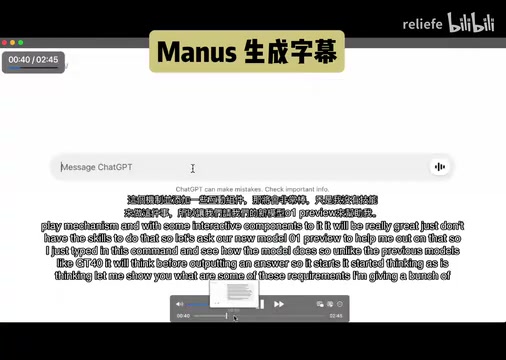
The core content of the presentation: the speaker inputs a single prompt into ChatGPT, enabling the model to understand the relational self-attention mechanism and generate visualization tools with interactive components. These tools can run directly in a browser, displaying attention arrows, word associations, and other information, ultimately serving educational purposes.
Three Core Challenges in Subtitle Translation
Challenge 1: Colloquial Expressions and Context Reconstruction
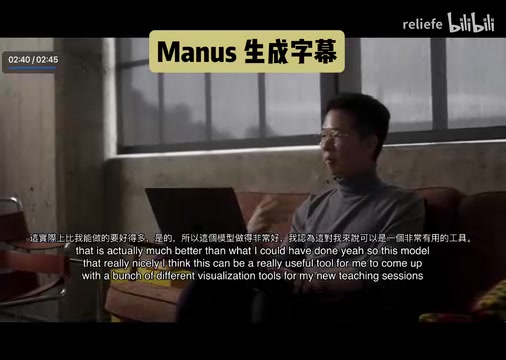
Colloquial expressions in technical presentations are the first hurdle for translation. Speakers frequently pause, repeat, and omit words—for example, phrases like "So it's a SQL, okay, figure out on that" in the original text are prone to speech recognition errors in the first place, and translation requires making reasonable inferences based on context.
Challenge 2: Accurate Translation of Technical Terminology
Terms like "Relational self-attention mechanism" and "visualization" must be translated precisely. A competent AI translation Agent needs not only to identify terminology but also to use translations that are standard in the Chinese academic community, rather than producing stiff word-for-word translations.
It's worth noting that Terminology Consistency is a classic challenge in machine translation. In traditional CAT (Computer-Assisted Translation) tools, this problem is addressed through termbases and Translation Memory (TM). However, LLM-based translation currently lacks native terminology constraint mechanisms—since the model relies on probabilistic sampling when generating each token, the same term may be mapped to different Chinese expressions in different contexts. Solutions include: explicitly providing a glossary in the prompt, using Constrained Decoding techniques, or performing terminology unification in post-processing. This is one of the key capabilities that current AI translation Agents urgently need to improve.
Challenge 3: Automatic Correction of Speech Recognition Errors
Looking at the raw material, there are already numerous recognition errors and segmentation issues from the speech-to-text stage. The upstream component of subtitle translation is Automatic Speech Recognition (ASR), which converts audio signals into text. Current mainstream ASR systems like OpenAI's Whisper and Google Speech-to-Text have achieved high accuracy on standard speech, but error rates still rise significantly when facing accents, speed variations, background noise, and technical terminology. Common recognition errors include homophone confusion, segmentation misalignment, and proper noun misidentification. These upstream errors propagate directly to the translation stage, creating an "error cascade" effect.
A truly effective AI Agent should be able to automatically detect and correct these errors during translation, rather than faithfully translating mistakes as-is.
Detailed Comparison of Three AI Agents' Subtitle Translation Performance
Before diving into the comparison, it's helpful to understand the evolution of machine translation technology. Machine translation has undergone three paradigm shifts: from rule-based, to Statistical Machine Translation (SMT), to Neural Machine Translation (NMT). Current mainstream NMT systems are based on the Transformer architecture's encoder-decoder structure, with representative systems including Google Translate and DeepL. The emergence of Large Language Models (LLMs) has brought a fourth transformation—LLM-based translation no longer relies on specialized translation models trained on parallel corpora, but instead leverages general language understanding capabilities and In-Context Learning to complete translation tasks. This approach shows unique advantages in handling long-text context, style adaptation, and terminology consistency, but also faces challenges such as Hallucination and consistency instability. The three tools tested here are typical representatives of this new paradigm.
Manus Translation Results: Complete Workflow, but Weak on Detail Correction
Manus is a general-purpose AI Agent product that gained rapid popularity from late 2024 to early 2025, developed by a Chinese team. Its core selling point is the ability to automatically decompose users' natural language instructions into multiple subtasks and complete end-to-end complex workflows by invoking tool chains including browser operations, code execution, and file processing. Manus adopts a ReAct (Reasoning + Acting)-style Agent architecture, performing reasoning before executing actions at each step and dynamically adjusting subsequent plans based on execution results.
In the subtitle translation task, Manus indeed has a solid approach to task decomposition and workflow orchestration. It can automatically identify the input as English subtitle text and process it sequentially following a "recognize → understand → translate → proofread" workflow. This architecture excels in workflow orchestration, but for fine-grained tasks requiring deep domain knowledge, its performance is still limited by the underlying model's capability boundaries.
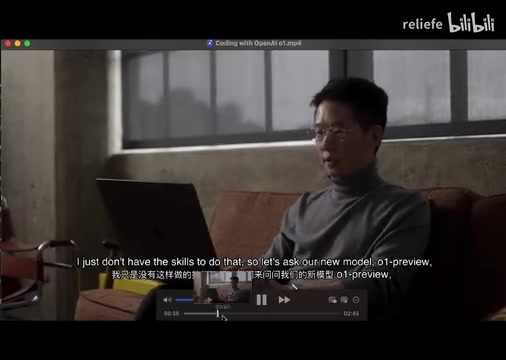
When facing heavily colloquial source text with poor speech recognition quality, Manus's error correction capability isn't strong enough—some speech recognition errors were carried directly into the translation.
Tiangong AI Translation Results: Fluent Chinese, but Inconsistent Terminology
Tiangong is an AI large model product launched by Kunlun Tech, integrating search, conversation, writing, translation, and other functions. Built on Kunlun's proprietary Tiangong large model, it has been extensively trained and optimized on Chinese corpora, giving it a localization advantage in Chinese generation fluency and naturalness. Tiangong is also gradually introducing Agent capabilities, supporting task execution within multi-turn conversations.
In this test, Tiangong showed a clear advantage in Chinese output fluency—the translations read more naturally in Chinese. However, as a comprehensive platform, its terminology management and consistency control mechanisms for vertical scenarios (such as technical documentation translation) are not yet as mature as specialized translation tools. When handling highly specialized AI technical terminology, it occasionally produced inconsistencies—the same concept was translated differently across different paragraphs, affecting overall translation consistency.
Liaobots Translation Results: Flexible Model Selection, but Variable Quality
Liaobots is an AI model aggregation platform that allows users to switch between multiple mainstream large language models within the same interface, including GPT-4o, Claude, Gemini, and others. This multi-model architecture provides users with tremendous flexibility—theoretically allowing the selection of the optimal model for each task.
However, in actual testing, translation quality varied significantly between different models. This is because models differ considerably in translation style, terminology handling, context window length, and other aspects, requiring users to have some understanding of model characteristics to make informed choices. Additionally, since Liaobots itself doesn't provide an additional Agent orchestration layer, task decomposition and workflow management largely depend on users designing their own prompts. For beginners, the learning curve is relatively steep.
Test Video Content: Self-Attention Mechanism Visualization Demo
As a side note, the test video's content itself is quite fascinating. The speaker demonstrates how a single prompt can get ChatGPT to generate an interactive visualization tool for the self-attention mechanism—hovering the mouse over a word reveals attention weight arrows, intuitively showing the relationships between words like "quick" and "brown."
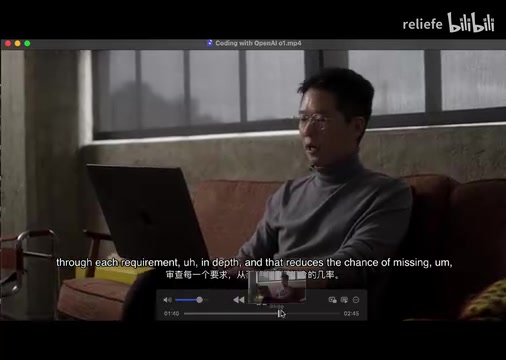
This type of visualization tool is highly valuable for AI education, and the speaker mentioned plans to incorporate these tools into new teaching courses. This reflects the emerging trend of AI-Assisted Educational Content Creation. Traditional development of educational visualization tools requires front-end programming skills, but the code generation capabilities of large language models now enable non-programmers to quickly create interactive teaching demonstrations. This trend is reshaping how STEM education content is produced—teachers can describe their needs in natural language, and AI generates runnable HTML/JavaScript visualization components, dramatically lowering the barrier to creating teaching resources. Similar projects include the combination of 3Blue1Brown's Manim animation engine with LLMs.
This aptly illustrates that AI can not only assist with translation but also directly participate in creating educational content.
Translation Scoring Comparison Table and Best Practice Recommendations
Through this real-world test, the performance of the three subtitle translation tools can be summarized as follows:
| Evaluation Dimension | Manus | Tiangong | Liaobots |
|---|---|---|---|
| Workflow Automation | ⭐⭐⭐⭐ | ⭐⭐⭐ | ⭐⭐⭐ |
| Chinese Fluency | ⭐⭐⭐ | ⭐⭐⭐⭐ | ⭐⭐⭐ |
| Terminology Accuracy | ⭐⭐⭐ | ⭐⭐⭐ | ⭐⭐⭐ |
| Error Correction | ⭐⭐ | ⭐⭐⭐ | ⭐⭐ |
| Ease of Use | Easy | Easy | Moderate |
Conclusion: Current AI Agents are not yet at an "out-of-the-box" level for subtitle translation. Each tool has its strengths, but all have varying degrees of weakness in handling colloquial text, correcting speech recognition errors, and maintaining terminology consistency.
Recommended Workflow: AI First Draft + Human Review
For those with subtitle translation needs, the following workflow is recommended:
- Choose your tool: Pick Manus for workflow automation, Tiangong for Chinese readability, or Liaobots if you have model tuning experience
- AI first draft: Use an AI Agent to quickly generate a translation draft, saving significant repetitive labor
- Human review: Have someone familiar with the relevant domain review terminology and context for professional accuracy
- Format adjustment: Check whether subtitle timing and line breaks are reasonable
This approach significantly improves efficiency while ensuring translation quality. As large model capabilities continue to advance and Agent frameworks keep evolving, fully automated high-quality subtitle translation will eventually become reality. But for now, maintaining a cautious attitude toward AI output remains necessary.
Key Takeaways
- Three AI Agents (Manus, Tiangong, Liaobots) each have pros and cons for foreign language subtitle translation, and none have achieved fully reliable performance
- Colloquial expressions, speech recognition errors, and terminology consistency are the three core challenges in AI subtitle translation
- The current best practice is a hybrid workflow combining AI first drafts with human review
- The test video showcases a real case of using ChatGPT to generate interactive visualization tools for the self-attention mechanism
- AI Agents' task decomposition capabilities are fairly mature, but there's still room for improvement in detail handling and error correction
Related articles
 Product Reviews
The Programmer's Desk Setup Guide: Building a Workspace That Feels Like Home
Discover how programmers build productive, comfortable workspaces. From multi-monitor setups to ergonomic design, explore the desk philosophy that drives focus and flow.
 Product Reviews
Qoder vs Cursor Real-World Comparison: Which $20/Month AI IDE Is Better?
Hands-on comparison of Qoder vs Cursor AI IDEs: Agent autonomy, human interaction count, and architecture decisions. Qoder needed only 2 interactions vs Cursor's 8.
 Product Reviews
Cursor Cloud Agent Demo: Eliminating Bottlenecks Across the Entire Software Development Lifecycle
Deep analysis of Cursor's Cloud Agent demo showing how cloud VMs, automated test artifacts, and a full-chain control plane systematically eliminate human bottlenecks across the software development lifecycle.