ManyAgents: Command an AI Coding Agent Team from a Single Mac Window

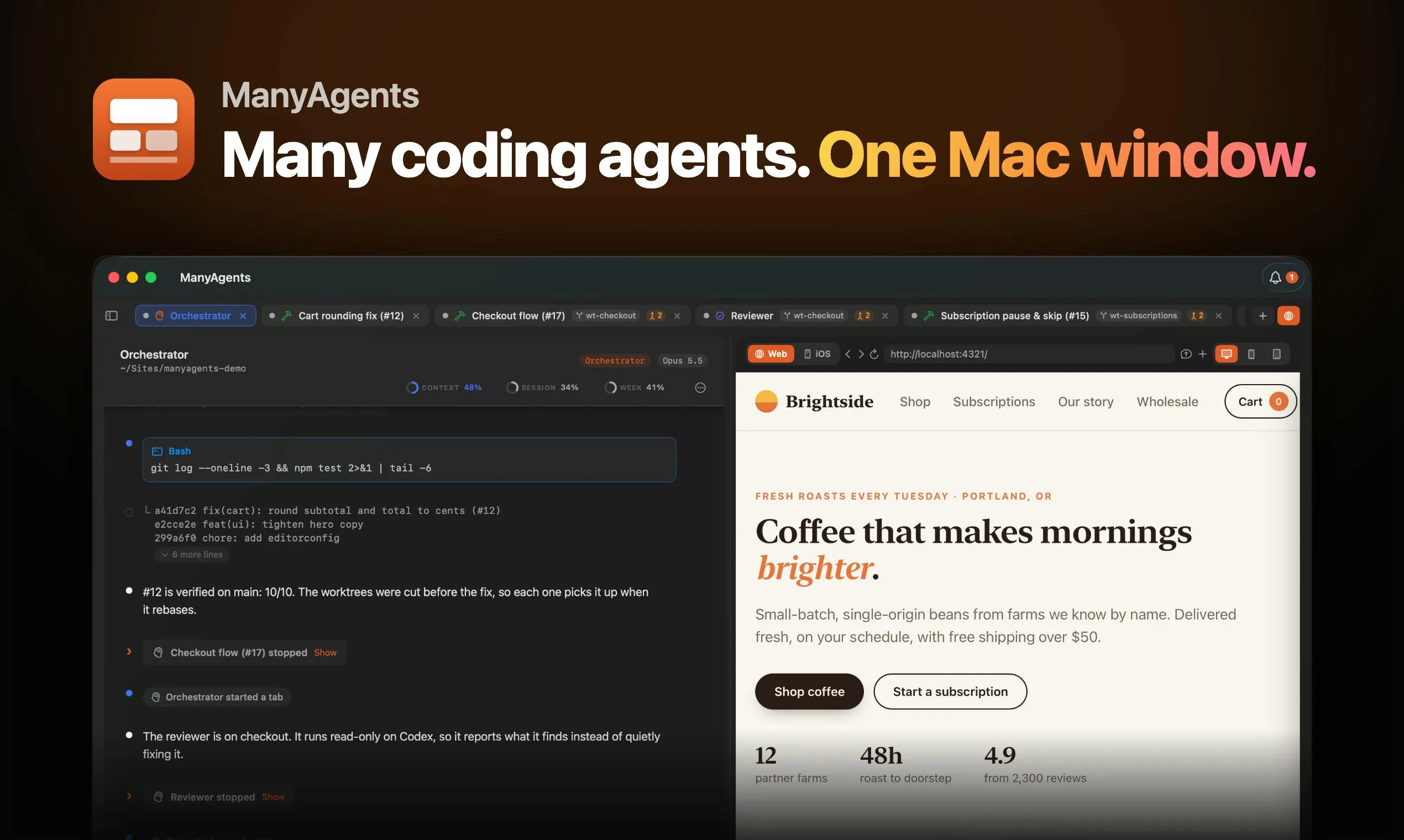
ManyAgents organizes agents like Claude Code into a team, coordinated by an orchestrator with built-in review.
ManyAgents is a Mac productivity tool for professional developers that organizes AI coding agents like Claude Code and Codex into a centrally coordinated team. An orchestrator splits development tasks so each agent works in parallel in its own isolated git worktree, avoiding code conflicts and context pollution. It includes a reviewer agent for quality checks and a browser environment for agents to test the web apps they generate, forming a write-test-fix loop. All agent questions and feedback are centralized to reduce window switching. The product uses your existing plans without extra API quota and offers a 14-day free trial. It received 80 upvotes on Product Hunt, ranking 11th for the day—reflecting some attention but not yet explosive growth. The article sees it as representing the shift from single assistants to multi-agent orchestration, though stability and real-world efficiency still need validation.
In an era where AI coding assistants are everywhere, efficiently managing multiple agents working together has become a new pain point. ManyAgents attempts to offer an elegant answer: it organizes coding agents like Claude Code and Codex into a team, letting you coordinate them all from a single Mac window.
The Core Mechanism of Multi-Agent Collaboration
At the heart of ManyAgents is an orchestrator, which is responsible for breaking down your development tasks and distributing them across multiple AI coding agents. Each agent runs in its own isolated git worktree, meaning they can work in parallel without interfering with each other, avoiding code conflicts and context pollution.
This design directly addresses a key limitation of current AI coding tools: a single agent often struggles to handle different parts of a complex task simultaneously, while manually switching between multiple tools is extremely inefficient. ManyAgents makes parallel development feasible through its isolated worktree structure.
Additionally, each agent uses the plans you already have, so there's no need to purchase or configure new API quotas, lowering the barrier to entry.
git worktree is a mechanism introduced in Git version 2.5 that allows multiple working trees to be checked out from the same repository, each corresponding to a different branch or commit while sharing the same .git object database. Compared to traditional repeated git clone operations, worktrees don't duplicate stored history objects, use less disk space, and make switching between branches and isolation more lightweight. Typical uses include: maintaining multiple release branches simultaneously, fixing urgent bugs without interrupting current development work, and experimenting with different features in parallel without the cost of additional clones. In multi-agent collaboration scenarios, each agent's changes are confined to its own working tree, greatly reducing the risk of code conflicts, uncommitted changes overwriting each other, and context being inadvertently polluted. However, worktrees only solve isolation at the filesystem level; branch merging, dependency sharing, and runtime port allocation still need to be handled by higher-level orchestration logic.
Orchestrator is a common pattern in distributed systems and automation tools, responsible for coordinating task decomposition, scheduling, result aggregation, and failure retries across multiple execution units, typically without directly executing business logic itself. In multi-agent AI coding systems, the orchestrator needs to solve several key problems: how to decompose a user's high-level requirements into subtasks of appropriate granularity; how to determine whether an agent's completed work satisfies dependencies to trigger downstream agents; and how to roll back or reassign tasks when an agent fails or its output is rejected by review. Compared to simply "opening a few more chat windows," the value of an orchestrator lies in explicitly managing task states and dependency graphs, enabling parallel results to be reliably aggregated. The design challenge lies in the granularity of task decomposition and control of error propagation—over-decomposition increases coordination overhead, while under-decomposition degrades to a single-agent mode.
Built-in Review and Browser Testing
Code generation is only the first step; quality assurance is equally important. ManyAgents comes equipped with a reviewer agent responsible for checking the output of other agents. This is essentially embedding a quality gate into the automated workflow, reducing the burden of manual line-by-line review.
Even more practical is the built-in browser. Agents can directly test the web applications they generate in the browser, forming a "write-test-fix" loop. For frontend development tasks, this feature is particularly crucial because it allows agents to self-verify rather than relying on developers to manually run through everything.
All questions and feedback generated by the agents are centralized in one place for you to handle uniformly, avoiding the need to switch back and forth between multiple windows and tools.
Reviewer agent is an implementation of the "multi-agent mutual checking" or "generate-verify" paradigm. It typically doesn't modify code directly but instead makes judgments or suggests modifications on another agent's output based on preset criteria (such as coding standards, whether tests pass, and requirement coverage). This approach draws on code review processes in software engineering and is also close to the academic actor-critic structure: the actor generates, and the critic evaluates. Its effectiveness depends on whether the review criteria are actionable and whether the reviewer agent can obtain sufficient context (such as original requirements, test results, and diff scope). The limitation is that the reviewer agent and the generating agent may share similar model biases, leading to "mutual confirmation of errors" rather than genuinely discovering problems; therefore, critical final judgments still require human intervention, and the reviewer agent is better suited as a first filter layer for reducing low-level errors.
Positioning and Experience
From a product positioning perspective, ManyAgents targets professional developers and teams, falling into the productivity tool category. It currently offers a 14-day free trial, with specific pricing not yet disclosed in the source material.
On Product Hunt, the product received 80 upvotes and 6 comments, ranking 11th for the day, indicating it has attracted some attention but hasn't yet achieved explosive virality. Creator Stu Green has placed the product's official website link on the Product Hunt page, where interested users can learn more.
Signals Worth Watching
ManyAgents represents one direction in the evolution of AI coding tools: from single assistants to multi-agent orchestration. As agents like Claude Code and Codex become increasingly capable, how to make them work together and review each other may become more important than the model capabilities of any single agent. This product's approach is worth developers' attention, especially for teams already using multiple AI coding tools in their daily work.
However, the stability and actual efficiency gains of multi-agent systems still need validation in real-world scenarios, and the coverage of built-in browser testing is also worth further observation.
One-line Summary
ManyAgents forms Claude Code and other agents into a team, coordinated by an orchestrator with built-in review.
Paragraph Summary
ManyAgents is a Mac productivity tool for professional developers whose core idea is to organize AI coding agents like Claude Code and Codex into a team that can be centrally coordinated. It uses an orchestrator to split development tasks, letting each agent work in parallel in its own isolated git worktree to avoid code conflicts and context pollution. The product includes a reviewer agent to quality-check outputs and provides a browser environment for agents to directly test the web applications they generate, forming a write-test-fix loop. All agent questions and feedback are presented centrally, reducing window switching. The product uses your existing plans without requiring additional API quota purchases and currently offers a 14-day free trial. It received 80 upvotes on Product Hunt and ranked 11th for the day, reflecting some attention but not yet explosive growth. The article suggests it represents the evolution of AI coding tools from single assistants to multi-agent orchestration, though stability and actual efficiency still need real-world validation.
Related articles

Private Key Set to 4? CA's Elementary Mistake Leaves TLS Exposed
CA eMudra set private keys to tiny values like 4, making TLS certificates brute-forceable. A Computerphile video demonstrates the full process from extracting public keys to forging certificates, and explores the fragility of the PKI trust chain.

How Gen Turns Data into Decisions with ChatGPT Work
In an OpenAI user case, business leader Gen shares how ChatGPT Work turns data into decisions: within hours of launch, teams can judge whether integrations and onboarding flows work, shifting decision iteration from hundreds of trial-and-error attempts to a fast feedback loop.

ChatGPT vs. Claude In-Depth Comparison: Strong at Coding but Weak at Research — How to Bridge the Gap?
A user considers switching from ChatGPT to Claude, finding Claude stronger at coding but shallower at research. We analyze the differences and share tips to make Claude's research deeper.