MAO: Putting Claude Code, Codex, and Grok on One Collaborative Canvas

MAO puts four AI coding assistants on one canvas, letting agents converse and delegate tasks.
The article introduces MAO, a new Product Hunt product that addresses the pain point of developers using Claude Code, Codex, Gemini, and Grok simultaneously while tools stay isolated and require manual context transfer. MAO uses a desktop canvas where users connect two agents that converse, delegate tasks, and return results, with humans as team leader. Built in Rust with native macOS, Linux, and Windows support, it offers a 7-day free trial then a $20 one-time purchase. PH data shows 71 votes, 5 comments, and 18th place—moderate traction. The author sees its bet on "AI tool orchestration" as hitting a real need but facing three challenges: cross-vendor API differences, canvas complexity, and one-time-purchase sustainability, and recommends it to indie developers already juggling multiple tools.
When AI Coding Assistants Start "Teaming Up"
Developers today face a fragmented ecosystem of AI tools: Claude Code excels at reasoning and long-context tasks, Codex (here referring to OpenAI's code model) performs reliably in completion and generation, and Gemini and Grok each have their own strengths. The problem is that these tools are isolated from one another—you need to copy and paste between different windows, manually pass context along, and collaboration efficiency gets chopped up by tool boundaries.
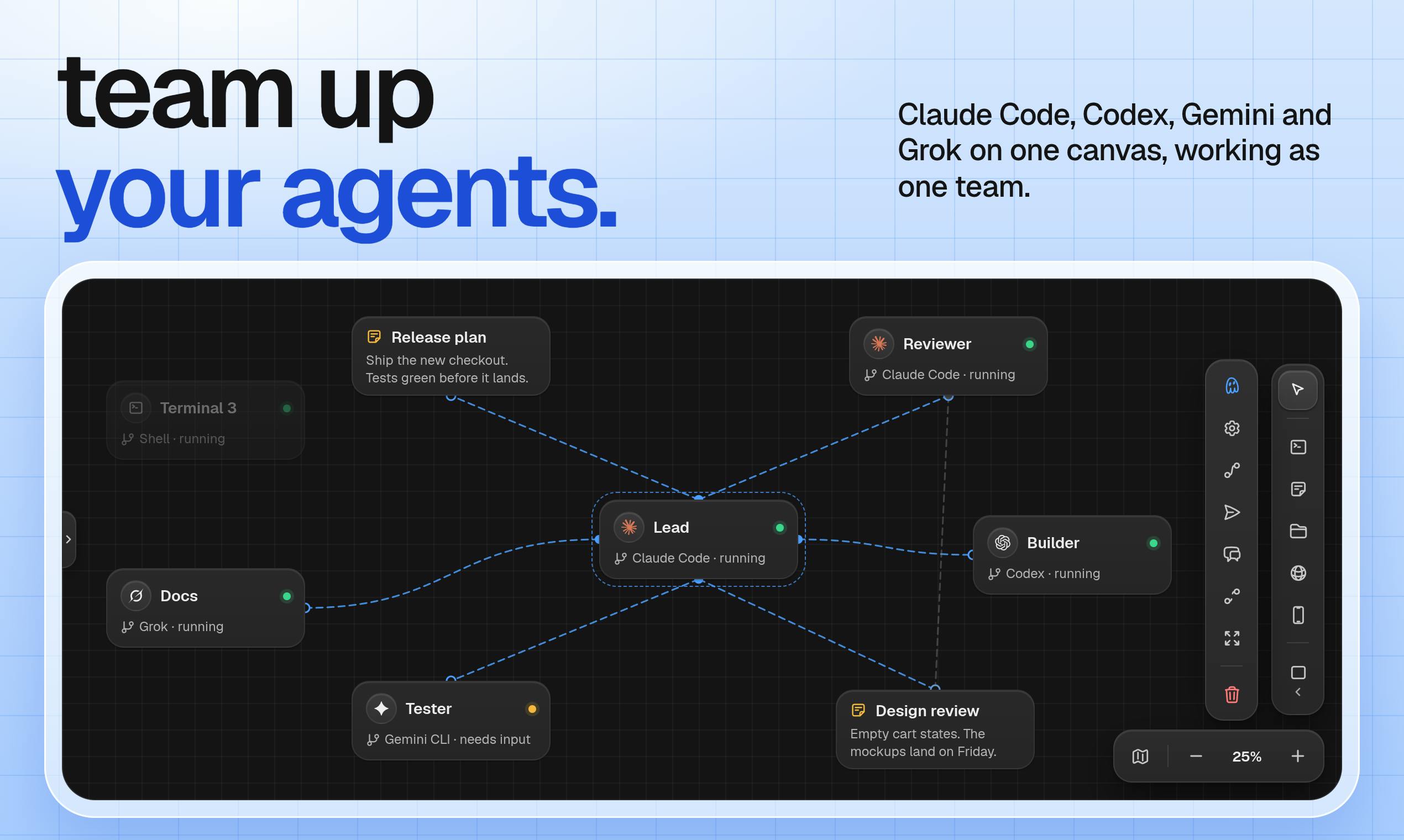
MAO, a new product on Product Hunt, attempts to solve this problem. Its proposition is straightforward: put Claude Code, Codex, Gemini, and Grok on a single canvas and let them work like a team. According to its page description, users simply "connect two agents," and they will talk to each other, assign tasks, and hand back results—with the human acting as team leader.
A Productized Attempt at Multi-Agent Collaboration
Multi-agent collaboration is not a new concept; the research community has long explored having multiple LLMs discuss with each other and divide labor to improve performance on complex tasks. What sets MAO apart is its product form: it is not a research framework but a developer-facing desktop tool that emphasizes the "canvas" as a visual interaction paradigm.
From the description, MAO's core mechanism is message passing and task delegation between agents. After users connect two agents, a dialogue channel forms between them; one agent can hand a subtask to the other, which returns the result upon completion. In theory, this model suits coding tasks that require multi-round reasoning and verification—for example, one agent generates code while another reviews or tests it.
Notably, it claims native cross-platform support: macOS, Linux, and Windows, built with Rust. Choosing Rust typically signals a focus on performance and memory safety, a reasonable technical choice for a desktop application that needs to run multiple agent sessions simultaneously.
Multi-Agent Collaboration refers to having multiple LLM agents with autonomous decision-making capabilities work together—through message passing, task decomposition, and result aggregation—to accomplish complex tasks that a single agent struggles with. Common topologies include decentralized discussion (multiple agents converse as equals until convergence), hierarchical delegation (an orchestrator decomposes tasks and dispatches them to workers), and debate-style verification (a generator and a reviewer compete). Unlike simple "model ensembling," the key to multi-agent systems lies in the design of communication protocols, role definitions, and termination conditions—without clear handoff formats and conflict-resolution mechanisms, agents can easily fall into circular conversations, shirk responsibility, or cascade errors. What MAO describes as "connecting two agents so they talk to each other" is essentially packaging this research paradigm into a visual product.
Rust is a systems programming language that emphasizes memory safety and zero-cost abstractions. Its ownership and borrow checker mechanisms eliminate data races at compile time, guaranteeing concurrency safety without garbage collection. For a desktop application that needs to maintain multiple long-lived connections, handle streaming token output, and render a complex canvas simultaneously, Rust's asynchronous runtime (such as Tokio) and low memory footprint are significant advantages; Rust-based desktop frameworks like Tauri are also often used to replace Electron to reduce installer size. Choosing Rust also means the team is willing to accept a steeper learning curve in exchange for runtime stability and cross-platform consistency.
Pricing and Target Users
MAO's business model is quite lightweight: a 7-day free trial with no credit card required, followed by a one-time payment of $20. At a time when AI tools generally adopt subscription models, a one-time purchase is a differentiated choice that also lowers the barrier for developers to try it.
According to Product Hunt data, the product received 71 upvotes and 5 comments, ranking 18th. On PH, this level of traction is moderate to above average, suggesting it hits a real need for some developers but has yet to generate widespread discussion. Its category tags are Mac, Developer Tools, and GitHub, implying its target users are programmers accustomed to working in local environments rather than enterprise teams.
Product Hunt is a global community for new product launches, where products are ranked by the number of upvotes received on the day of launch; daily leaderboards typically feature dozens of products. A top ranking means homepage exposure and early user feedback, but vote counts are heavily influenced by launch timing, community operations, and category popularity. For developer tools, dozens of votes and single-digit comments fall into the typical "niche but precise" range: it shows reach into the core circle but no breakout yet. When evaluating PH data, one should consider comment quality rather than just vote counts, because genuine usage feedback often hides in the details of comments.
Judgment from Multiple Perspectives
Currently, public information about MAO comes mainly from its Product Hunt page, with limited independent reviews and user feedback, so the following analysis should be taken with caution.
From a product positioning standpoint, MAO is betting on the niche of "AI tool orchestration." As command-line and desktop coding agents like Claude Code and Codex become more widespread, scenarios where developers use multiple agents simultaneously will only increase. How to make them collaborate rather than operate in silos is a real pain point. MAO offers an intuitive answer through a canvas plus message passing.
But the challenges are equally obvious. First, the quality of collaboration between agents depends heavily on the instruction-following capabilities of the underlying models; API differences and stability across vendors (Anthropic, OpenAI, Google, xAI) will directly affect the experience. Second, canvas-style interaction may become complicated as the number of agents grows, and maintaining readability will require product design refinement. Third, the sustainability of the $20 one-time purchase model is questionable—if the product needs continuous adaptation to API changes from each vendor, maintenance costs will not be trivial.
One-time Purchase / Lifetime Deal and SaaS Subscription are two mainstream software business models. A one-time purchase charges a single fee and lowers the user's decision threshold, but revenue is not sustainable—especially when the product depends on third-party APIs and requires ongoing adaptation and maintenance costs. Subscriptions, meanwhile, match the cost of continuous service but tend to lose price-sensitive users early on. For "glue layer" tools, billing for the underlying model APIs usually still falls to the user or is passed through by the product, so whether a $20 one-time price covers long-term maintenance depends on user scale and the frequency of API changes. Some teams adopt a hybrid model of "one-time purchase + optional upgrade packs" to balance cash flow and sustainability.
Who Should Try It
If you already use multiple AI coding assistants in your daily development and are tired of manually shuttling context between them, MAO's free trial is worth a try. It is more of a "glue layer" tool: it does not replace any single model but tries to make them work together. For indie developers and small teams, this lightweight, one-time-purchase tool format has some appeal; for enterprise environments with strict compliance requirements, the data flows across vendor APIs will need additional evaluation.
Whether MAO can grow from a new PH product into a commonly used tool in this niche depends on whether it can turn the demonstrative concept of "letting agents talk to each other" into stable, predictable everyday productivity.
One-line Summary
MAO puts four AI coding assistants on one canvas, letting agents converse and delegate tasks to each other.
Paragraph Summary
The article introduces MAO, a new product on Product Hunt that aims to solve the pain point of developers using Claude Code, Codex, Gemini, and Grok simultaneously while tools remain isolated and require manual context transfer. In a desktop canvas form, MAO lets users connect two agents so they converse, delegate tasks, and return results, with humans acting as team leader. Built with Rust, it natively supports macOS, Linux, and Windows, priced at a 7-day free trial followed by a $20 one-time purchase. PH data shows 71 votes, 5 comments, and 18th place—moderate to above-average traction. The author believes its bet on "AI tool orchestration" hits a real need but faces three major challenges: cross-vendor API differences, canvas complexity management, and the sustainability of the one-time purchase model. Indie developers already using multiple tools are encouraged to try it.
Related articles

How Gen Turns Data into Decisions with ChatGPT Work
In an OpenAI user case, business leader Gen shares how ChatGPT Work turns data into decisions: within hours of launch, teams can judge whether integrations and onboarding flows work, shifting decision iteration from hundreds of trial-and-error attempts to a fast feedback loop.

ChatGPT vs. Claude In-Depth Comparison: Strong at Coding but Weak at Research — How to Bridge the Gap?
A user considers switching from ChatGPT to Claude, finding Claude stronger at coding but shallower at research. We analyze the differences and share tips to make Claude's research deeper.

Theranos Whistleblower Warns: The AI Boom Is "a Great Opportunity to Deceive"
Theranos whistleblower Tyler Shultz warns the AI boom is "a great opportunity to deceive" as never-profitable companies raise capital at trillion-dollar valuations. This article examines the real-world context, key differences between AI and Theranos, and practical criteria for investors and practitioners.