Market Incentives for AI Safety Investment: A Game-Theoretic Supply Chain Analysis

A game-theoretic model shows downstream competition boosts AI safety investment, while upstream underinvests due to externalities, requiring regulation to fix misaligned incentives.
This study uses a game-theoretic model to analyze how market incentives affect safety investment in the AI supply chain. Key findings: downstream competition typically pushes firms to invest in safety above the industry profit optimum as safety becomes a differentiation tool; upstream LLM providers may underinvest because they cannot fully capture spillover benefits. This misalignment stems from positive externalities, making private returns lower than social returns, so markets cannot spontaneously achieve the social optimum. Regulation can correct it by adjusting payoffs but must avoid distorting competition. The study stresses AI safety is an institutional design challenge requiring interdisciplinary analysis.
Market Incentives for AI Safety Investment: A Game-Theoretic Supply Chain Analysis
Introduction: AI Safety Is Not Just a Technical Problem
Modern AI systems deliver enormous practical value, but they also come with social risks such as toxic content, malicious use, and disinformation. Mitigating these risks depends not only on technical feasibility but also on whether the companies developing and deploying these systems have sufficient incentive to invest in safety.
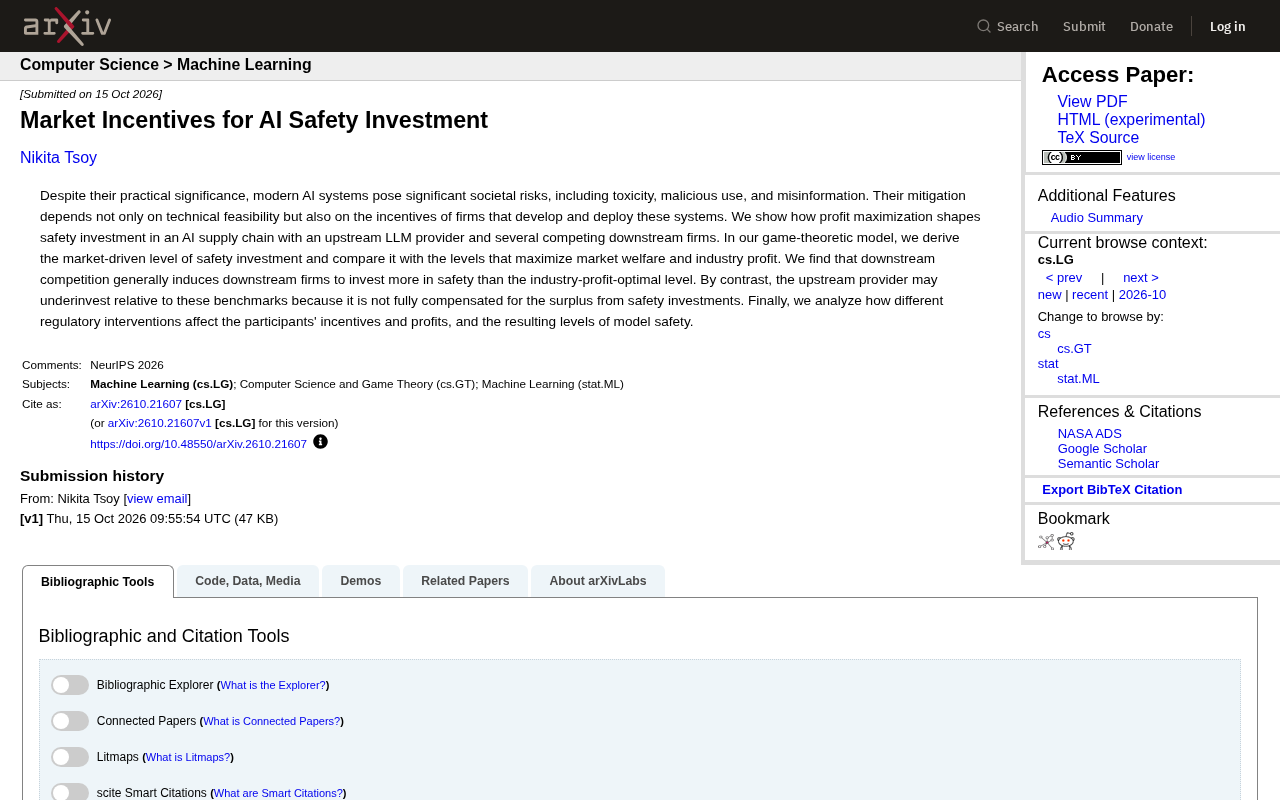
A recent study uses a game-theoretic model to analyze in depth how profit maximization shapes safety investment behavior across the AI supply chain. The research constructs a supply chain model consisting of an upstream LLM provider and multiple competing downstream firms, revealing the gaps between market-driven safety investment levels and both the social welfare optimum and the industry profit optimum. This finding highlights a market mechanism in AI safety governance that cannot be overlooked.
Game Theory and Supply Chain Models: Game theory is a mathematical framework for studying how multiple rational decision-makers choose strategies under mutual influence. In the AI supply chain, upstream LLM providers (such as OpenAI and Anthropic) supply foundation models to downstream firms (such as application developers), which then serve end users. The study abstracts this structure into a sequential game: the upstream provider first sets the model safety level and price, and downstream firms then decide their own safety investments based on the competitive environment. By solving for the subgame perfect Nash equilibrium, researchers can compare safety investment levels under different market structures with the theoretical optimum.
Externalities and Market Failure: An externality refers to an effect of one party's behavior on a third party that is not reflected in market prices. Safety investment has positive externalities: when the upstream provider improves model safety, both downstream firms and users benefit, but the upstream cannot charge all beneficiaries. This "insufficient compensation" causes the private marginal benefit to fall below the social marginal benefit, resulting in underinvestment. Market failure means that the price mechanism alone cannot achieve Pareto optimality, requiring regulation or institutional design to internalize externalities.
Key Findings: Downstream Competition Promotes Safety, Upstream May Underinvest
Downstream Competition: The Unexpected Driver of Safety Investment
A key conclusion of the study is that downstream competition typically pushes downstream firms to invest in safety above the industry profit optimum. This may seem counterintuitive—competition is usually thought to drive down costs—but here, competition actually becomes a driver of safety investment.
The reason is that when multiple downstream firms compete for the same market, safety performance becomes an important means of differentiation. Consumer or client preferences for safety give firms an incentive to increase safety investment to gain a competitive edge. This market pressure translates into higher safety spending, even if such spending may be "excessive" from the perspective of overall industry profit maximization.
Upstream Providers: The Hidden Concern of Misaligned Incentives
In sharp contrast to downstream "overinvestment," upstream LLM providers may underinvest relative to both the social welfare optimum and the industry profit optimum benchmarks.
The study points out that this is because upstream providers cannot fully capture all the surplus value generated by safety investment. When upstream firms invest in improving model safety, some of the benefits spill over to downstream firms, and the upstream cannot fully capture these benefits through pricing mechanisms. This "insufficient compensation" problem leads to inadequate upstream safety investment incentives.
This finding reveals a fundamental incentive misalignment in the AI supply chain: the positive externalities of safety investment make private returns lower than social returns, causing market failure.
Surplus Value and Pricing Mechanisms: In economics, surplus value refers to the sum of consumer surplus and producer surplus in a transaction. Upstream LLM providers earn revenue through API pricing or licensing fees, but some of the value created by safety investment (such as brand premiums and user trust that downstream firms gain from safer models) cannot be fully priced by the upstream. For example, a downstream firm may attract more users by using a safer model, and this benefit accrues entirely to the downstream. The upstream can only indirectly capture part of the value by raising model prices, but faces demand elasticity constraints. As a result, the return on upstream safety investment is systematically underestimated, leading to underinvestment. This logic is similar to the classic double marginalization problem, but here it involves safety as a non-contractible quality dimension.
Regulatory Intervention: How Does It Affect Incentives Across Parties?
The study further analyzes how different regulatory interventions affect the incentives, profits, and ultimately the model safety levels of each participant. Although the original abstract does not elaborate on specific policy tools, this analytical framework provides important reference for policymakers.
Starting from the game-theoretic model, regulation can correct incentive misalignment by adjusting the payoff structures of different parties. For example, to address the insufficient compensation problem for upstream providers, regulators could design mechanisms that enable them to better internalize the externalities of safety investment; for downstream competitive dynamics, regulators need to avoid excessive intervention that distorts the safety incentives created by market competition.
Incentive Compatibility and Mechanism Design: The core of regulatory intervention is designing a set of rules such that each participant, while pursuing its own profit maximization, behaves in a way that aligns with the social optimum—that is, satisfying "incentive compatibility." For example, to address upstream underinvestment, regulators could consider providing safety subsidies to upstream, requiring downstream to share part of the safety costs, or establishing safety certification systems to increase the market returns on safety investment. For downstream competition, regulators should avoid excessive intervention that weakens competition, since competition itself is a driver of safety investment. Mechanism design theory suggests that any regulatory tool will change the equilibrium outcome of the game, and policymakers need to weigh efficiency against equity and consider implementation costs under information asymmetry.
In-Depth Analysis: Can Market Mechanisms Spontaneously Achieve AI Safety?
The value of this study lies in the fact that it breaks the simplistic assumption that "the market will spontaneously provide the optimal level of safety." Through rigorous game-theoretic modeling, it demonstrates that the direction and intensity of market incentives differ systematically across different segments of the supply chain.
For the AI industry, this means that relying solely on market forces may not achieve socially optimal safety levels. Underinvestment in safety by upstream foundation model providers could become a weak link in the entire AI ecosystem. While downstream competitive investment may exceed the industry profit optimum, whether it reaches the social optimum still depends on the specific form of competition and consumer preferences.
This analysis also provides an economic perspective on the current AI safety debate. While the technical community hotly discusses technical measures such as alignment and red-teaming, the design of market structures and incentive mechanisms is equally critical. After all, even if technical solutions are feasible, safety levels will be difficult to improve if firms lack investment incentives.
Social Optimum vs. Industry Profit Optimum: The social optimum refers to the safety investment level that maximizes total social welfare, including consumer surplus, producer surplus, and externalities; the industry profit optimum refers to the level that maximizes total supply chain profit. The two may diverge: downstream competition may push safety investment above the industry profit optimum but not necessarily to the social optimum, because consumers' willingness to pay for safety may be lower than the true social value. Moreover, upstream underinvestment means that even with downstream overinvestment, the overall safety level may still fall below the social optimum. This framework helps distinguish the gap between "market outcomes" and "desirable outcomes," providing a benchmark for policy evaluation.
Conclusions and Implications
Through a game-theoretic analysis of the AI supply chain, this study reveals the complex effects of market incentives on safety investment: downstream competition tends to push safety investment higher, while upstream providers may underinvest due to insufficient compensation. Regulatory intervention needs to precisely target these incentive misalignments to effectively raise the overall model safety level.
For AI practitioners and policymakers, this research reminds us that AI safety is not only a technical challenge but also an institutional design challenge. Understanding the incentive structures of market participants is a prerequisite for designing effective governance frameworks. Future AI safety research needs more interdisciplinary analyses of this kind, closely integrating economics, game theory, and AI technology development.
One-line Summary
A game-theoretic model reveals that downstream competition drives up safety investment in the AI supply chain, while upstream underinvests due to externalities, requiring regulation to correct incentive misalignment.
Paragraph Summary
This study uses a game-theoretic model to analyze how market incentives affect safety investment in the AI supply chain. The core findings are: downstream competition typically pushes firms to invest in safety above the industry profit optimum because safety becomes a means of differentiation; while upstream LLM providers may underinvest because they cannot fully capture the spillover benefits of safety investment. This incentive misalignment stems from the positive externalities of safety investment, causing private returns to fall below social returns, so the market cannot spontaneously achieve the social optimum. Regulatory intervention can correct the misalignment by adjusting payoff structures, but must be precisely designed to avoid distorting competition. The study emphasizes that AI safety is not only a technical challenge but also an institutional design challenge, requiring interdisciplinary analysis from economics and game theory perspectives.
Related articles

Workbuddy for Absolute Beginners: How a Desktop AI Agent Fits Into Real Workflows
A beginner's guide to the Workbuddy desktop AI agent: installation, claiming credits, file management, and building automated workflows—compared with CodeX for fit and cost, helping professionals shift from AI question-askers to AI managers.

OpenAI's New Agent Stack: Computer Use, Decisions API, and Ultra-Fast Workflows
OpenAI Dev Day unveiled a new agent stack: Computer Use outperforms humans, Decisions API delivers ultra-low-latency classification via Luna, Agents API opens the same Computer Use capabilities, and GPT-6.1 Sol costs only one-seventh of Astra. Core updates, benchmark data, and developer insights.

Liang Wenfeng Open-Sources DeepInfo Inference Framework, Takes On U.S. Ban
DeepSeek open-sources its DeepInfo inference framework after its models, featuring GPU/CPU cross-pipelining, small-model prediction with large-model verification, and full Huawei Ascend and NVIDIA chip support—facing the U.S. federal ban head-on. This article analyzes its significance for AI deployment and open-source strategy.