MARS: Dual-Path Multiscale Residual Streams Improve Generalization in Video Forgery Detection

MARS uses fixed difference residuals and adaptive appearance in a dual path to improve cross-dataset generalization of deepfake detection.
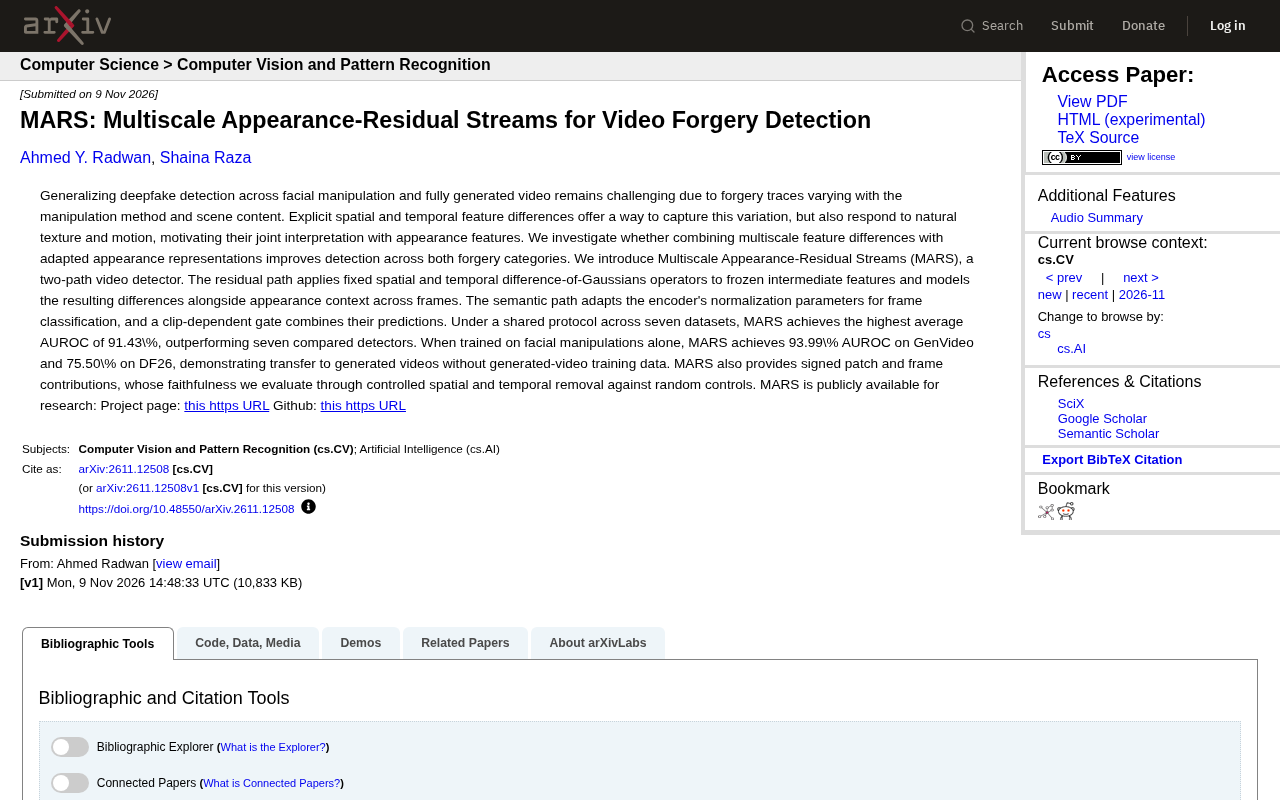
The Vector Institute proposes MARS to address insufficient cross-dataset generalization in deepfake detection caused by forgery traces varying with manipulation methods and scenes. MARS uses a dual-path video detection architecture: a residual path applies fixed spatial and temporal difference-of-Gaussians operators to frozen backbone features to generate multiscale difference features; a semantic path adjusts encoder normalization parameters for frame-level classification; clip-level gating dynamically weights the two predictions. Across seven datasets and seven comparison detectors, MARS achieves the highest average AUROC and transfers to fully generated video detection when trained only on face manipulation data. It also provides signed patch and frame contributions and evaluates explanation faithfulness via controlled removal experiments. Performance on real compressed videos and low-quality scenarios is not yet disclosed, and absolute cross-category transfer performance has room for improvement.
Deepfake detection faces a thorny dilemma: forgery traces vary with manipulation methods and scene content, causing models to generalize poorly across datasets. MARS (Multiscale Appearance-Residual Streams), proposed by the Vector Institute, attempts to solve this problem with a dual-path architecture—combining multiscale feature differences with adaptive appearance representations—and achieves leading average AUROC across multiple datasets.
Background: Why Forgery Traces Are Hard to Generalize
The core challenge of deepfake detection is that forgery cues are not fixed. Traces left by different manipulation methods (e.g., face swapping, expression reenactment, full-face generation) differ significantly in spatial and temporal dimensions, while the textures and motion of the scene content itself produce similar signals that interfere with the detector's judgment.
The paper points out that explicit spatial and temporal feature differences can indeed capture such variation, but these differences also respond to natural textures and motion. Therefore, relying on residual features alone is insufficient; they must be interpreted jointly with appearance features. The design of MARS is built around this insight.
AUROC (Area Under the Receiver Operating Characteristic Curve) is a common metric for evaluating the overall performance of a binary detector, ranging from 0 to 1. It measures the probability that, when a true sample and a fake sample are drawn at random, the model assigns a higher probability of being true to the true sample than to the fake sample. Compared with accuracy at a fixed threshold, AUROC is unaffected by class proportions and threshold choice, so it is often used in scenarios such as deepfake detection where positive and negative samples may be imbalanced and cross-dataset comparison is needed. "Average AUROC" in this article refers to the mean over multiple datasets or subsets, used to comprehensively reflect generalization ability.
MARS's Dual-Path Architecture
MARS is a two-path video detector that separately handles residual signals and semantic appearance.
Residual Path: Fixed Difference Operators Capture Forgery Traces
The residual path applies fixed spatial and temporal difference-of-Gaussians operators to frozen intermediate features to generate multiscale difference features. These differences are then modeled together with cross-frame appearance context. The key lies in "fixed" and "frozen": the operators do not participate in learning, and the backbone features are not updated, thereby preventing the model from overfitting to specific forgery patterns.
Difference-of-Gaussians (DoG) is a classic band-pass filtering operator: two Gaussian kernels with different standard deviations are used to smooth the image (or feature map) separately, and the results are subtracted, preserving edge and texture changes at a specific scale. In deepfake detection, the forgery process often leaves high-frequency or mid-frequency traces in manipulated regions that are inconsistent with the surrounding natural texture, and DoG can amplify such local differences at multiple scales. MARS extends DoG to the temporal dimension, performing similar differences on features of adjacent frames, thereby capturing both spatial texture anomalies and inter-frame motion anomalies. Because the Gaussian kernel parameters are fixed and do not participate in training, this operator acts as a prior "anomaly amplifier," reducing the model's overfitting to specific forgery patterns.
Semantic Path: Adaptive Normalization for Frame Classification
The semantic path adjusts the encoder's normalization parameters to adapt to the frame-level classification task. The predictions of the two paths are combined by a gating mechanism that depends on the video clip, enabling dynamic weighting. This design allows the model to flexibly balance residual cues and semantic cues across different clips.
Adaptive normalization refers to dynamically computing normalization statistics (mean, variance) based on input features at inference time, rather than using global statistics fixed from the training set. Common forms include Instance Normalization and AdaIN: the former normalizes each sample and each channel separately, while the latter uses external conditions to generate scaling and offset parameters. In MARS's semantic path, adjusting the encoder's normalization parameters is equivalent to letting the feature distribution adapt to the content of the current frame, enabling the same backbone network to better serve the frame-level real/fake classification task. This design does not change the backbone weights and only adjusts the affine parameters of the normalization layers, so it is computationally cheap and easy to parallelize with the residual path that uses frozen features.
Experimental Results: Outstanding Cross-Dataset Generalization
The researchers evaluated MARS on seven datasets using a unified protocol and compared it with seven competing detectors. MARS achieved the highest average AUROC, outperforming all comparison methods.
More noteworthy is its cross-category transfer ability: when trained only on face manipulation data, MARS achieved a high AUROC on GenVideo and also performed well on DF26, indicating that the model can transfer to fully generated video detection tasks without training on generated video data.
Interpretability: Signed Contributions and Faithfulness Evaluation
MARS also provides signed patch and frame contributions to explain the basis for detection. The researchers evaluated the faithfulness of these contributions through controlled spatial and temporal removal experiments compared with random controls. This provides a quantifiable validation path for the interpretability of deepfake detection, rather than remaining at the visualization level.
Explanation faithfulness measures whether the explanation truly reflects the model's decision basis, rather than merely appearing plausible. A common validation method is the controlled removal experiment: according to the important regions (patches or frames) given by the explanation, occlude or replace them and observe whether the model's output probability drops significantly; at the same time, compare with randomly removing the same number of regions. If the performance drop caused by removal according to the explanation is significantly greater than that caused by random removal, the explanation is considered faithful. MARS provides signed contribution values that can distinguish evidence supporting "real" from evidence supporting "fake," enabling such removal experiments to be conducted separately in the spatial and temporal dimensions, thereby quantifying the reliability of the explanations.
Industry Significance and Limitations
MARS's approach reveals a direction: the generalization of forgery detection should not rely on a single type of trace, but should improve robustness through joint modeling of multiscale residuals and appearance semantics. The combination of fixed difference operators and frozen features also reduces the model's dependence on the training data distribution.
However, the paper has not yet disclosed performance on real compressed videos and low-quality scenarios, and there is still room for improvement in the absolute performance of cross-category transfer. MARS has released its project page and GitHub repository for the research community to reproduce and further validate.
One-line Summary
MARS uses a dual path of fixed difference residuals and adaptive appearance to improve cross-dataset generalization of deepfake detection.
Paragraph Summary
The Vector Institute proposes MARS to address the problem in deepfake detection that forgery traces vary with manipulation methods and scenes, leading to insufficient cross-dataset generalization. MARS adopts a dual-path video detection architecture: the residual path applies fixed spatial and temporal difference-of-Gaussians operators to frozen backbone features to generate multiscale difference features; the semantic path adjusts the encoder's normalization parameters to adapt to frame-level classification; the two predictions are dynamically weighted by clip-level gating. In a unified evaluation across seven datasets and seven comparison detectors, MARS achieved the highest average AUROC and can transfer to fully generated video detection when trained only on face manipulation data. The model also provides signed patch and frame contributions and evaluates explanation faithfulness through controlled removal experiments. The paper has not yet disclosed performance on real compressed videos and low-quality scenarios, and there is still room for improvement in the absolute performance of cross-category transfer.
Related articles

From 0 to 1: Vibe Coding an AI Knowledge Base — A Practical Retrospective and Tech Stack Breakdown
A retrospective on building the AI knowledge base OilBook from scratch with Vibe Coding: Next.js+Neon stack, Oil Dev Skill workflow, Stripe paywall security, interview-style writing, AI-flavor control, and Vercel deployment.

GLM-5.4 Hands-On: Native Vision Meets a New Vibe Coding Workflow
Hands-on with Zhipu GLM-5.4: native vision tested across a 3D product demo, pure-code video generation, and remote-control Vibe Coding, compared with GPT-6.2 and Gemini Neon.

AI and Humans Claim to Prove the Riemann Hypothesis: Machine-Verified, Yet Nobody Can Understand It
Anthropic mathematician and AI Claude claim to prove the Riemann Hypothesis with 17 million lines of Lean code, machine-verified but unreadable by humans. This article analyzes the event, the zero proportion record from 41.6% to 67.2%, and the gap between machine verification and human understanding.