MATE: Preventing Successful Memories from Misleading Embodied Agents

MATE inserts deterministic action normalization between retrieval and execution to make historical trajectories truly reusable.
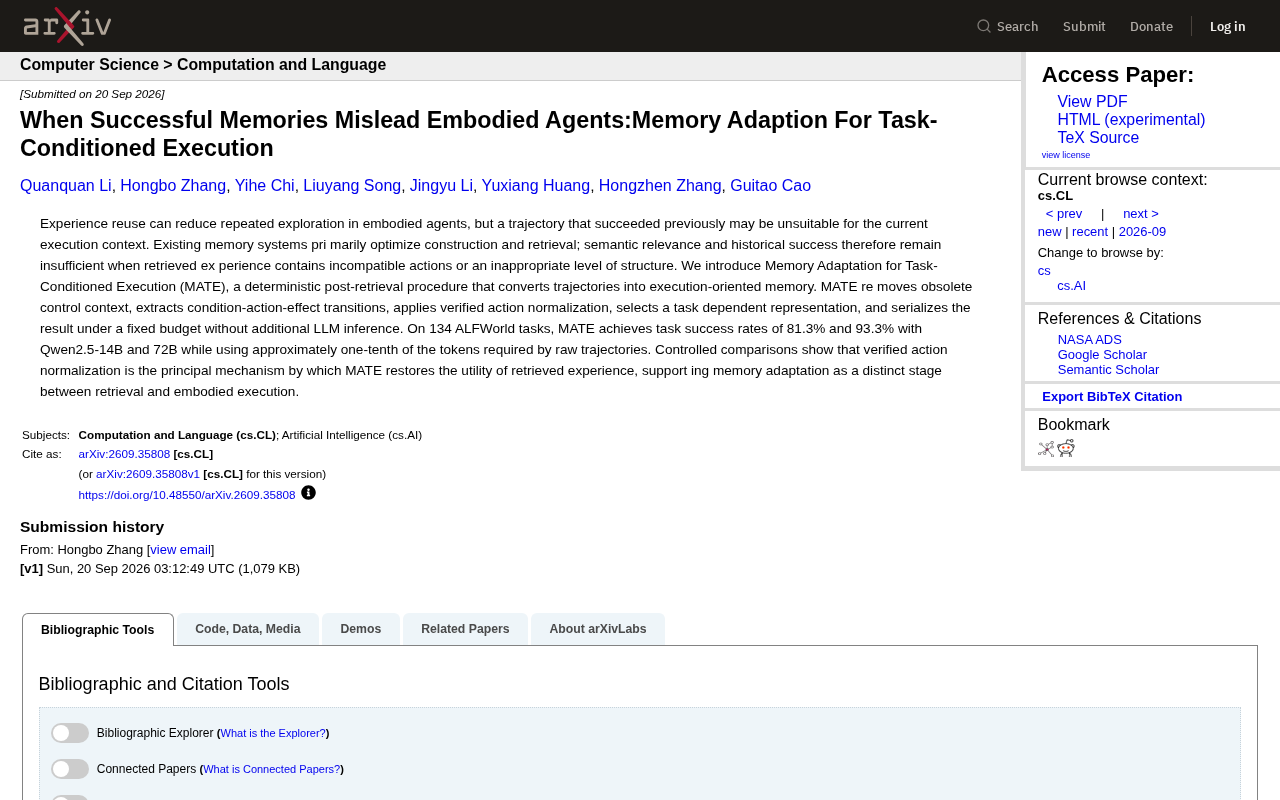
Embodied agents face a hidden trap when reusing past successful trajectories: semantically relevant experiences don't guarantee executable actions in the current environment. The paper proposes MATE, which adds an independent "memory adaptation" stage between retrieval and execution. Through deterministic steps — removing stale context, extracting condition-action-effect transitions, and applying verified action normalization — MATE converts raw trajectories into task-ready representations without any additional LLM inference. On 134 ALFWorld tasks, MATE achieves 81.3% and 93.3% success with Qwen2.5-14B and 72B respectively, while cutting token consumption to roughly one-tenth of raw trajectories. Ablation experiments confirm action normalization as the core mechanism.
When "Successful Memories" Become a Liability
When executing tasks, embodied agents often try to reuse past experiences to reduce the cost of repeated exploration. This seems perfectly reasonable — if a particular trajectory succeeded before, why not reuse it? But a newly published arXiv paper, When Successful Memories Mislead Embodied Agents, highlights a long-overlooked problem: a trajectory that succeeded in the past may not be applicable to the current execution environment.
The root cause is that most existing memory systems focus their effort on two phases: how to build memory and how to retrieve it. They rely on semantic relevance and historical success rates to judge whether a piece of experience is worth reusing. But when retrieved experience contains actions incompatible with the current scene, or when its structural hierarchy doesn't match the current task, semantic relevance and historical success are simply not enough. In other words, no matter how accurately something is retrieved, if the content itself doesn't fit, it will still lead the agent astray.
An embodied agent is an AI system that can perceive states, execute actions, and interact with its environment — physical or simulated. Its core distinction from purely text-based or conversational agents is that it must handle spatial relationships, object states, and continuous action sequences. In embodied agent memory research, mainstream approaches typically store historical trajectories as embedding vectors and retrieve the most semantically similar experiences for direct reuse when a new task arrives. This "store-retrieve-reuse" paradigm works reasonably well in static or highly controlled environments, but when the layout, object positions, or available action sets change, semantically similar trajectories can fail completely at the execution level — creating a mismatch where experiences are semantically relevant yet action-incompatible.
MATE: Adding the Missing Link Between Retrieval and Execution
To address this pain point, the researchers propose MATE (Memory Adaptation for Task-Conditioned Execution). Its core purpose is clear: it is a deterministic post-retrieval processing pipeline that transforms raw trajectories into execution-ready memory representations.
Notably, MATE argues that memory adaptation should exist as a distinct, independent stage between retrieval and embodied execution. This represents a conceptual reframing — where the field previously simplified systems into "retrieve then execute," MATE inserts a necessary step that "translates" experiences into a usable form.
MATE's Processing Steps
MATE applies the following operations sequentially to each retrieved trajectory:
- Remove stale control context: Strip out historical control information irrelevant to the current execution;
- Extract condition-action-effect transitions: Decompose the trajectory into structured causal units;
- Apply verified action normalization: The most critical mechanism in the entire pipeline;
- Select task-relevant representations: Dynamically choose appropriate memory representations for the current task;
- Serialize within a fixed budget: Compress the output to fit within a defined token budget.
One key point worth emphasizing: the entire pipeline requires no additional LLM inference. This means MATE is a deterministic, predictable processing logic — not another expensive large model call stacked on top. For deployment scenarios where cost control matters, this is a pragmatic design choice.
Condition-action-effect transitions are a structured representation method originating from planning and reinforcement learning. They decompose an action step into three elements: the preconditions that must be satisfied to execute the action (condition), the specific operation performed (action), and the resulting environmental change (effect). The advantage of this decomposition is that it transforms a linear action sequence into causally structured units, enabling the agent to determine whether a given action step is still applicable in the current environment — rather than blindly replicating the historical trajectory step by step. MATE uses these transition units as the basic granularity for subsequent action normalization.
Results: Higher Success Rates, Lower Token Consumption
The research team validated MATE on 134 ALFWorld tasks. ALFWorld is a widely used benchmark in embodied agent research, involving a series of operations in simulated home environments.
The results are compelling:
- With Qwen2.5-14B, task success rate reaches 81.3%;
- With the larger Qwen2.5-72B, success rate climbs to 93.3%;
- More importantly, MATE consumes approximately one-tenth the tokens of raw trajectories.
Achieving both higher success rates and a tenfold reduction in token costs simultaneously carries significant practical value. Raw trajectories are often verbose and noisy — feeding them directly to a model wastes context window space and risks confusing the model with irrelevant information. By refining memories, MATE addresses both cost and quality at once.
ALFWorld is an embodied agent benchmark that aligns a text-based game environment (TextWorld) with a visual simulation (AI2-THOR). Tasks span household operations such as picking up, placing, heating, cooling, and cleaning objects, requiring agents to navigate rooms and manipulate multiple objects to complete multi-step instructions. Because tasks require long-horizon planning over a large action space, ALFWorld is a common testbed for evaluating memory reuse and planning capabilities. It is worth noting that ALFWorld is a relatively controlled simulated environment with limited object types and room layouts — which is why the paper flags generalization to more complex real-world settings as an open question.
Core Insight: Action Normalization Is the Key
The paper's most valuable finding comes from its controlled comparisons. Through ablation analysis, the researchers confirm that verified action normalization is the primary mechanism by which MATE restores the usability of retrieved experiences.
This finding directly answers the central question raised earlier — why do previously successful memories mislead agents? The answer is that retrieved action sequences may contain specific actions incompatible with the current environment. If reused without modification, these "incompatible actions" become sources of failure. Action normalization transforms them into forms that are executable and verifiable in the current environment, thereby reactivating the value of historical experience.
This finding also supports MATE's broader argument: memory adaptation genuinely deserves to be treated as an independent research stage, not as a side concern handled incidentally during retrieval or execution.
Implications for Embodied Agent Research
MATE's approach offers several insights for embodied agent and agent memory system research. First, the bottleneck in experience reuse may not be "how accurately we retrieve" but "whether what we retrieve can be directly used" — prompting researchers to shift attention from retrieval optimization toward post-retrieval adaptation. Second, deterministic pipelines remain highly competitive in cost-sensitive scenarios — not every problem needs another LLM layer. Third, the empirical evidence identifying action normalization as the core mechanism points the way toward designing stronger memory adaptation methods in the future.
Of course, as a newly published preprint, MATE's validation is currently concentrated on the ALFWorld benchmark. Its generalization to more complex, open-ended real-world environments remains to be tested. But the perspective it introduces — memory adaptation as an independent stage — is a valuable contribution to the rapidly evolving field of agent memory architecture research.
Related articles

FastAPI: A High-Performance Python Framework and a Production-Ready API Development Powerhouse
FastAPI is a high-performance web framework based on Python type hints, supporting async and automatic OpenAPI docs. With over 100k GitHub stars, this article analyzes its core strengths, production readiness, and selection advice.

Tesla Optimus Begins Mass Production: Can the Goal of 20,000 Units Per Week Be Achieved?
Tesla Optimus officially begins mass production as Musk sets a target of 20,000 units per week. This article analyzes the supply chain challenges behind mass production, the real gap in capacity ramp-up, and the competitive landscape for humanoid robots.

PCL: A Minecraft Launcher with 8.5k Stars — Why Was It Written in VB.NET?
An in-depth analysis of PCL, the GitHub Minecraft launcher with 8,500+ stars: why it chose VB.NET, its features and China network advantages, and the limits of Windows-only.