Math or Statistics? A Guide to Choosing Your Undergraduate Major for AI/ML

A deep comparison of math vs. statistics undergrad degrees for aspiring AI/ML professionals.
This guide helps students deciding between a math or statistics undergraduate degree to enter AI/ML. It compares both majors on theoretical depth, career alignment with data science, graduate school flexibility, and practical skill gaps. The key takeaway: the difference between degrees matters less than self-taught programming, projects, and internships.
A Typical Crossroads
For many students hoping to break into AI/ML and data science but unable to gain direct admission to a Computer Science program, a common dilemma arises: should you choose Mathematics (BS Mathematics) or Statistics (BS Statistics) for your undergraduate degree?
A Reddit user recently posed this highly representative question. They had originally leaned toward a math major and had even mapped out a four-year self-study roadmap covering programming, Python, SQL, Data Structures & Algorithms (DSA), machine learning, and cloud computing. But after diving deeper into statistics, they began to wonder whether statistics might actually be the better fit for data science and AI/ML.
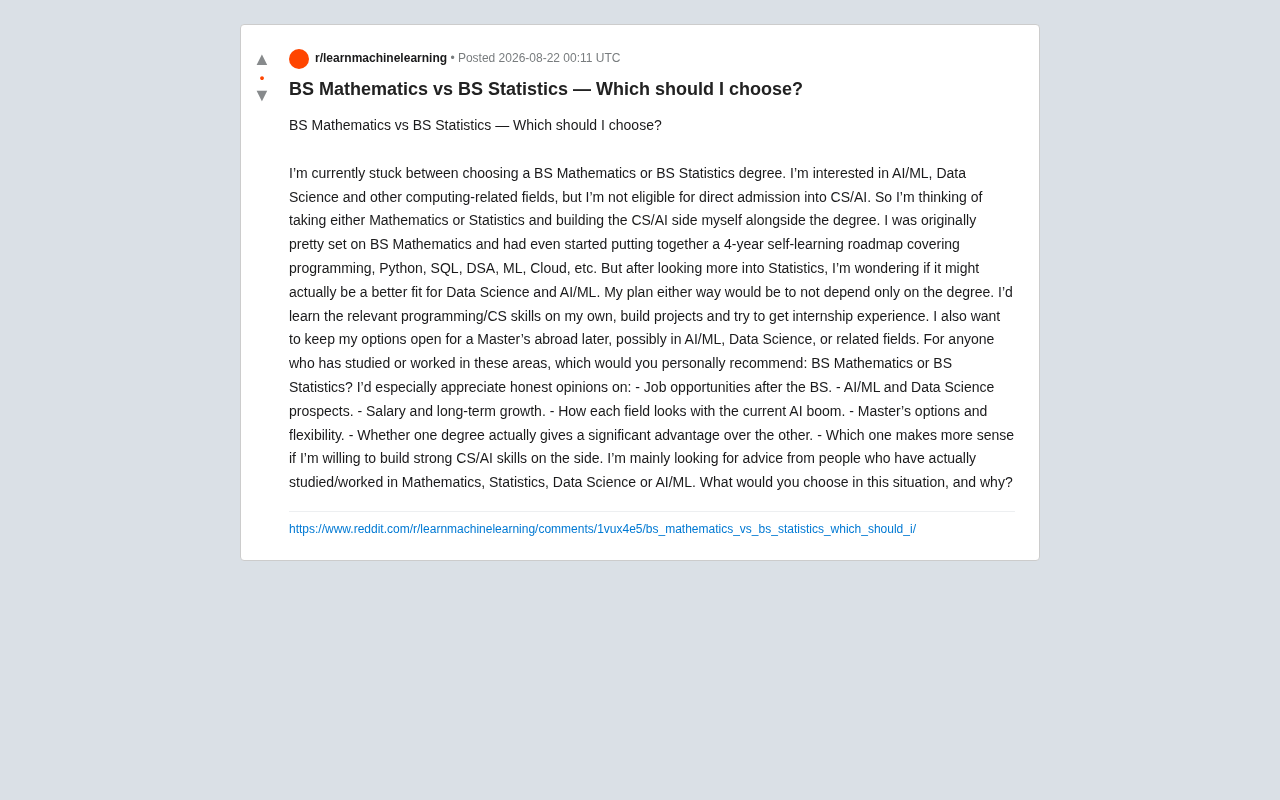
The deeper question lurking behind this choice is: When the standard CS path isn't available, how do you use an alternative undergraduate degree plus self-directed learning to maximize your chances of entering the AI field?
Math vs. Statistics: Differences in Underlying Logic
Mathematics: Abstract Thinking and Generalizability
A math major provides the most foundational and versatile intellectual training. Linear algebra, calculus, probability theory, optimization theory—these are the mathematical bedrock of modern deep learning. Backpropagation is essentially the chain rule, neural network training is an optimization problem, and the attention mechanism in Transformers is built on matrix operations.
Specifically, Backpropagation is the core algorithm for training neural networks, and it is essentially a systematic application of the Chain Rule from calculus. In a multi-layer neural network, the gradient of the loss function with respect to each layer's weights must be computed by propagating error signals layer by layer. The chain rule allows us to decompose the derivative of a complex composite function into a product of local derivatives at each layer, efficiently calculating how each parameter affects the final loss. This is precisely the core skill that math students train repeatedly in multivariable calculus courses. Understanding this mechanism not only helps with debugging models (such as identifying vanishing or exploding gradient problems) but also forms the theoretical foundation for designing new network architectures and optimization strategies.
The Transformer architecture, proposed by a Google team in the 2017 paper Attention Is All You Need, has become the foundation of modern large language models (such as GPT and BERT). Its core Self-Attention mechanism is essentially a series of matrix multiplication operations: the input sequence is linearly transformed into three matrices—Query (Q), Key (K), and Value (V). Attention weights are obtained by multiplying Q with the transpose of K, applying Softmax normalization, and then multiplying the result with V to produce the output. The entire process involves matrix multiplication, transposition, scaling, and other linear algebra operations. This means a solid foundation in linear algebra—including matrix decomposition, eigenvalue analysis, and vector space theory—is crucial for deeply understanding and improving Transformer architectures.
The strength of mathematics lies in its exceptional transferability. Someone with strong mathematical foundations will find it easier to understand the mathematical principles behind any new algorithm and will go further in research-oriented directions (such as AI theory and algorithm design). The trade-off is that math programs rarely teach data processing or hands-on modeling directly—these must be entirely self-taught.
Statistics: A Natural Affinity with Data Science
Statistics is more closely aligned with the day-to-day work of data science. Hypothesis testing, regression analysis, Bayesian inference, experimental design, sampling theory—these are direct tools for data analysis and machine learning modeling. In fact, many core concepts in machine learning (such as the bias-variance tradeoff, regularization, and model evaluation) originate from statistics.
The Bias-Variance Tradeoff is one of the central concepts in statistical learning theory. It reveals that a model's prediction error can be decomposed into three parts: bias (systematic error caused by overly simplistic model assumptions), variance (instability caused by the model being overly sensitive to fluctuations in training data), and irreducible error (noise inherent in the data itself). Low bias with high variance corresponds to overfitting, while high bias with low variance corresponds to underfitting. Regularization techniques—such as L1 regularization (Lasso) and L2 regularization (Ridge)—are tools developed by statistics to address this tradeoff. By adding penalty terms to the loss function to constrain model complexity, they strike a balance between bias and variance. These concepts run through the entire modeling process, from traditional linear regression to modern deep learning.
It's worth specifically mentioning that Bayesian Inference plays an increasingly important role in modern AI. Based on Bayes' theorem, this approach updates beliefs about parameters or hypotheses by combining prior knowledge with observed data. Unlike traditional frequentist statistical methods, Bayesian methods treat parameters as random variables rather than fixed values, naturally quantifying uncertainty. In modern AI, Bayesian optimization is used for hyperparameter tuning, Bayesian neural networks provide uncertainty estimates for predictions (which is especially important in high-stakes scenarios like medical diagnosis and autonomous driving), and Variational Inference forms the theoretical foundation for generative models such as Variational Autoencoders (VAEs). Statistics programs typically teach Bayesian theory systematically, providing direct knowledge preparation for understanding these cutting-edge methods.
For those hoping to quickly enter data science roles, statistics coursework often maps more directly to workplace scenarios. It also covers probability and mathematical foundations but places greater emphasis on how to extract valid conclusions from data.
Practical Considerations in the AI Boom
The Difference Between Degrees Is Overestimated
Based on the general consensus among practitioners, one sobering insight stands out: In AI/ML job hunting, the difference between a math and a statistics undergraduate degree is far smaller than most people imagine.
What truly determines competitiveness is programming ability, project experience, and internship history. Regardless of which major you choose, relying solely on the degree without proactively building a CS/AI skill stack will make it very difficult to stand out in a competitive market.
The strategy of "not relying solely on a degree, self-teaching programming, building projects, and securing internships" is actually more critical than the choice of major itself.
Key Skills in the Self-Study Roadmap
For non-CS students, several modules in the self-study roadmap deserve special attention.
Data Structures & Algorithms (DSA) is a foundational computer science course covering data organization methods such as arrays, linked lists, trees, graphs, and hash tables, as well as problem-solving strategies including sorting, searching, dynamic programming, and graph algorithms. In AI/ML engineering practice, DSA's importance manifests at multiple levels: efficient data preprocessing pipelines require well-designed data structures; large-scale model inference requires algorithm-level optimization to reduce time and space complexity; and nearly all tech company technical interviews center on DSA problems. For non-CS students, systematic DSA practice through platforms like LeetCode is essential preparation for clearing the job-hunting threshold.
Cloud computing has also become the infrastructure layer of modern AI/ML engineering. The GPU/TPU compute power needed to train large-scale deep learning models, distributed storage systems for massive training datasets, and containerized microservice architectures for deploying models as online services—all depend on elastic resources provided by cloud platforms. Major cloud providers like AWS (Amazon Web Services), Google Cloud Platform (GCP), and Microsoft Azure each offer complete AI/ML toolchains, including managed services like AWS SageMaker, Google Vertex AI, and Azure Machine Learning. Mastering at least one cloud platform's basic usage and understanding DevOps/MLOps concepts such as Docker containerization, Kubernetes orchestration, and CI/CD pipelines has become a standard requirement for data scientist and ML engineer positions—an essential component of any practitioner's self-study roadmap.
Career Directions and Salary Prospects
From an employment perspective, both majors can lead to roles such as data analyst, data scientist, and machine learning engineer, but the paths differ slightly:
- Statistics offers more directly relevant positions in data analytics, quantitative analysis, biostatistics, and financial risk management.
- Mathematics is more favored for roles requiring deep theoretical foundations (such as algorithm research, quantitative trading, and AI research), though these positions typically require a master's or even a doctoral degree.
Salary and long-term career growth depend more on individual skill depth and industry than on the undergraduate major label.
Flexibility for Graduate Studies
If you plan to pursue a master's degree abroad in AI/ML or data science, both majors provide a solid application foundation:
- A math background is well-received when applying to theory-oriented AI/ML programs, applied mathematics, and even statistics master's programs, as its mathematical preparation is considered more comprehensive.
- A statistics background also has advantages when applying to data science, statistics, and machine learning master's programs, with smoother course articulation.
One detail worth noting: many top AI/ML and data science master's programs explicitly list "linear algebra, probability theory, and programming ability" as prerequisites. Math majors are typically better prepared in the first two areas, while programming ability must be supplemented through self-study.
Advice for Those Facing This Decision
Taking everything into account, here are several practical recommendations:
1. If you enjoy abstract thinking and your goal leans toward research or a PhD: choose math. The theoretical depth that math provides offers greater long-term returns on the AI research path, and it gives you a wider range of options when applying to master's programs.
2. If you prioritize rapid employment and hands-on data work: choose statistics. Statistics has a higher skill overlap with data science and allows you to build demonstrable practical capabilities more quickly.
3. Regardless of which you choose, your self-study plan is the decisive factor. A systematic learning roadmap covering Python, SQL, DSA, ML, and cloud computing—combined with projects and internships—is what truly creates a competitive moat.
4. Focus on course details, not the major's name. Some math programs offer extensive statistics and computational courses; some statistics programs have rigorous math requirements. Carefully reviewing the specific curriculum is more meaningful than agonizing over the name of the major.
Conclusion
The choice between math and statistics is not fundamentally a question of "which is better" but rather "which better suits your personality and goals." In the AI boom, both are viable paths to data science and AI/ML.
The real difference isn't on the diploma—it's in whether you proactively build skills, accumulate projects, and pursue hands-on opportunities. Your choice of major is just the starting point; continuous self-directed learning is the key to reaching the destination.
Related articles

@ai-sdk/vue 3.0.306 Patch Release Syncs with [email protected] Update
@ai-sdk/vue 3.0.306 released, synced with [email protected]. A routine patch release for the Vercel AI SDK ecosystem with no public API changes; the Vue adapter layer stays version-aligned with the core package.

Gemini 4 Argon API Launches: The Era of Million-Token Output Begins
Google launches Gemini 4 Argon with sparse MoE architecture, up to 1M output tokens, and a 68.90% Vals Index score, available across API, AI Studio, and the Gemini app.

DukaanAI: Turning Product Photos into Inventory Lists with Open-Source AI
DukaanAI is an AI inventory tool for small retailers that turns product photos into inventory entries using the open-source Gemma 3 model, with local inference, editable fields, and CSV export.