MausBot: Open-Source Local Grok Bot for Free Multi-AI Agent Management

MausBot is a local-first, Apache 2.0 open-source AI agent aggregator that unifies multi-agent management via chat.
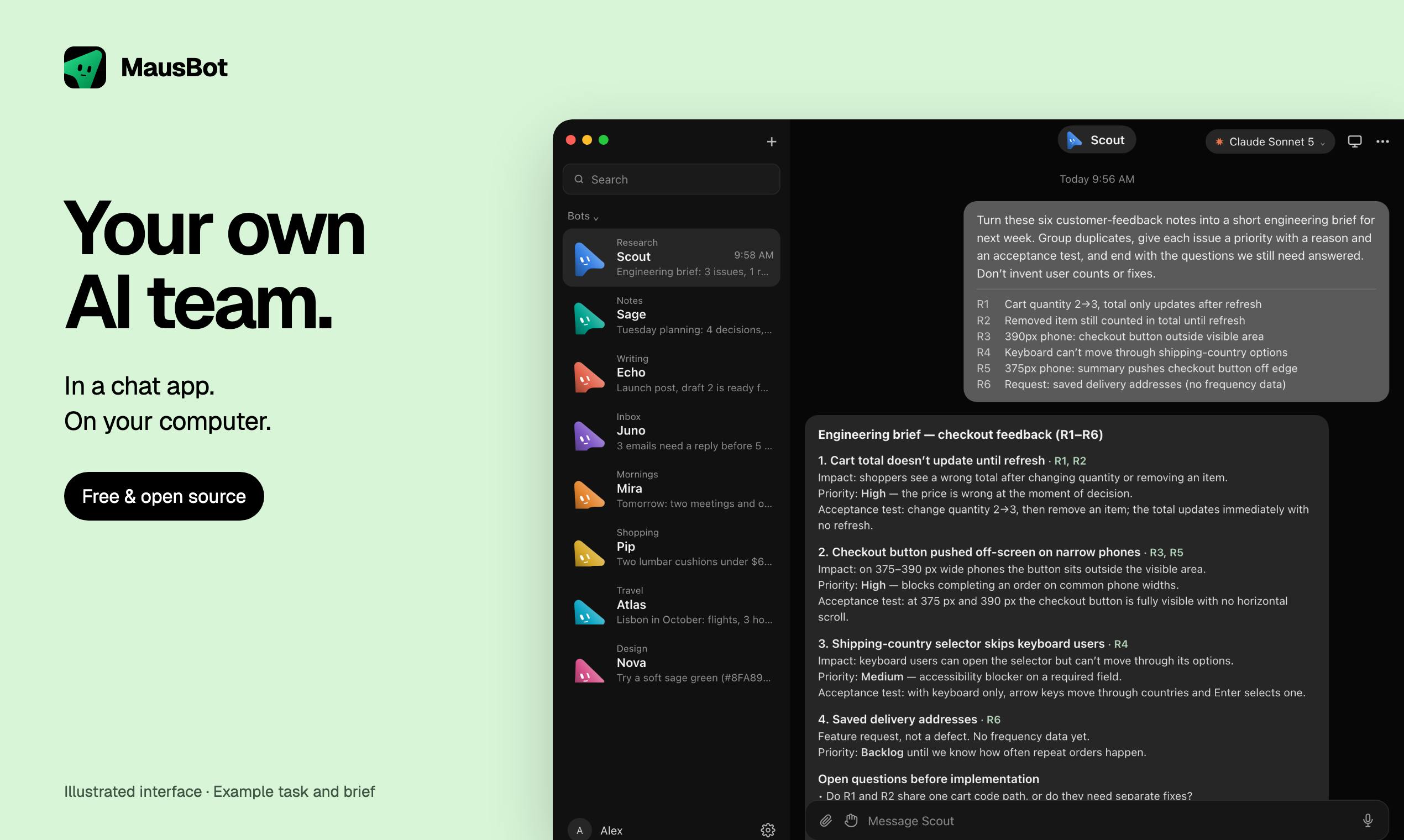
MausBot is an open-source AI agent management tool on Product Hunt, positioned as a local-first aggregator. It runs on the user's computer, lets you assign tasks to each bot, and collaborate via a familiar chat interface with built-in tools. Licensed under Apache 2.0 with a BYOK model, it keeps data local and is ideal for privacy- or cost-conscious users.
In an era where AI tools are increasingly fragmented, getting intelligent agents from different platforms to work together has become a headache for many developers and productivity enthusiasts. An open-source project called MausBot recently appeared on Product Hunt, aiming to solve this pain point with a "local + chat interface" approach.
Core Positioning: A Local-First AI Agent Aggregator
MausBot's tagline is "Open-source Grok bot: free, local." It is not a standalone AI model, but rather an agent management tool hosted on the user's own computer. According to the official description, you can assign a specific task to each bot and then collaborate with it through a familiar chat interface.
This means MausBot consolidates AI agents that were originally scattered across different platforms—especially those supporting models like Grok—into a single local entry point. The project is open-sourced under the Apache 2.0 license, and users need to bring their own service provider account or API key. Related costs and quota limits are determined by the service provider.
This model differentiates itself from current mainstream cloud-based AI orchestration tools: data and control stay local, making it suitable for users who are sensitive about privacy or cost.
What is an AI Agent?
An AI agent refers to an AI system that can autonomously perceive its environment, make decisions, and invoke tools to complete tasks—distinct from chatbots that only handle single-turn Q&A. A typical agent first understands the user's goal, then plans steps, invokes tools like search or code execution, and finally summarizes the results. Grok is a model launched by xAI that supports tool calling and real-time information retrieval, so it is often used as the brain of an agent.
The Difference Between "Local-First" and "Cloud Orchestration"
Cloud orchestration tools (such as various online Agent platforms) place task scheduling on the service provider's servers, requiring user data to be uploaded; MausBot, on the other hand, places scheduling logic on the user's own computer, keeping API keys and session records local, and only sending necessary requests to the model service provider. This architecture offers advantages in privacy compliance, offline availability, and controllability, at the cost of requiring users to maintain their own runtime environment and key security.
Chat Interface and Task Assignment Mechanism
MausBot emphasizes a "familiar chat interface," which lowers the barrier to entry. Users don't need to learn complex orchestration syntax—they simply give instructions to the bot as they would in everyday conversation.
Judging from the Product Hunt description, MausBot has built-in "tools and routines" to help accomplish actual work. Although the official description doesn't elaborate on technical details, it can be inferred that it supports binding specific tools to specific bots, thereby giving each agent specialized capabilities.
For users already using multiple AI services, this "one interface to manage all agents" approach can reduce the cost of switching back and forth. The 98 upvotes and 10 comments also indicate that the community has a real demand for localized, open-source AI workflows.
Open-Source Model and Cost Structure
MausBot chose the Apache 2.0 license, which is a highly business-friendly open-source agreement. Developers can freely use, modify, and even integrate it into their own projects, as long as they retain the copyright notice.
In terms of cost, MausBot itself is free, but users need to bear the costs of the AI service providers they connect to. This "BYOK" (Bring Your Own Key) model is becoming increasingly common in open-source AI tools—it returns pricing power to users while also avoiding the compliance risks of reselling APIs for the project team.
It's worth noting that the service provider's rate limits and billing rules still apply. For heavy users, MausBot can help you manage things uniformly, but it won't reduce the underlying invocation costs.
What the Apache 2.0 License Means
Apache 2.0 is an OSI-approved open-source license that allows commercial use, modification, distribution, and sublicensing, and includes explicit patent grant provisions, making it more suitable for enterprise integration than the GPL series. Users only need to retain the copyright and license notices and indicate modified files. For teams wanting to do secondary development or embed it into their own products, this is a low-barrier option.
The Practical Meaning of the BYOK Model
BYOK (Bring Your Own Key) means the software itself does not proxy model calls; instead, users fill in the API key they applied for from the service provider. The advantage is transparent pricing with no middleman markup, and the project team doesn't have to bear the compliance and risk control responsibilities of API resale; the cost is that users must manage key rotation and quota monitoring themselves, and if a key is leaked, the risk falls on the user.
Who Should Use MausBot
Judging from its product categories, MausBot is classified under productivity tools, open source, and artificial intelligence. Its target users roughly fall into two categories: developers who need to run multiple AI agents on their local machine, and productivity users who want to automate daily tasks through chat.
If you already have a Grok or other compatible service provider's API key and care about keeping data local, MausBot provides a lightweight integration solution. But if you expect a complete out-of-the-box AI experience, you still need to configure a service provider account first.
MausBot is currently ranked 10th on Product Hunt, launched by creators including Milind Soni. How the project actually performs still needs more users to try it out and verify, but the combination of "local + open source + multi-agent chat" has already hit a real market demand.
How to Tell If You Need It
If your current workflow is "switching between different AI services across multiple browser tabs," MausBot's value lies in converging these entry points into one place and managing them with a unified task assignment approach. If you only need daily Q&A from a single model, or are completely unwilling to deal with API key configuration, the benefits are limited. Additionally, running locally means you need an always-on machine and basic command-line or installation/configuration skills.
One-line Summary
MausBot is a local-first, Apache 2.0 open-source AI agent aggregator that unifies management of multiple agents through a chat interface.
Paragraph Summary
MausBot is an open-source AI agent management tool that appeared on Product Hunt, positioned as a "local-first aggregator." It is not a model itself, but a scheduling entry point running on the user's computer. Users can assign specific tasks to each bot and collaborate through a familiar chat interface, with built-in tools and routines supporting actual work. The project uses the Apache 2.0 license and adopts a BYOK model where users bring their own service provider API keys. The software is free, but underlying invocation costs and rate limits are still determined by the service provider. Data and control stay local, making it suitable for users who care about privacy or cost. It received 98 votes and 10 comments on Product Hunt, ranking 10th, reflecting real demand for localized, open-source AI workflows. Target users are developers who need to run multiple agents on their local machine, and productivity users who want to automate daily tasks through chat.
Related articles

How Big Can Stars Really Get? The Physical Limits of the Largest Stars
Red supergiants are the largest stars by volume, with radii up to 2,000 times the Sun, engulfing the inner solar system. But there is no precise upper limit on stellar size—models predict up to 15,000 solar radii. The most massive blue stars are far smaller than red supergiants—biggest and heaviest are two different things.

Apple HomeView Smart Display Full Feature Breakdown: Wall-Mount or Desktop, $299
Apple launches HomeView, a $299 smart display with wall-mount and desktop options, 12MP camera for facial recognition, smart home control, music playback, and recipe step-by-step cooking. Full breakdown of watch faces, apps, privacy, and cooking integration.

Where Did the Promised New Studio Go? Craft Computing Answers After Five Years
Craft Computing's host responds to viewer questions: the new studio promised five years ago was shelved as construction costs soared from $30,000 to $75,000, and was replaced by a 168-square-foot garage conversion.