MaxIM: An RL-Driven Framework for Optimally Informative Incremental Summarization

MaxIM uses information-theoretic reward shaping to solve credit assignment in incremental summarization, beating RL baselines on long-horizon tasks.
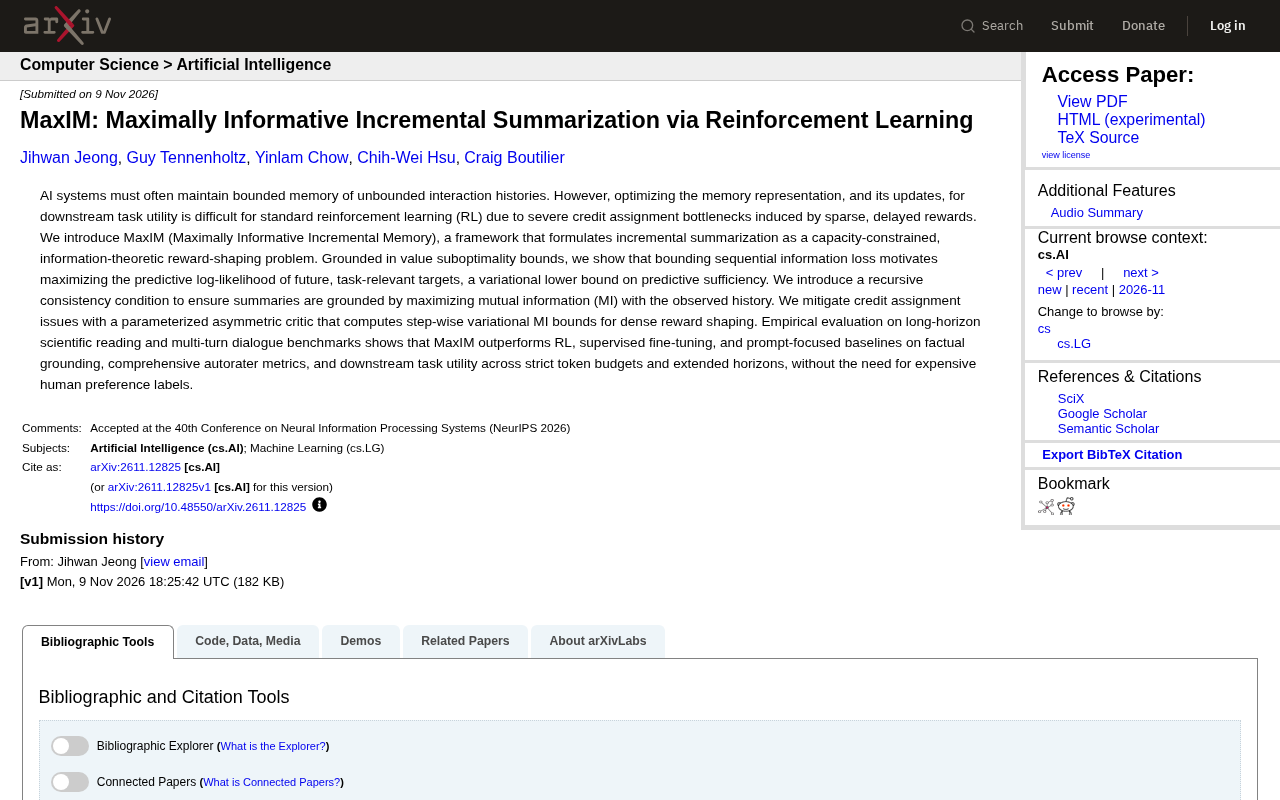
This article proposes MaxIM, which formulates incremental summarization for AI systems as information-theoretic reward shaping under capacity constraints. It overcomes the credit assignment bottleneck of sparse delayed rewards by proving that limiting information loss maximizes predictive log-likelihood of future task-relevant objectives, adding recursive consistency to maximize summary–history mutual information, and using a parameterized asymmetric critic to provide dense rewards via variational MI lower bounds. MaxIM outperforms RL, SFT, and prompt-focused baselines on long-horizon scientific reading and multi-turn dialogue without human preference labels.
Introduction
AI systems that handle unbounded interaction histories often need to maintain bounded memory. However, optimizing the memory representation and its updates to improve downstream task utility is very difficult for standard reinforcement learning (RL), mainly due to severe credit assignment bottlenecks caused by sparse, delayed rewards. This article introduces the MaxIM (Maximally Informative Incremental Memory) framework, which formulates incremental summarization as an information-theoretic reward shaping problem under capacity constraints. Through theoretical analysis and experimental validation, it outperforms baselines such as RL and supervised fine-tuning on multiple long-horizon tasks.
Core Problem and Challenges
The core tension facing AI systems is that interaction histories grow without bound while memory capacity is limited. To address this, systems must continuously perform incremental summarization, compressing history into a compact representation while retaining information useful for downstream tasks. Standard RL methods optimize summarization policies via sparse delayed rewards, but suffer from the credit assignment problem—it is hard to determine which parts of the history contributed to the final reward.
MaxIM is proposed precisely to address this bottleneck. From an information-theoretic perspective, it models the summarization process as an information maximization problem under capacity constraints and designs a dense reward shaping mechanism to alleviate credit assignment issues.
The credit assignment problem is one of the core challenges in reinforcement learning. It refers to the difficulty of determining which specific actions or states contributed to the final reward when an agent executes actions over multiple time steps and receives only delayed and sparse reward signals. In the incremental summarization setting, the summarization policy compresses historical information at each step, but downstream task rewards often appear only at the end of the sequence, preventing the model from effectively learning the quality of intermediate steps. Traditional methods such as Monte Carlo returns or temporal-difference learning perform poorly under high variance and sparse rewards, so dense reward shaping or auxiliary tasks are needed to mitigate this issue. MaxIM provides step-by-step reward signals through an information-theoretic lower bound, which is precisely a design targeting this bottleneck.
Method: Information-Theoretic Reward Shaping and Recursive Consistency
MaxIM's theoretical foundation lies in value suboptimality bounds. The authors prove that limiting sequence information loss promotes maximizing the predictive log-likelihood of future task-relevant objectives, which is a variational lower bound on predictive sufficiency. In short, a good summary should accurately predict the information needed for future tasks.
To achieve this, MaxIM introduces a recursive consistency condition, ensuring that the summary is grounded in history by maximizing the mutual information (MI) between the summary and the observed history. Specifically, summary updates must satisfy recursive consistency, i.e., the new summary should retain maximum mutual information with the history.
The credit assignment problem is alleviated through a parameterized asymmetric critic. This critic computes step-by-step variational mutual information lower bounds, providing dense reward signals that guide policy learning. This design avoids the high-variance problem under sparse rewards while requiring no expensive human preference labels.
The variational lower bound is a common tool in information theory and variational inference, used to provide an optimizable lower bound when mutual information or log-likelihood is difficult to compute directly. Specifically, when the true posterior distribution is intractable, a parameterized variational distribution is introduced to approximate it, and Jensen's inequality is used to derive a lower bound on the log-likelihood. The "variational lower bound on the predictive log-likelihood" mentioned in MaxIM means that by maximizing this lower bound, one indirectly maximizes the predictive likelihood of future task-relevant objectives, thereby ensuring that the summary retains the information required for predictive sufficiency. This technique makes the computation of mutual information differentiable and easy to optimize via neural networks, and it is the theoretical basis for the asymmetric critic providing dense rewards.
Mutual information (MI) measures the degree of statistical dependence between two random variables and is defined as the KL divergence between the joint distribution and the product of the marginals. In MaxIM, mutual information is used to quantify the information overlap between the summary and the observed history: the recursive consistency condition requires maximizing the mutual information between the new summary and the history to ensure that the summary does not lose key information from the history. However, exact computation of mutual information typically involves high-dimensional integrals and is difficult to handle directly, so a variational lower bound is used for estimation. By maximizing this lower bound, the model can learn compact yet information-rich summary representations, avoiding degeneration into irrelevant or redundant compression.
Experimental Evaluation: Advantages on Long-Horizon Tasks
MaxIM was empirically evaluated on long-horizon scientific reading and multi-turn dialogue benchmarks. Experimental results show that under strict token budgets and extended horizons, MaxIM outperforms RL, supervised fine-tuning, and prompt-focused baselines in factual grounding, comprehensive automatic evaluation metrics, and downstream task utility.
Interestingly, MaxIM requires no human preference labels, greatly reducing data annotation costs. In scientific reading tasks, the model must extract key information from long documents and answer follow-up questions; in multi-turn dialogue, the model must maintain dialogue state to generate coherent responses. MaxIM performs well in these scenarios, validating the effectiveness of its information-theoretic reward shaping.
Long-horizon tasks refer to task settings with long decision sequences and significant reward delays, such as long-document reading comprehension and multi-turn dialogue. Such tasks impose higher demands on memory management: the model must retain historical information spanning multiple steps under a limited token budget and use this information for subsequent reasoning. Compared with short-horizon tasks, the credit assignment problem is more severe in long-horizon tasks because the time interval between reward signals and key decisions is larger and sparsity is stronger. MaxIM's evaluation on scientific reading and multi-turn dialogue benchmarks is precisely intended to verify its ability to maintain information sufficiency and task utility under long-horizon conditions.
Conclusion and Outlook
Through information-theoretic reward shaping and recursive consistency conditions, MaxIM effectively addresses the credit assignment bottleneck in incremental summarization and achieves leading performance on multiple benchmarks. Future work can explore more complex task scenarios and more efficient computational implementations. This framework provides new ideas for applying reinforcement learning to memory management.
One-line Summary
MaxIM addresses the credit assignment bottleneck in incremental summarization via information-theoretic reward shaping, outperforming baselines such as RL on long-horizon tasks.
Paragraph Summary
This article proposes the MaxIM framework, which formulates incremental summarization for AI systems as an information-theoretic reward shaping problem under capacity constraints. To address the credit assignment bottleneck in standard reinforcement learning caused by sparse delayed rewards, MaxIM proves based on value suboptimality bounds that limiting information loss can maximize the predictive log-likelihood of future task-relevant objectives, and introduces a recursive consistency condition to ensure maximum mutual information between the summary and history. Meanwhile, a parameterized asymmetric critic computes step-by-step variational mutual information lower bounds to provide dense reward signals. On long-horizon scientific reading and multi-turn dialogue benchmarks, MaxIM outperforms RL, supervised fine-tuning, and prompt-focused baselines in factual grounding, automatic evaluation metrics, and downstream task utility, without requiring human preference labels.
Related articles

Prompt Engineering for Beginners: From Writing Prompts to Engineering Thinking
Starting from the essence and four functions of prompts, this article systematically explains the six-step process, four success criteria, learning value, and practical limitations of prompt engineering to help you build a complete understanding.

Anthropic Launches Nasdaq IPO: AI Giant's Listing and Risk Disclosures
Anthropic officially launches its Nasdaq IPO under ticker ANT, with market valuation expected to potentially exceed SpaceX's record. The prospectus devotes nearly 100 pages to AI risks, while first-half revenue grew over 14x but net losses widened sharply, reigniting the AI bubble debate.

Rust cURL Clone Uses 4,832 unsafe Blocks—Is the Memory Safety Myth Broken?
A Rust cURL clone uses 4,832 unsafe keywords, challenging Rust's memory safety narrative. We analyze what unsafe really means, compare Fil-C, and examine rewrite motives.