McDonald's Bets on AI Dynamic Pricing: Will Your Big Mac Get More Expensive?

McDonald's tests AI dynamic pricing for burgers, raising questions about algorithmic fairness, surveillance pricing, and consumer trust.
McDonald's is experimenting with AI-driven dynamic pricing that adjusts menu prices in real time based on foot traffic, time of day, weather, and other variables. While similar models have long existed in airlines and hotels, the key controversy is whether the algorithm helps consumers find cheaper windows — or simply extracts more money at peak demand. When pricing draws on individual behavioral profiles, fairness and privacy are both at stake, a practice regulators now call "surveillance pricing." McDonald's prior AI drive-thru pilot was scrapped after repeated errors, underscoring how difficult fast food AI deployment really is. At a deeper level, this experiment tests society's tolerance for a world where everything carries a dynamic price tag.
When AI Starts Setting the Price of Your Burger
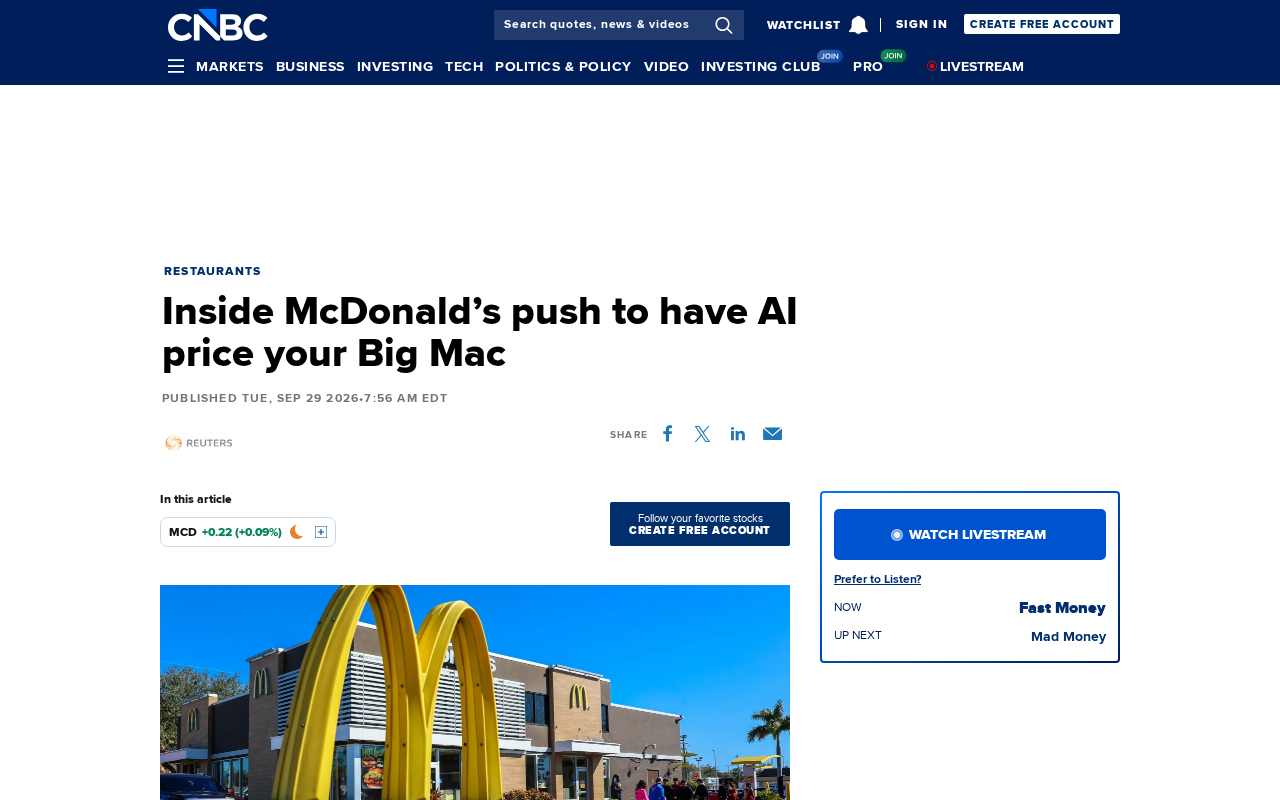
McDonald's is pushing forward with a potentially game-changing technological experiment — using artificial intelligence to dynamically price every Big Mac. The discussion thread on Hacker News hasn't generated massive traffic, but it touches on a deeply contentious issue: algorithmic pricing, long established in e-commerce and ride-hailing, is quietly making its way into people's everyday meals.
At its core, AI dynamic pricing means letting a system automatically adjust product prices based on real-time, multi-dimensional variables — supply and demand, time of day, weather, in-store foot traffic, and even individual consumer behavior. Airlines and hotels have been running this playbook for years. But when the same logic gets applied to a burger that costs a few dollars, consumer sensitivity and discomfort spike dramatically.
From Menu Boards to Algorithms: Rethinking the Logic of Pricing
Traditional fast food pricing is relatively fixed — a menu board might go months, even longer, without a price update. That transparency and stability is precisely the foundation of consumer trust in fast food brands. You know roughly what a Big Mac is going to cost you.
AI dynamic pricing attempts to dismantle that static structure. In theory, it could help McDonald's maximize revenue during peak hours and stimulate demand during slow periods by lowering prices — a more granular approach to revenue management. The widespread adoption of digital menu boards provides the hardware backbone for real-time price changes; the numbers on screen can be refreshed within seconds.
For the business, this is an attractive efficiency play: better returns per square foot, less waste, pricing that more closely tracks the demand curve. But technical feasibility doesn't automatically translate into commercial wisdom — and it certainly doesn't mean consumers will accept it.
Revenue management traces its roots to the deregulation of the U.S. airline industry in the 1970s, when American Airlines pioneered the SABRE system to dynamically adjust fares based on seat availability and booking windows. The methodology later expanded to hotels, car rentals, and ride-hailing — Uber's surge pricing is perhaps the most familiar example for consumers. Its mathematical foundation is price discrimination theory: charging different prices to consumers with different willingness to pay in order to maximize total revenue. What makes fast food uniquely challenging is that consumers have an extremely low tolerance for price fluctuations, and purchasing decisions are often impulsive and immediate. That means if a price hike exceeds expectations, a customer can walk straight across the street to a competitor — unlike airline tickets, there's virtually no switching cost.
The Central Controversy: Whose Interests Is This Optimizing?
The sharpest critique of this kind of practice has always been the same: is AI pricing designed to offer consumers better deals during off-peak hours, or to precisely extract higher prices when consumers are willing to pay them?
The line between the two is razor-thin. When a system detects that a location's lunch rush is perpetually packed, does it choose to lower prices to redistribute demand — or raise them to capture more margin? Commercial logic tends toward the latter. This is precisely why so-called "surveillance pricing" has drawn regulatory scrutiny. When pricing begins to draw on individual consumer profiles and behavioral predictions, both fairness and privacy boundaries come under serious pressure.
The brief discussion on Hacker News represents a limited sample, but the tech community broadly remains wary of such applications, worried that algorithmic black boxes will tilt the information asymmetry even further in companies' favor.
The concept of "surveillance pricing" drew formal attention from the U.S. Federal Trade Commission (FTC) in 2024, when it sent inquiry letters to eight pricing software vendors — including Mastercard and Revionics — demanding disclosure of how they use consumer personal data to set individualized prices. The key difference between surveillance pricing and traditional dynamic pricing is granularity: the former can profile individual consumers based on purchase history, geolocation, device type, and even credit scores to determine the price shown to each person — without them ever knowing. At the legal level, the U.S. has no federal legislation explicitly regulating personalized pricing, but the EU's Digital Markets Act (DMA) has begun requiring platforms to disclose their personalized pricing logic. This regulatory divergence will have profound implications for how multinational companies structure their strategies.
The Fast Food Industry's AI Ambitions vs. Reality
It's worth noting that this isn't McDonald's first stumble with AI. The company previously tested an AI voice assistant for drive-thru ordering, only to watch it go viral on social media for repeatedly mishearing customers and adding absurd items to their orders — leading the company to shut down several pilot locations. That episode illustrates how much harder AI deployment is in fast food environments than any lab demo would suggest.
Dynamic pricing faces an even more subtle challenge — it's not just a technical problem, it's a trust problem. The moment consumers start sensing that "someone else paid less for the same burger" or that "prices go up exactly when you want to eat," brand affinity can collapse fast. One of fast food's core competitive advantages is predictable affordability, and algorithmic pricing is inherently in tension with that predictability.
The Deeper Significance of This Experiment
McDonald's latest attempt is fundamentally a litmus test for the boundaries of AI technology. It's testing not just whether algorithms can price more intelligently, but also how much tolerance society has for the trend of making everything dynamically priced.
Zooming out: once AI has the ability to sense and predict individual behavior in real time, the pricing of nearly any product or service can be "personalized." That represents enormous efficiency gains — but also a potential erosion of consumer agency. How regulators, industries, and the public draw the rules of this game will shape far more than just the price of a Big Mac.
Regardless of how far McDonald's ultimately pushes this initiative, it serves as a reminder: when AI enters everyday consumer life, it rarely arrives in dazzling form. More often, it hides behind a number on a screen that quietly keeps changing.
Related articles

Felix Rieseberg Personal Homepage
Felix Rieseberg's personal homepage sparks attention on Hacker News. This article covers the Slack engineer's technical background, the rise and fall of nativefier, and the value of a developer homepage as a tech calling card.

@ai-sdk/vue 3.0.306 Patch Release Syncs with [email protected] Update
@ai-sdk/vue 3.0.306 released, synced with [email protected]. A routine patch release for the Vercel AI SDK ecosystem with no public API changes; the Vue adapter layer stays version-aligned with the core package.

Gemini 4 Argon API Launches: The Era of Million-Token Output Begins
Google launches Gemini 4 Argon with sparse MoE architecture, up to 1M output tokens, and a 68.90% Vals Index score, available across API, AI Studio, and the Gemini app.