MCP Events Are Here: Let the World Trigger Your AI Agents

MCP events let AI agents respond autonomously to environmental changes, not just user prompts.
OpenAI's support for the proposed MCP events specification signals a fundamental paradigm shift in AI agent architecture. Instead of interactions always starting with a user, MCP servers can now proactively broadcast state changes — new messages, comments, or tasks — directly triggering agent workflows. This transforms agents from passive Q&A tools into continuously running, event-driven software entities. But with this evolution comes a familiar set of distributed systems engineering challenges: idempotency, retry logic, event ordering, authorization boundaries, and auditability — requiring developers to adopt an entirely new engineering methodology.
From "User-Initiated" to "Event-Driven": A Paradigm Shift
For a long time, our mental model of MCP (Model Context Protocol) was essentially fixed: a user asks a question, the agent reasons, calls a tool, and returns a result. The interaction always started with a human. This one-directional "agent → tool" pattern has been the foundational logic of virtually every AI application built so far.
But OpenAI recently added support for a proposed MCP events specification — and it may fundamentally change that mental model. Under the new design, an MCP server can now proactively declare that "something has changed" — for example, a message was created, a comment was added, or a new task appeared. These events can then directly trigger an agent's workflow.

The interaction chain therefore evolves from "agent → tool" to "event → agent → tool → action." The starting point is no longer a person — it's the environment itself.
MCP (Model Context Protocol) is an open protocol proposed by Anthropic in late 2024, designed to standardize how AI models communicate with external tools and data sources. Much like USB-C provides a universal interface for hardware devices, MCP gives AI applications a common "tool-calling" specification, enabling AI models from different vendors to connect consistently with file systems, databases, API services, and other external resources. In its original design, MCP followed a request-response pattern: the client (typically an AI model or agent) initiates tool call requests, and the server executes and returns results. This model is inherently passive and synchronous. The events extension that OpenAI has now backed introduces server-side push capabilities on top of the existing protocol, allowing MCP servers to broadcast event notifications to subscribers whenever state changes occur — a fundamental expansion of the protocol's communication direction.
A Real-World Scenario: From Bug Report to Automatic Fix
Imagine this workflow: someone reports a bug in Slack. The event fires, the agent reads the message, checks the code repository, reproduces the issue, writes a fix along with test cases, and submits a draft Pull Request.
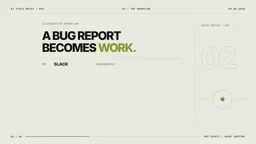
There's no polling loop. No one has to manually kick off the agent. The environment becomes the trigger, and the agent behaves like a software process on standby — automatically responding whenever the world changes.
This might sound like a minor improvement, but it strikes at the core assumption of agent architecture: agents are no longer passive question-answering machines waiting for instructions. They become continuously running systems capable of sensing external state changes and acting on them proactively.
Why This Changes the Agent Mental Model
Many agents today are still stuck in the same loop: prompt, reasoning cycle, tool call, answer. It's a short-lived, single-interaction pattern.

Truly long-running agents need a structure that more closely mirrors reality: events, state and memory, reasoning, tools, actions — and then new events. It's a continuous, stateful cycle, not a one-off exchange.
The core insight here is worth sitting with: the next evolution of MCP may not be about adding more tools — it may be about giving agents a standardized way to know when the world has changed. Tools solve "what can be done"; events solve "when to do it." The latter is precisely the missing piece that separates agents in demos from agents in production.
Old Distributed Systems Problems, Now Knocking on Agents' Door
Once an agent becomes event-driven, persistent software, a familiar set of engineering challenges arrives with it. These are problems the distributed systems community has been studying for decades:

- Idempotency: Will processing the same event multiple times cause duplicate operations?
- Retries and deduplication: How do you retry failed event deliveries? How do you prevent side effects from duplicate delivery?
- Event ordering: How do you ensure correct processing logic when events arrive out of order?
- Authorization: When an event triggers agent actions, how are permission boundaries defined?
- State consistency: How do you maintain consistent state during long-running processes?
- Fault recovery and auditability: How do you roll back after an error? Are all automated actions traceable?
In other words, when an agent evolves from "chatbot" to "event-driven background service," the challenges it faces are no longer just prompt engineering problems — they're real distributed systems engineering problems.
Idempotency is a foundational concept in distributed systems: it means that executing the same operation once produces exactly the same result as executing it multiple times. In event-driven systems, because networks are unreliable, messages may be delivered more than once (at-least-once delivery). If the processing logic isn't idempotent, duplicate processing leads to data corruption — for example, the same bug report triggering two PR submissions. Traditional solutions include assigning a unique ID to each event and recording its processed state, or using database unique constraints to prevent duplicate writes. For agents, this challenge is even more complex: AI reasoning is not deterministic. Even with identical inputs, two executions may produce different code changes. How to define "agent-level idempotency" has no industry consensus yet — and this is one of the key engineering hurdles standing between experimental event-driven agents and production-grade ones.
Closing Thoughts
The MCP events specification is still in the proposal stage, but OpenAI's early backing sends a clear signal: the future form of AI agents may be event-driven, persistently running software entities — not passive conversational tools.
For developers, this is both an opportunity and a reminder. Building next-generation agents may require revisiting the distributed systems playbook. Sensing when the world changes is just the first step. Responding to those changes reliably and auditably — that's where the real challenge lies.
Related articles

Chain of Thought Isn't Just for AI: How Humans Can Use CoT to Improve Thinking Quality
Chain of Thought isn't just a prompt trick for large models. Starting from a Hacker News discussion, this article analyzes why CoT works for human thinking too, breaks down actionable ways to transfer it, and highlights the key differences between human CoT and machine CoT.
Cloudflare Teams Up with OpenAI: Closi…
Cloudflare Teams Up with OpenAI: Closing the Loop from Vulnerability Discovery to Defense with AI
Cloudflare uses OpenAI Daybreak to investigate security vulnerabilities and generate reviewable remediation plans, while developers use Codex to boost coding efficiency and quality.

Orca Multi-Agent Orchestration in Practice: A Guide to Parallel Collaboration with Claude and Codex
Orca is Stable AI's free open-source agent workbench supporting 34 agents like Claude Code and Codex in parallel. Learn its Git worktree isolation, multi-model orchestration, and mobile management.