MCP Protocol Explained: Bridging the Gap Between LLMs and Traditional Software

MCP is the standardized bridge that lets LLMs call traditional software systems, enabling reuse of existing business assets.
MCP (Model Context Protocol) is a protocol that enables large language models to connect with external tools and traditional business systems in a standardized way. Traditional software interfaces are designed for program-to-program communication, which LLMs cannot directly interpret. MCP solves this by providing each tool with a natural-language description and structured metadata, allowing models to semantically match and invoke the right capabilities — without changing any underlying business logic. Released as open source by Anthropic in late 2024, MCP uses a client-server architecture supporting Tools, Resources, and Prompts, and has become a foundational layer in modern Agent development.
In the Agent development ecosystem, MCP (Model Context Protocol) has become an unavoidable core component. Many developers new to large language models find it both familiar and elusive — they've heard the name, but can't quite articulate what problem it actually solves, or how it differs from a Skill. This article, based on public course content from Teacher Shanshan of the Mashi Group on Bilibili, explains MCP's working mechanism and its necessity in the most straightforward way possible.
What Is MCP: A Protocol Connecting LLMs to the Outside World
At its core, MCP is a protocol. Its purpose is to allow large language models to connect with external tools, external business systems, and traditional development interfaces in a standardized way.
The easiest analogy for "protocol" is the HTTP protocol. When you make a request and receive a response on the internet, the entire interaction follows the HTTP protocol. The essence of a protocol is a set of rules and constraints. MCP works the same way — it's an agreed-upon set of rules that governs how a large language model interacts with external tools.
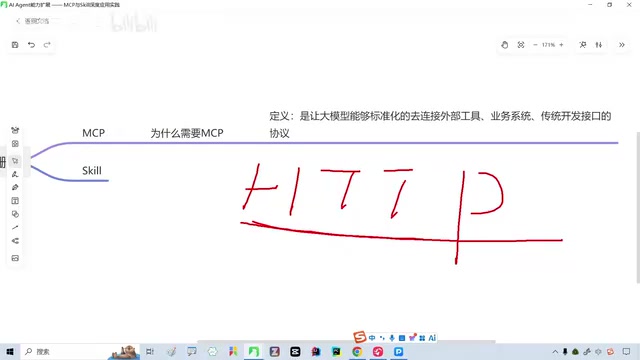
The definition alone may still feel abstract. To truly understand the value of MCP, we need to first step back into the software development world that existed before large language models.
MCP (Model Context Protocol) was officially released and open-sourced by Anthropic in November 2024, with the goal of becoming a universal standard for AI assistants to connect with external data sources and tools. It adopts a client-server architecture: the MCP Client is typically embedded in AI applications (such as Claude Desktop, Cursor, etc.), while the MCP Server is implemented by tool or business system developers to expose capabilities externally. The two communicate via a standardized JSON-RPC protocol, supporting three core capability types: Tools, Resources, and Prompts. This layered design means that any AI application following the MCP specification can seamlessly connect to any tool service that also follows the MCP specification — truly achieving "implement once, use everywhere."
Why MCP Is Needed: Traditional Interfaces Are Built for Programs, Not LLMs
Before large language models became widespread, the software industry had already accumulated an enormous number of systems. Developers working in Java, C++, Go, or PHP may have spent a decade building large volumes of mature business systems.
Take an e-commerce system as an example: it typically contains a large number of interfaces such as product query and inventory query. When exposing access externally, developers would publish an endpoint — for instance, a GET request to a path like /product/query. The frontend calls the backend through this path, which in turn calls specific services and accesses the database, ultimately returning a product list.
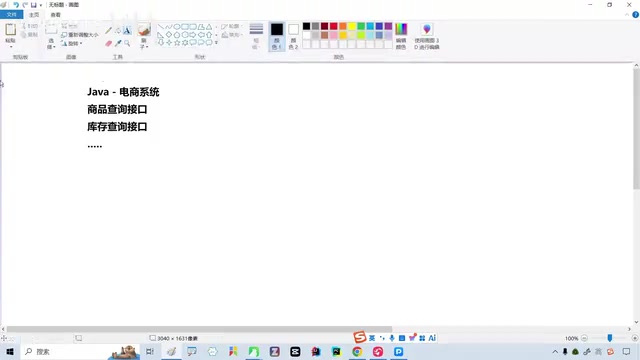
The key issue is this: these traditional interfaces are designed for programs, not for large language models. Programs can understand each other's parameters, methods, and return values — but a large language model cannot. If you hand a raw interface directly to GPT, it has no idea what the interface does or what parameters to pass.
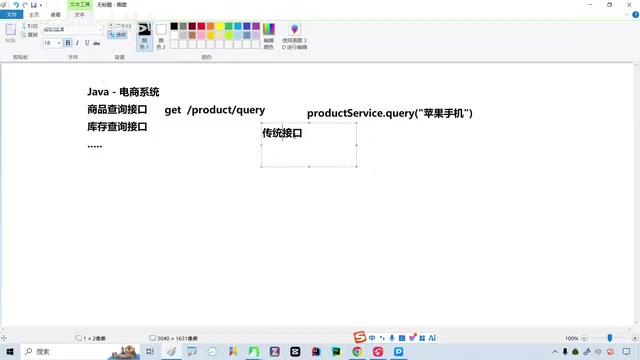
What a large language model actually needs is a tool description it can understand. That means describing in natural language (Chinese, English, or otherwise) what a tool does — for example, "query inventory" — rather than dumping the raw implementation details of an underlying interface at it. MCP was created precisely to solve this problem: helping large language models understand what tools can do, and enabling them to call existing software functionality.
How MCP Works: Wrapping Existing Systems into Tools for LLMs to Call
Once the pain point is clear, MCP's working mechanism becomes straightforward. Take an e-commerce system's search interface as an example: you can wrap it into an MCP tool. There's no restriction on programming language — any interface written in any language can be wrapped. Once wrapped, the large language model simply calls this tool.
The full call chain looks like this: a user makes a request, which is passed through an Agent to the large language model. The model understands the need — "I need to query product information" — and finds a corresponding MCP tool, then calls it directly. Behind the scenes, the tool still invokes the same original logic — going through the service layer and hitting the database for the query.
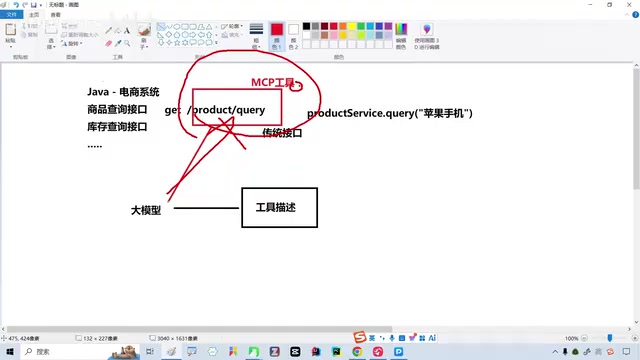
This brings an important benefit: existing business logic does not need to be rewritten. The complete logic for querying products was already implemented long ago. All you need to do is wrap the legacy system into an MCP tool for the large language model to call.
At the technical implementation level, the tool description in MCP is the critical hub of the entire call flow. Each MCP tool must provide structured metadata, including the tool name (
name), a functional description (description), and a JSON Schema definition of its parameters. When reasoning, the large language model reads this metadata as context and uses semantic understanding to determine whether the current task requires calling a tool and what parameters to pass — a process known as "Function Calling" or "Tool Use." As a result, the quality of the tool description directly affects the accuracy of the model's calls: the clearer the description and the more detailed the parameter explanations, the more accurately the model can match and invoke the tool. This is the aspect of MCP Server development that deserves the most careful attention.
The Core Value of MCP: Reusing Traditional Software Assets
MCP's significance can be summed up in one sentence: it bridges the gap between large language models and the traditional software world.
Before large language models emerged, Java systems were Java's, Python systems were Python's, and LLMs were LLMs' — each independent, with no direct connection between them. The rise of large language models doesn't mean that all the traditional business systems built up over the years should be thrown away and rebuilt from scratch — that's neither realistic nor necessary.
The practical approach is: keep existing systems unchanged, and use the MCP protocol layer to allow large language models to reuse those existing business capabilities. This is the fundamental reason MCP has taken off so quickly — it builds a standardized bridge between emerging large language model technology and the vast existing base of software assets.
The distinction between MCP and the commonly encountered concept of "Skill" is worth a brief note. Skills are typically functions defined within an AI framework (such as Microsoft Semantic Kernel), tightly coupled to that framework with limited cross-platform reusability. MCP, by contrast, is an open protocol that is cross-framework and cross-language — as long as a system implements the MCP Server interface, it can be called by any AI application that supports an MCP Client, regardless of the technology stack. Additionally, a large number of ready-to-use MCP Server implementations have already emerged in the market, covering common scenarios such as file systems, databases, GitHub, Slack, and browser control. Developers can integrate these directly without building from scratch, further lowering the barrier to adoption.
Summary
The core logic of MCP is not complicated: traditional interfaces are designed for programs, which LLMs cannot understand; MCP uses a standardized protocol and natural-language tool descriptions to let large language models comprehend and invoke these capabilities; and the underlying implementation continues to reuse existing systems without any redundant development. Understanding the principle of "reuse what exists, connect both ends" is grasping the most essential value of MCP. More advanced topics — such as the specific differences between MCP and Skills, and Codex integration — can be explored further once the foundational mechanism is solidly understood.
Related articles

How Big Can Stars Really Get? The Physical Limits of the Largest Stars
Red supergiants are the largest stars by volume, with radii up to 2,000 times the Sun, engulfing the inner solar system. But there is no precise upper limit on stellar size—models predict up to 15,000 solar radii. The most massive blue stars are far smaller than red supergiants—biggest and heaviest are two different things.

Apple HomeView Smart Display Full Feature Breakdown: Wall-Mount or Desktop, $299
Apple launches HomeView, a $299 smart display with wall-mount and desktop options, 12MP camera for facial recognition, smart home control, music playback, and recipe step-by-step cooking. Full breakdown of watch faces, apps, privacy, and cooking integration.

Where Did the Promised New Studio Go? Craft Computing Answers After Five Years
Craft Computing's host responds to viewer questions: the new studio promised five years ago was shelved as construction costs soared from $30,000 to $75,000, and was replaced by a 168-square-foot garage conversion.