MCP Protocol Explained: The Universal Interface Connecting AI Agents to Everything

MCP is Anthropic's open standard for AI tool connectivity, now adopted by OpenAI, Google, and Microsoft as a de facto industry norm.
The Model Context Protocol (MCP) is an open standard from Anthropic designed to replace fragmented custom AI integrations with a universal "plug." Its client-server architecture lets any MCP-compatible AI application connect to any MCP server, enabling a build-once, use-everywhere approach. The standard quickly gained widespread community adoption and the backing of OpenAI, Google DeepMind, and Microsoft — with Microsoft committing to native MCP support in Windows. Researchers have also flagged serious security concerns, including prompt injection attacks and malicious servers, highlighting the need for stronger authentication and permission controls as the ecosystem matures.
One Open Standard to Connect AI to Almost Anything
As people began expecting AI assistants to do more than just chat — to read files, query databases, and operate applications — a thorny engineering problem emerged: every new connection had to be built by hand, and each model-tool pair required its own custom integration. The more combinations there were, the more the integration work multiplied exponentially. This fragmented reality is exactly what the Model Context Protocol (MCP) was designed to end.
Anthropic defines MCP as an open standard, and its official documentation offers a fitting analogy: it's like a USB-C port for AI applications. Just as a single unified connector replaced the chaos of proprietary chargers and cables, MCP aims to replace the patchwork of custom AI integrations with one common language.
From Fragmented Integrations to a Common Language
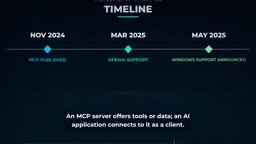
MCP was released as open source, bundled with a set of ready-made connectors for popular tools. Its architecture is straightforward: an MCP server exposes tools or data, while AI applications act as clients that connect to those servers. This clear separation of concerns means developers only need to implement the standard once, and their server becomes callable by any MCP-compatible agent.
This "build once, use everywhere" quality quickly ignited community enthusiasm. Thousands of developers jumped in, producing servers for code editors, calendars, design tools, and more. The nightmare of rebuilding integrations for every model-tool combination was compressed into a single shared protocol.
On the technical side, MCP's client-server communication is built on JSON-RPC 2.0 and supports three core primitives: Tools (callable functions for the model to perform actions), Resources (data exposed for the model to read), and Prompts (reusable prompt templates encapsulating interaction workflows). Servers communicate with clients via either standard input/output (stdio) — suited for local processes — or HTTP+SSE (Server-Sent Events) for remote deployment. This design allows MCP servers to be implemented in any programming language, as long as they conform to the protocol spec. Anthropic officially provides SDKs for both Python and TypeScript, significantly lowering the barrier for developers.
Major Players Fall in Line, Standard Becomes Fact
MCP's real weight became apparent in how the major players responded. After Anthropic's launch, OpenAI announced support for MCP across its agent tools; Google DeepMind and Microsoft followed. When competing frontier labs all rally behind the same interface standard, that protocol stops being one company's proposal and becomes the industry's de facto standard.
Microsoft went a step further, announcing that Windows would natively support MCP. Integration at the operating system level means MCP is no longer just an option in a developer's toolchain — it has a real shot at becoming the underlying infrastructure through which everyday users interact with AI agents.
Why This Matters
The significance of a shared standard is simple: any agent can work with any tool. In the past, even the most capable AI model was constrained by the walls keeping it out of the real world. MCP untangles that mess into a single universal plug, giving agents the ability to call external resources and complete real-world tasks.
This is why the industry increasingly views MCP as "the default way to connect agents to the world." It doesn't solve the intelligence problem inside the model — it solves the engineering problem of how that intelligence lands and connects. And that engineering layer is often the critical bottleneck for deploying AI at scale.
Security Risks That Can't Be Ignored
Connecting agents to real tools opens up new capabilities — and new vulnerabilities. Researchers have sounded the alarm: malicious MCP servers and instructions hidden inside data (a class of attacks known as prompt injection) can be used to manipulate agents into performing unintended actions.
When an agent has access to files, databases, and applications, a compromised link in the chain can have consequences far more severe than traditional software vulnerabilities. The low barrier that a standard creates also demands that the broader ecosystem establish stricter defenses around authentication, permission controls, and server trustworthiness. This is a challenge the MCP ecosystem must face head-on as it matures.
Prompt injection is currently one of the most closely watched attack vectors in the MCP ecosystem. The mechanism is this: an attacker embeds malicious instructions inside external data that the model may read — such as documents, web pages, or database fields. When the agent processes that data, the hidden instructions are mistakenly treated as legitimate user or system commands, hijacking the agent's behavior. In the MCP context, this threat is especially pronounced: the more tools an agent is connected to and the more external data it can read, the larger the potential attack surface. Researchers have also identified a related threat called "tool poisoning," where a malicious MCP server embeds hidden instructions inside tool descriptions to trick the model into performing actions contrary to the user's intent. Defensive approaches being explored by the community include: signing and authenticating MCP servers, enforcing the principle of least privilege, and introducing sandboxed isolation layers between agents and tools.
Timeline at a Glance
- Anthropic released the Model Context Protocol (MCP) on November 25;
- The following March, OpenAI announced support for MCP across its agent tools;
- Later that same year, Google DeepMind and Microsoft announced support in turn;
- Microsoft confirmed that Windows would natively support MCP.
From an open standard proposed by one company, to adoption by competitors, to native integration at the operating system level — MCP completed the journey from proposal to industry consensus in a remarkably short time. AI agents, at last, all share the same plug.
Related articles

Astro 7 Rewrote Every Page, So IndexNow Now Hashes What a Crawler Reads
NeuraGrowth documents how an Astro 7 upgrade caused 273 pages to be misjudged as updated, and switched IndexNow hashing from file bytes to crawler-readable content—text, links, title, meta, and JSON-LD only.

From Python to AI Agents: A Full-Stack Learning Path with 488 Lessons and 23 Projects
A Udemy course covering Python, machine learning, deep learning, LLMs, RAG, and AI Agents, with 488 lessons and 23 real-world projects. This article analyzes the logic of this full-stack AI learning path, who it suits, and self-study advice.

What Is a Residential Proxy? A Comparative Analysis of ISP, Datacenter, and Residential Proxies
An in-depth analysis of residential proxies (ISP proxies), their types, and how they differ from datacenter proxies, covering static vs. rotating residential IP selection criteria, use cases, and FAQs for e-commerce, social media, and data collection teams.