MCP Social Scheduler Comparison: Buffer Is Free, Postiz Is Open Source
Once MCP became table stakes, onboarding cost, AI permission boundaries, media ownership, and platform coverage became the real dividing lines for schedulers.
Now that at least six social schedulers have built-in MCP servers, "supports MCP" is no longer a selling point. Based on comparison data from the Smart Post Studio blog, the article identifies four things that truly separate them: onboarding cost (Buffer is free and first-party hosted, Postiz is open source and self-hosted from about $5, Sprout Social is locked behind a $399/user high tier), AI permission boundaries (most tools allow AI to publish directly, while Smart Post Studio enforces a ten-minute scheduling buffer and writes audit logs), media file ownership (cloud schedulers require uploads and re-encoding, while desktop direct publishing and self-hosting preserve original quality), and platform coverage (eight platforms versus a trade-off with 30+ platforms). The article emphasizes that "not supported" should be read as "to our knowledge, there is none," and warns that information in the MCP ecosystem will keep drifting.
Title
MCP Social Scheduler Comparison: Buffer Is Free, Postiz Is Open Source
Meta Description
A side-by-side comparison of MCP support across Buffer, Postiz, PostSyncer, Hootsuite, Sprout Social, and other social schedulers, with a focus on four key differences: onboarding cost, AI publishing permissions, media file storage, and platform coverage, plus selection advice based on need.
Article Content
Six months ago, "my scheduler has an MCP server" was still a real differentiator. Now, at least six schedulers have built-in MCP servers. Treating that as a selling point is probably a bet that you won't check.
So this article doesn't discuss "who has MCP." It discusses what truly separates these tools once almost everyone has MCP: onboarding cost, the boundaries of AI permissions, where media files live, and which platforms are covered.
One stance needs to be made clear upfront: the original source material for this article comes from the official Smart Post Studio blog. They make this kind of tool themselves and rank second in the first comparison table. The analysis below retains their data but makes independent judgments about the parts where they evaluate themselves.
Onboarding Takes Just One Minute
The setup process is nearly identical across vendors: get the MCP URL from the scheduler's settings, paste it into Claude's Settings → Connectors → Add custom connector, complete OAuth authorization, and then give instructions in natural language, such as "write a week of posts about X and schedule them for Tuesday and Thursday mornings." The AI reads the queue, drafts, and schedules, and you review in the app as usual.
What you actually need to choose is: which scheduler is on the other end?
MCP (Model Context Protocol) is an open protocol released by Anthropic at the end of 2024. It lets large-model applications connect to external tools and data sources in a standardized way. Think of it as a "USB-C port for the AI side": previously, every AI client that wanted to connect to a service had to write a separate plugin; with MCP, the service provider only needs to implement one server, and any client that supports the protocol (Claude, ChatGPT, Cursor, Raycast, etc.) can plug and play. The protocol centers on three types of capabilities: Tools (callable actions, such as "create draft"), Resources (readable data), and Prompts (preset instruction templates). The "get the MCP URL and paste it" mentioned in the article is exactly MCP's remote transport mode (Streamable HTTP), combined with OAuth for authorization. Understanding this makes it clear why "does it have MCP" went from a selling point to table stakes within half a year: the protocol lowered integration costs, and network effects followed.
Current State of MCP Support by Vendor
According to the data reviewed by the original article on October 14, 2026, MCP support among mainstream schedulers is as follows:
| Tool | MCP Status | Onboarding Cost | Can AI Publish Directly? |
|---|---|---|---|
| Buffer | Officially hosted | Free on all plans, including the free tier | Yes |
| Postiz | Official open source | Self-hosted from about $5/month; cloud version about $23/month | Yes |
| PostSyncer | Official | From $7/month (10 accounts) | Draft, schedule, reply, read analytics |
| RecurPost | Official | From $9/month | Docs say Facebook Pages can publish instantly |
| Socialync | Official | Business plan $40/month | Not specified |
| Hootsuite | Three MCP connectors (Perch/Nest/Lumen), released June 24, 2026 | Requires the corresponding paid plan | Perch covers planning and publishing |
| Sprout Social | Requires Advanced tier | $399+/user/month | Not specified |
| Later | Not found | — | — |
| Smart Post Studio | Beta (July 29, 2026) | Paid plans from $8/month | No, by design |
Three signals can be read from the table. Buffer's MCP is completely free and first-party hosted, covering Claude, ChatGPT, Cursor, Raycast, and Perplexity—the best "zero-cost onboarding" option. Sprout Social locks agent access behind a high tier of $399/user/month, clearly aimed at enterprises with procurement departments rather than individual creators. And most tools allow AI to publish directly, which is the difference that truly deserves caution.
The Boundaries of AI Permissions Are the Real Dividing Line
Most comparisons skip this column, but it determines what kind of risk you're taking on.
Postiz's MCP tools support creating, drafting, or publishing immediately; Buffer's server can publish; RecurPost can schedule or publish instantly. In other words, as long as an AI agent holds a valid token, it can push content to a public account without your knowledge.
Smart Post Studio takes the opposite approach: its MCP server has no "publish immediately" tool at all. Any AI action can only produce drafts or scheduled posts at least ten minutes in advance. The content clearly appears in the queue, editable and cancelable, and every step is written to an audit log.
Whether this is a feature or a limitation depends on what you're building. If you want a fully automated pipeline with no one at the wheel from generation to go-live, the ten-minute buffer is an obstacle, and Postiz or Buffer is a better fit. But if you feel uneasy about "a model speaking on your behalf without review"—and given that large models still hallucinate and tokens can still leak, that unease is reasonable—then this buffer is the reason to choose it. Both camps have a defensible position; the key is knowing which choice the tool you use has made for you.
OAuth authorization and tokens are the underlying mechanism for understanding permission risk. When you connect a scheduler's MCP server to Claude, it goes through the OAuth 2.0 authorization flow: the scheduler issues an access token, and the AI client then uses that token to call tools without needing your account password. The problem is that once a token is issued, it represents your identity for its validity period—if the server side lacks fine-grained scope control, the token held by the AI has the same permissions as you do after logging in yourself. This is exactly why "can AI publish directly" becomes a key difference: if the MCP server simply doesn't expose the "publish immediately" action at the tool level, then even if the token leaks or the model misuses it, the worst outcome is an extra revocable draft. Conversely, if a publishing tool exists, the only line of defense is the hope that the model doesn't hallucinate and the token doesn't leak. This is also the origin of the industry's advocacy of the "least privilege" principle: permissions should be narrowed on the server side rather than relying on the caller's self-discipline.
Where Media Files Ultimately Live
All cloud schedulers work the same way: videos are first uploaded to their servers, and at the appointed time they upload them to the platform. Connecting MCP doesn't change this; it only changes who triggers the upload from you to the AI. This has two consequences: the original files are stored on third-party infrastructure, and they are re-encoded during transfer, so cloud schedulers' file size limits are often far lower than what the platforms themselves allow.
Smart Post Studio splits the task: scheduling is in the cloud, and the AI can access it from anywhere; publishing calls the platform API directly from your own machine, preserving original quality, with 4K files never passing through their servers.
An honest caveat is needed here: self-hosted Postiz can achieve a similar effect through another path—media doesn't pass through a third party. The difference is that you have to operate the server yourself (Postgres, Redis, updates, backups), whereas the former uses a computer you'd turn on anyway. The original article also acknowledges that among hosted MCP schedulers they found no second one that does this, but "to our knowledge" is not the same as "certain." The cost is equally real: for platforms published via desktop, your computer must be on when posting, while platforms connected via the web version have no such limitation.
Transcoding is the core step through which cloud schedulers affect image quality. Platform APIs usually require videos to be uploaded in a specific container, codec, and resolution, and schedulers often transcode files uniformly before forwarding them to platforms to accommodate the different specs of multiple platforms. Every transcode is a lossy process: bitrate is compressed, color information may be clipped, and HDR and high-frame-rate content are especially vulnerable. Transcoding also tightens file size limits—a platform itself may allow multi-GB uploads, but a scheduler's servers often set a lower threshold to control storage and compute costs. The way around this is to have the publishing action call the platform API directly from a local machine, so media doesn't land on third-party servers and naturally doesn't need transcoding. Smart Post Studio's desktop publishing path and self-hosted Postiz in the article follow this approach, at the cost of needing an online device or operating your own infrastructure.
Platform Coverage Involves Trade-offs
No matter how strong an MCP server is, it depends on how many platforms are connected behind it. Smart Post Studio covers eight: Instagram, Facebook, Threads, TikTok, X, YouTube, LinkedIn, and Fanvue.
The Fanvue point needs precise wording. Fanvue has its own official MCP server that can reply to fans, pull data, and manage posts, so saying it's "the only way to let AI reach Fanvue" is false. The accurate claim is narrower: to their knowledge, it's the only multi-platform scheduler whose MCP server can reach Fanvue. Fanvue's own server only handles Fanvue and can't cross-post your Reel to Instagram and Threads; if you want one assistant to schedule the same creative to both Fanvue and public accounts at once, that's the gap it fills.
The shortcomings are equally clear: no support for Pinterest, Bluesky, Mastodon, or Google Business Profile. Socialync covers Bluesky, and self-hosted Postiz claims support for 30+ platforms. If your platform mix includes these, you'll need to look elsewhere.
Choosing by Need
- Want to get started for free today: Buffer. First-party MCP, available on the free tier, widest client support.
- Want full control of the stack: Postiz. Open source, self-hostable, 30+ platforms.
- Want to manage multiple accounts at the lowest paid price: PostSyncer, $7 covers 10 accounts.
- Enterprise with an existing procurement budget: Sprout Social, provided that tier is already in the budget.
- Want a review window before anything goes out: Smart Post Studio, whose ten-minute buffer and audit log are its entire selling point.
- Post large videos and care about ownership of original files: Smart Post Studio, or self-hosted Postiz if you're willing to operate a server.
- Need Pinterest, Bluesky, or Google Business Profile: None of these fit for now.
MCP support becoming table stakes is good for all users. It pushes the questions truly worth discussing back to where they belong: how software handles your content, and what it allows machines to do on your behalf.
Notes on Data Reliability
The original article explains how it verified things: Buffer's claims were read directly from its developer page (July 30, 2026); Postiz, PostSyncer, and Socialync's MCP support comes from their respective official websites; RecurPost's information appears in a third-party server directory; and Sprout Social's tier restriction comes from third-party reports that could not be confirmed from its pricing page.
Regarding the "none" entries in the table, the original article's phrasing is worth borrowing: saying a tool doesn't offer MCP means "we couldn't find evidence that it does." No company announces what it has decided not to do, so the absence of a statement doesn't mean the feature doesn't exist. Every "none" should be read as "as of the review date, to our knowledge, there is none."
Hootsuite is a typical example: when the article first launched, its integration page didn't mention MCP and was marked unknown; later the documentation went live, confirming that on June 24, 2026 it launched three MCP servers—Perch, Nest, and Lumen—orchestrated by the Wisdom AI layer, connectable to Claude and ChatGPT through the same Settings → Connectors flow, but each requires the corresponding paid Hootsuite product. For individual creators, the practical difference is price: Hootsuite's MCP is tied to plans starting at $99/month, while the original author's product is $8/month.
The MCP ecosystem changes quickly, and such details will keep drifting. The original article promises to review quarterly and correct errors (including errors that favor itself). For readers, the value of this comparison isn't whether any single cell is right or wrong, but that it puts two usually ignored dimensions—"permission boundaries" and "media ownership"—on the table.
Negative statements like "to our knowledge, there is none" deserve particular caution in a fast-evolving ecosystem. This involves the problem of asymmetric evidence: proving that a feature exists takes only one link, but proving that it doesn't exist requires exhaustive search, and vendors usually don't announce "we decided not to do something." Therefore, "not supported" in a comparison should be understood as "no public evidence found as of the review date," not a definitive conclusion. Mitigation measures include: labeling the review date, keeping links to information sources, establishing a regular review mechanism, and doing extra cross-validation for judgments that favor one's own product. Hootsuite's shift from "unknown" to "confirmed to have three MCP servers" is exactly the example—information drifts, and the shelf life of a conclusion depends on how often it's reviewed. When using such comparisons, readers should factor both the "review date" and the "type of information source" (first-party documentation, third-party reporting, directory listing) into their judgment.
One-line Summary
Once MCP became table stakes, onboarding cost, AI permission boundaries, media ownership, and platform coverage became the real dividing lines for schedulers.
Paragraph Summary
Now that at least six social schedulers have built-in MCP servers, "supports MCP" is no longer a selling point. Based on comparison data from the Smart Post Studio blog, the article points out four things that truly separate them: onboarding cost (Buffer is free and first-party hosted, Postiz is open source and self-hosted from about $5, Sprout Social is locked behind a $399/user high tier), AI permission boundaries (most tools allow AI to publish directly, while Smart Post Studio enforces a ten-minute scheduling buffer and writes audit logs), media file ownership (cloud schedulers require uploads and re-encoding, while desktop direct publishing and self-hosting preserve original quality), and platform coverage (eight platforms versus a trade-off with 30+ platforms). The article emphasizes that "not supported" should be read as "to our knowledge, there is none," and warns that information in the MCP ecosystem will keep drifting.
Related articles
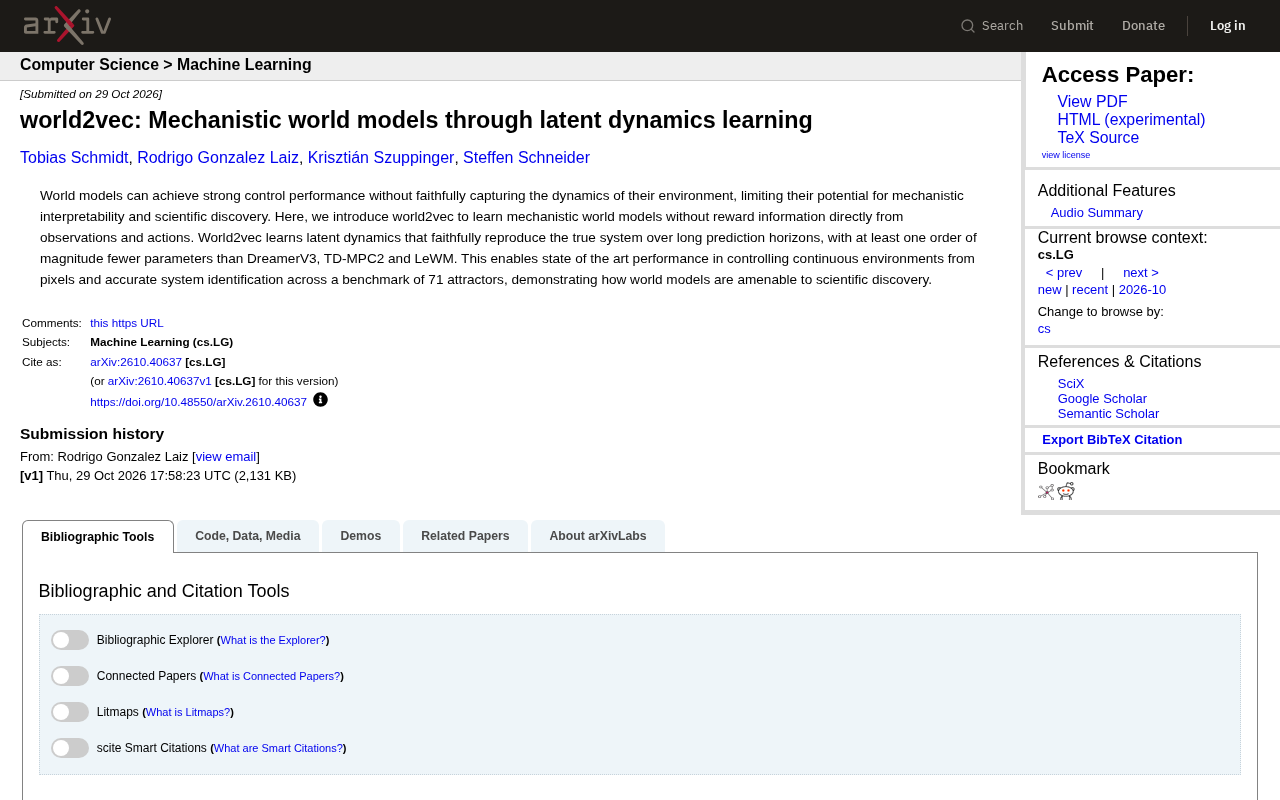
world2vec: Building Mechanistic World Models with Latent Dynamics Learning
world2vec proposes a reward-free method for learning mechanistic world models via latent dynamics, faithfully reproducing systems over long horizons with at least an order of magnitude fewer parameters than DreamerV3, TD-MPC2, and LeWM, and achieving accurate system identification on 71 attractor benchmarks.

A New KL-DRO Paradigm: Adaptive Scenario Generation Around a Learned Density Model
KL-DRO research proposes centering the KL ball on a learned density model instead of the empirical distribution, with adaptive scenario generation guiding sampling toward the worst case. Experiments show lower cost under distribution shift when records are scarce and the model can extrapolate, with comparable in-distribution cost.

ODE Samplers for Discrete Diffusion Models: Exponential Residual Flows Accelerate Generation
Discrete diffusion models lack deterministic ODE sampling? This article introduces Exponential Residual Flows (ERFs), which introduce continuous residual variables per token to construct piecewise ODEs for deterministic sampling and support consistency distillation acceleration. Superior to prior methods on code and text generation tasks.