MCP Trends Hub: A Deep Dive into the MCP Protocol-Based Trending Topics Aggregation Tool

MCP Trends Hub: an open-source project aggregating web-wide trending topics via the MCP protocol
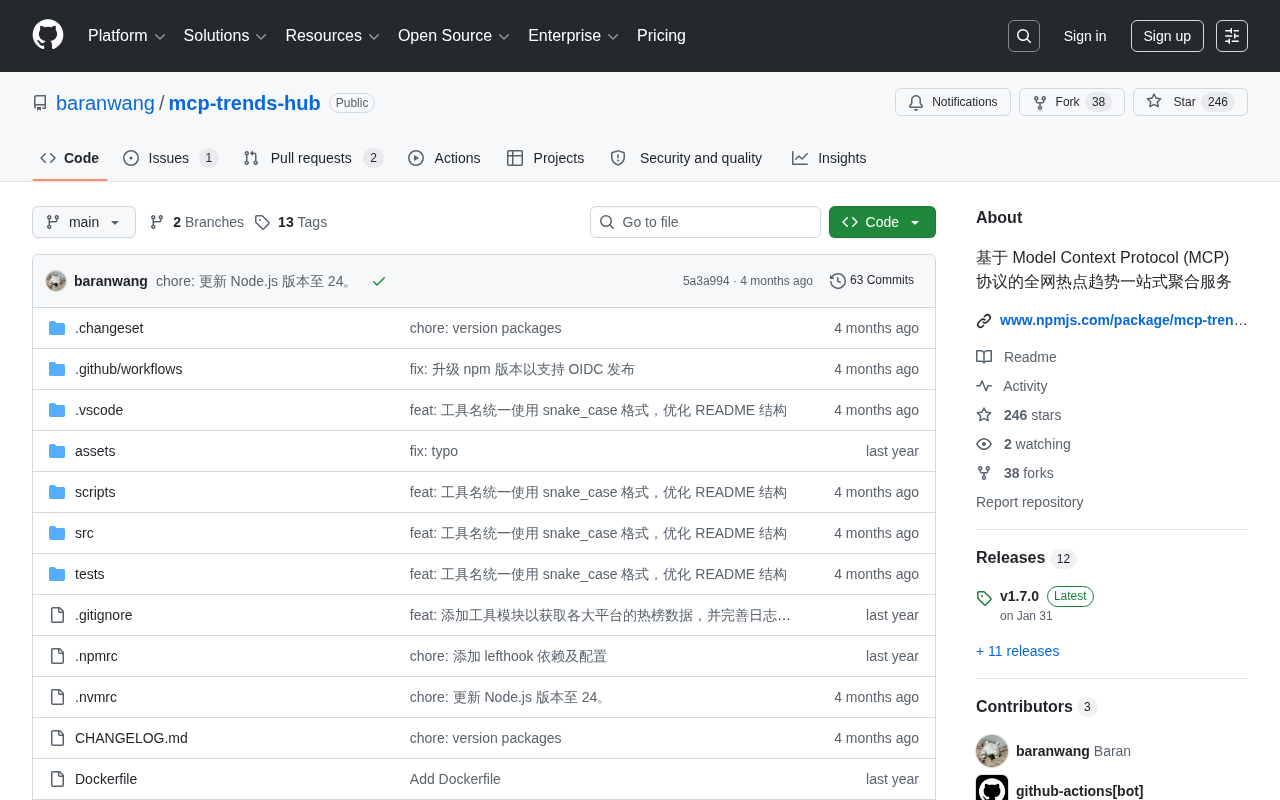
MCP Trends Hub is an open-source project built on the Model Context Protocol (MCP), developed in TypeScript. It standardizes and aggregates trending data from platforms like Weibo, Zhihu, and Douyin for direct invocation by AI clients. Suited for AI assistant enhancement, automated content creation, and lightweight public opinion monitoring, the project earned 246 Stars shortly after launch, reflecting strong community demand for real-time AI data integration.
Project Overview: What Is MCP Trends Hub?
In an age of information overload, efficiently tracking trending topics across the web has long been a pain point for developers and content creators. Recently, an open-source project on GitHub called MCP Trends Hub has garnered significant attention — built on the Model Context Protocol (MCP), it delivers a one-stop aggregation service for trending topics across the entire web. Shortly after launch, the project earned 246 Stars and 38 Forks, demonstrating strong community interest in this direction.
What Is the MCP Protocol? Why Does It Matter?
Model Context Protocol (MCP) is an open protocol officially open-sourced by Anthropic in November 2024, designed to standardize interactions between large language models (LLMs) and external data sources or tools. Think of MCP as a "USB port" for AI applications — it defines a unified communication specification that allows AI models to invoke external services and fetch real-time data in a standardized way.
Notably, MCP's design was inspired by Microsoft's Language Server Protocol (LSP), built for the VS Code ecosystem. LSP successfully decoupled editors from programming language services, enabling any editor to integrate intelligent code completion, go-to-definition, and other capabilities for any language. MCP applies this decoupling philosophy to the AI domain. On the technical level, it uses JSON-RPC 2.0 as the underlying communication protocol, supports both stdio local process communication and HTTP+SSE remote communication, and defines three clear architectural roles: Host (the host application), Client (the protocol client), and Server (the tool service).
Three Core Values of the MCP Protocol
- Standardized Interface: Different AI clients (such as Claude Desktop, Cursor, etc.) can all connect to services through the same protocol, eliminating the need for client-specific adapters
- Decoupled Design: Data source integration and AI model invocation are completely separated, making independent scaling and maintenance straightforward
- Real-time Data Access: AI models can fetch the latest external data through MCP, breaking through the timeliness limitations of training data
Design Philosophy and Technical Architecture of MCP Trends Hub
What Problem Does It Solve?
Traditional trending topic aggregation solutions typically require developers to write their own scrapers, handle API integrations, and maintain data format conversions — all tedious work. The elegance of MCP Trends Hub lies in packaging all of this into a standard service that complies with the MCP protocol. This means any MCP-compatible AI client can directly call this service to retrieve trending data from platforms like Weibo Hot Search, Zhihu Hot List, Douyin Trends, and more.
Three-Layer Architecture Built with TypeScript
The project is developed in TypeScript, balancing type safety with development efficiency. TypeScript has become one of the de facto standard languages for MCP Server development — Anthropic officially provides a complete TypeScript version of @modelcontextprotocol/sdk, including type definitions and toolchain support. TypeScript's static type system is particularly critical when handling heterogeneous data from multiple platforms: it catches data format mismatches at compile time rather than exposing them at runtime. Meanwhile, the rich ecosystem of scraping and HTTP request libraries in Node.js (such as Axios, Cheerio, and Playwright) also makes TypeScript the preferred tech stack for data-collection MCP Servers.
As an MCP Server, its architecture is divided into three layers:
- Data Collection Layer: Interfaces with trending data APIs from major platforms, covering mainstream content platforms like Weibo, Zhihu, and Douyin
- Data Standardization Layer: Unifies heterogeneous data formats from different platforms into the standard format specified by the MCP protocol
- MCP Service Layer: Exposes Tool interfaces via the MCP protocol for on-demand invocation by AI clients
When a user asks "What's trending today?" in an AI conversation, the AI model automatically calls the tools provided by MCP Trends Hub, retrieves real-time trending data, and presents it to the user in natural language.
Three Key Use Cases for MCP Trends Hub
Use Case 1: Adding Real-Time Information Capabilities to AI Assistants
Once MCP Trends Hub is connected to Claude Desktop or other MCP-compatible clients, your AI assistant gains the ability to perceive trending topics across the web in real time. Whether for daily news consumption or content creation topic selection, everything can be accomplished through natural language conversation.
Use Case 2: Building Automated Content Creation Pipelines
Combined with AI's text generation capabilities, MCP Trends Hub can serve as a critical component in automated content creation pipelines. A typical workflow looks like this: automatically fetch trending topics → AI analyzes trends → generate content summaries or commentary — all without manual intervention.
Use Case 3: Lightweight Public Opinion Monitoring Systems
For enterprises and brands, aggregating multi-platform trending data through MCP Trends Hub, combined with AI's analytical capabilities, enables rapid construction of a lightweight public opinion monitoring system that captures brand-related trending developments in real time.
The value of this use case becomes clear when contrasted with traditional approaches: previously, enterprise-grade public opinion monitoring systems typically required deploying dedicated scraper clusters, message queues (like Kafka), full-text search engines (like Elasticsearch), and standalone NLP analysis modules. The entire system was expensive to build and required dedicated teams for long-term maintenance. The emergence of the MCP protocol fundamentally changes this landscape — by encapsulating data collection capabilities into standardized tool interfaces, enterprises can directly leverage the reasoning capabilities of existing AI clients for semantic analysis, compressing what once required months of development into hours of integration work, dramatically lowering the barrier to public opinion monitoring for small and medium businesses.
MCP Ecosystem Trends and Outlook
The emergence of MCP Trends Hub is not an isolated case — it reflects the rapidly growing MCP ecosystem. As more developers recognize the value of the MCP protocol, the following directions are worth watching:
- Continued emergence of vertical-domain MCP services: From financial data to weather information, from code repositories to enterprise knowledge bases, various MCP Servers are covering an ever-expanding range of data scenarios
- Accelerating adoption of MCP clients: Mainstream AI applications are actively supporting the MCP protocol, lowering the barrier to entry for developers
- Composable AI applications becoming mainstream: Multiple MCP services working together can build complex and powerful AI workflows
It's worth noting that MCP Trends Hub earned 246 Stars shortly after launch, indicating strong demand in the developer community for the "AI + real-time data" combination. Trending topic aggregation is just a starting point — the true potential of the MCP protocol lies in enabling AI models to seamlessly tap into the entire internet's data ecosystem.
Conclusion: An MCP Practice Project Worth Following
MCP Trends Hub is a small but refined open-source project that clearly demonstrates the enormous potential of the MCP protocol in practical applications. For developers, it serves both as a ready-to-use trending topic aggregation tool and as an excellent reference project for learning MCP Server development. If you're exploring how to enable AI applications to access real-time data, or if you're interested in the development of the MCP ecosystem, this project is well worth diving into and experimenting with.
Key Takeaways
- MCP Trends Hub is built on the Model Context Protocol to deliver a one-stop aggregation service for trending topics across the web
- Developed in TypeScript, it standardizes multi-platform trending data into MCP protocol format for direct invocation by AI clients
- Applicable to multiple real-world scenarios including AI assistant information enhancement, automated content creation, and public opinion monitoring
- Earning 246 Stars shortly after launch reflects strong developer community demand for real-time AI data access
- The MCP ecosystem is growing rapidly, with more vertical-domain MCP services and composable AI applications becoming the trend
Related articles
 Product Reviews
The Programmer's Desk Setup Guide: Building a Workspace That Feels Like Home
Discover how programmers build productive, comfortable workspaces. From multi-monitor setups to ergonomic design, explore the desk philosophy that drives focus and flow.
 Product Reviews
Qoder vs Cursor Real-World Comparison: Which $20/Month AI IDE Is Better?
Hands-on comparison of Qoder vs Cursor AI IDEs: Agent autonomy, human interaction count, and architecture decisions. Qoder needed only 2 interactions vs Cursor's 8.
 Product Reviews
Cursor Cloud Agent Demo: Eliminating Bottlenecks Across the Entire Software Development Lifecycle
Deep analysis of Cursor's Cloud Agent demo showing how cloud VMs, automated test artifacts, and a full-chain control plane systematically eliminate human bottlenecks across the software development lifecycle.