Meadow: Replacing Algorithms with Human Curation and Planting Music into the City Map
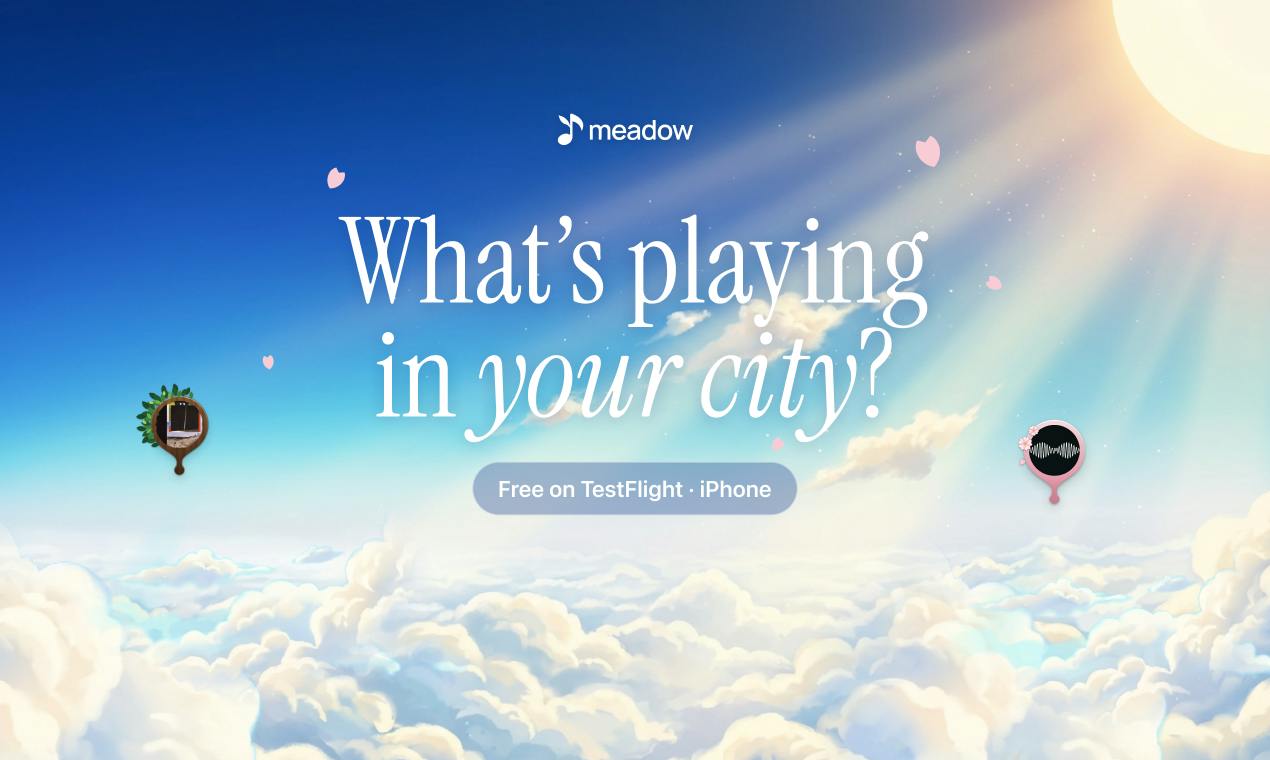
Meadow lets users plant songs at geographic locations for passersby to collect passively, restructuring music discovery in an anti-algorithm way.
Meadow is an iPhone app that binds songs to real geographic coordinates. Passersby can passively collect them via Live Activities with the phone in their pocket and plant their own songs in the same spot, creating a spatialized music-sharing loop. Collections go into a Garden space exportable to Apple Music, while the Feed shows what the city is playing—discovery based on space, not relationships. Explicitly anti-algorithm, it trades "one song per location" for irreplicable locality at the cost of scaled distribution. Distributed free via TestFlight, its core challenge is whether user density can cross the threshold to make the city a truly explorable music map.
In an era where recommendation algorithms have all but taken over music consumption, an iPhone app called Meadow proposes a nearly contrarian idea: bring music back to specific places, chosen by real people rather than pushed by a system.
Meadow's core mechanic is simple: you can "plant" a song at a real-world location. When someone passes by, they can hear the song you left behind, add it to their collection, and plant their own song at the same spot for the next passerby. No algorithmic intervention—just music hand-picked for a particular place.
Product Mechanics: Geocached Songs and Passive Collection
Meadow splits the music experience into two actions—planting and collecting. Planting is an active creative act: you walk to a real location, pick a song, and bind it to a set of coordinates. Collecting is designed to be as lightweight as possible: with your phone in your pocket, collection is completed via Live Activities, so you don't need to stare at the screen.
This design approach is worth noting. Most location-based music products center their interaction around a "discover" page, where users must actively open the app, browse a map, and tap to play. Meadow goes the opposite direction, reducing the collecting action to the lowest possible attention cost and making walking itself the trigger. This aligns with its positioning as "hidden songs"—rather than having you search for music, it lets music appear as you pass by.
Collected songs go into a personal space called the Garden. The name itself carries a metaphor: whatever you plant and whatever you pick up grows here into a music garden of your own. Collections in the Garden can also be exported as an Apple Music playlist, meaning the in-app music experience can flow back into the user's existing music library rather than forming a closed silo.
Live Activities is a system-level feature introduced by Apple in iOS 16.1 that lets apps continuously display real-time updating information (such as delivery progress or game scores) on the lock screen and Dynamic Island without requiring the user to open the app. Meadow uses this to compress "collecting a song" into a background action that requires no active interaction: when a user approaches a planted song, the Live Activity shows a prompt and completes the collection, even with the phone in a pocket. The key to this mechanism is that it hands the triggering of location services to the system rather than the user interface, making "passing by" itself an interaction event—this is the technical precondition that allows Meadow to minimize the attention cost of collecting.
TestFlight is Apple's official beta distribution platform, where developers can push unreleased beta apps to up to 10,000 external testers and collect crash logs and feedback. Compared with a full App Store release, a TestFlight build is not subject to full review and iterates faster, but it also means users must first install the TestFlight app and then accept an invitation, which naturally filters out casual users. For Meadow, which depends on user density, this distribution method lowers the cost of early validation while limiting the reachable user base during the cold-start phase.
The Social Layer: A Feed and a City Music Map
Beyond personal collections, Meadow also offers a Feed that shows "what your city is playing." This design aggregates songs scattered across coordinate points into a city-scale view of musical atmosphere.
Its social logic differs from typical music social products. Platforms like Spotify show what friends are listening to—a recommendation based on interpersonal relationships; Meadow shows musical traces at locations—a discovery based on spatial relationships. What you see is not someone's taste, but the musical choices made at a street corner or along a road. This information structure naturally carries a sense of exploration and makes "the city" an object that can be listened to.
It's worth noting that the quality of this layer of experience depends heavily on user density. The more people who plant songs, the richer the encounters when passing by. For a product that is just getting started and is currently offered free to iPhone users via TestFlight, cold start is a real problem it must confront.
The Anti-Algorithm Stance: A Deliberate Trade-off
Meadow's tagline states its position plainly: chosen by people, not algorithms. In today's product landscape, this statement has a clear target.
The advantage of algorithmic recommendation lies in scale—it can quickly match user preferences across vast amounts of content, giving everyone personalized results. But this efficiency also invites criticism of homogenization: recommendation systems tend to reinforce existing preferences, making discovery increasingly predictable. Through the hard constraint of "one song per location," Meadow deliberately gives up the ability to match at scale in exchange for a kind of locality that cannot be replicated. The song you hear at a certain place is bound to that place itself—an experience that recommendation systems cannot mass-produce.
This trade-off has costs. Without algorithms, there is no fallback content distribution mechanism; whether users have a good experience depends entirely on whether other real people have left something along their route. The product hands responsibility for content quality back to the community.
Homogenization in recommendation systems is often described as the "filter bubble" or "echo chamber" effect: collaborative filtering and content-feature matching tend to push content similar to a user's historical preferences, boosting click-through rates in the short term while shrinking the space for serendipitous discovery in the long term. Meadow's anti-algorithm stance essentially replaces preference matching with spatial constraint—the basis for recommendation shifts from "what you might like" to "what is at this coordinate," thereby returning the power of discovery to the physical world and to strangers' random choices. This kind of "non-personalized discovery" is not entirely new, but binding it to a single geographic coordinate, so that content and place form an inseparable one-to-one relationship, is the core difference from traditional playlists or radio.
Platform and Availability
Meadow currently supports iPhone only and is distributed free via TestFlight. Choosing TestFlight over a full release usually means the product is still in testing and iteration, and the maker needs to gather feedback from early users to polish the experience. For a product that relies on geographic data and real-time location, validating whether the core loop works within a controlled scope first is a reasonable pace.
Judging from its Product Hunt performance, Meadow received 69 upvotes, ranked 9th for the day, and got 6 comments. That result shows it drew some attention at launch, though it's hardly explosive. For a product that emphasizes on-location experience and requires users to go outside to use it, the growth curve was never going to be as steep as that of a purely online tool.
The Real Challenge for This Kind of Product
Meadow's concept is complete, its interactions restrained, and its anti-algorithm positioning clear enough. But its core problem is not product design—it's density. The value of geocached-song products grows non-linearly with user density: when a city has only a few dozen users, the odds of encountering a song while walking are extremely low, and the experience is close to idling; once density crosses a certain threshold, the city truly becomes an explorable music map.
From this perspective, Meadow's TestFlight phase looks more like a search for the first group of people willing to keep planting songs in the city. Its success won't depend on how clever the features are, but on whether it can first build a sufficiently dense musical distribution in a handful of cities. This is a community operations problem, not a technical one.
For users who enjoy walking around the city and are tired of algorithmic recommendations, Meadow offers a small experiment worth trying: leave a song for a place and see whether someone happens to pass by.
One-line Summary
Meadow lets users plant songs at geographic locations, with passersby collecting them passively—reconstructing music discovery in an anti-algorithm way.
Paragraph Summary
Meadow is an iPhone app whose core mechanic is binding songs to real geographic coordinates. When passersby approach a location, they can passively collect the song via Live Activities even with the phone in their pocket, and can plant their own song in the same place, forming a spatialized music-sharing loop. Collections go into a personal space called the Garden and can be exported as an Apple Music playlist; the Feed shows what the city is playing, creating a discovery logic based on space rather than interpersonal relationships. The product is explicitly anti-algorithm, trading the hard constraint of "one song per location" for irreplicable locality, at the cost of giving up scaled content distribution. It is currently distributed free only via TestFlight, and the core challenge is whether user density can cross the threshold that would make the city a truly explorable music map.
Related articles
 Tech Frontiers
Gemini Omni 1.2 Flash: AI Video Moves Toward Draft-Style Editing
Google's Gemini Omni 1.2 Flash update enables conversational, draft-style editing of the same video—swap scenes while keeping products, adjust lighting while keeping characters. Clips up to 15s, 720p costs 30% less than the previous Flash—ideal for e-commerce ads, previs, and short-asset production.

Codex Tutorial: One-Command Install and Run Your First Task
Codex tutorial: one-command install and run your first task. Covers the four Codex forms, sandbox and approval guardrails, AGENTS.md and MCP configs, cloud network policy, and the iron rule of human review—everything you need to get started with this autonomous coding agent.
 Tech Frontiers
Localix: An Open-Source Agentic Development Environment with Multi-Model and Local AI Integration
Localix is an MIT open-source Agentic Development Environment (ADE) supporting seamless Claude Code plugin loading, multi-model cloud and local execution, Mini Apps extensions, and agent context management—an open AI collaboration workbench for developers.