Mechanistic Interpretability Needs a Logic of Inference: Five Principles from Observing Neurons to Scientific Explanation

MI needs to borrow neuroscience's logic of inference, using five principles to standardize mechanistic inference and emphasize external evidence.
This article introduces a paper on the logic of inference for Mechanistic Interpretability (MI). It notes that MI is shifting from "what can be observed" to "how observations support mechanistic explanations," and faces inference bottlenecks similar to neuroscience, such as inferring causation from correlation, generalizing from local to global, and relating model mechanisms to the external world. The paper proposes five principles organized into a recursive inference logic, emphasizing repeated verification and revision across levels such as neurons, circuits, and behavior. This logic supports dual goals: accumulating internal mechanistic knowledge and generating testable external hypotheses. The core conclusion: evidence internal to MI alone is insufficient to establish what model mechanisms reveal about the world; evidence beyond MI is ultimately needed to validate hypotheses, and researchers should avoid equating model mechanisms directly with world truth.
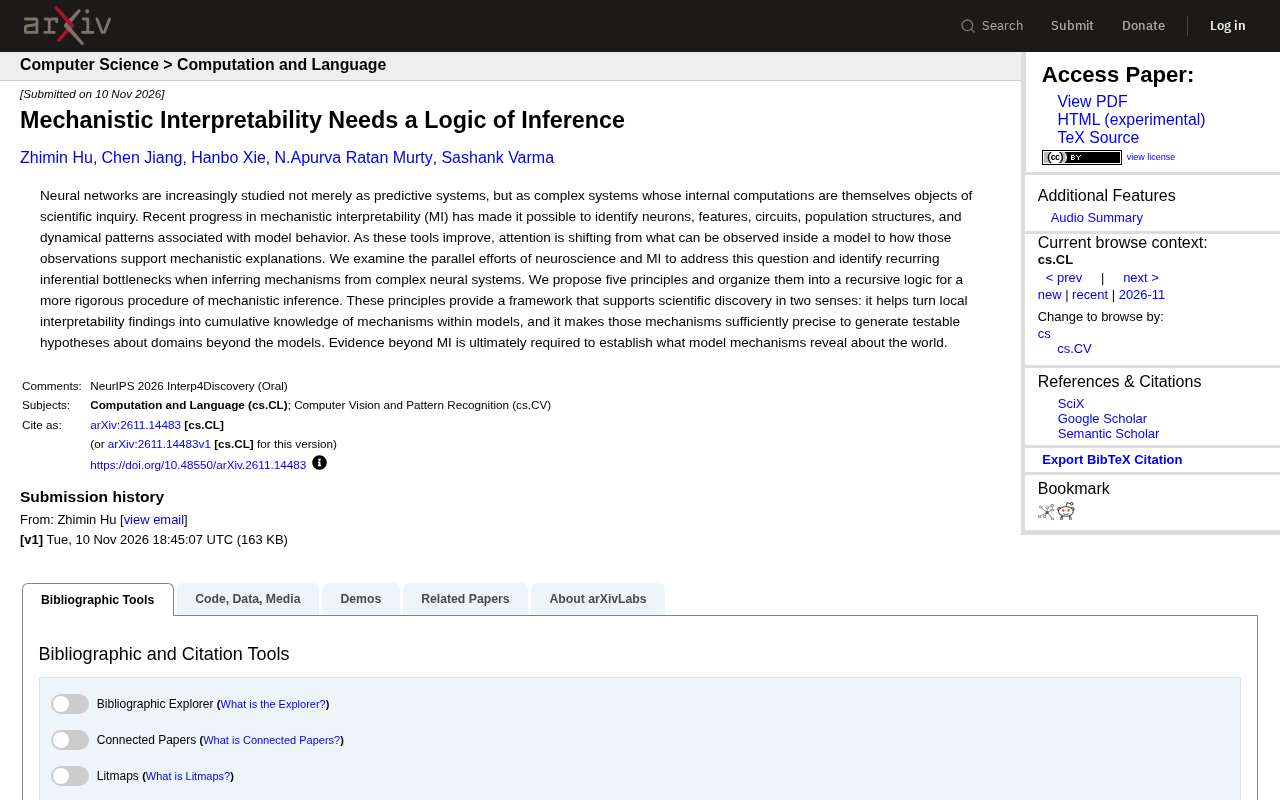
Neural networks are increasingly viewed as complex systems whose internal computations are themselves objects of scientific study. Advances in Mechanistic Interpretability (MI) allow us to identify neurons, features, circuits, population structures, and dynamical patterns associated with model behavior. As tools improve, the focus is shifting from what can be observed inside a model to how these observations support mechanistic explanations. A paper from rss, Mechanistic Interpretability Needs a Logic of Inference, points out that neuroscience and MI face similar inference bottlenecks when inferring mechanisms from complex neural systems, and proposes five principles organized into a recursive logic to build a more rigorous mechanistic inference process.
From Observation to Explanation: MI's Inference Bottleneck
MI's goal is not merely prediction but understanding the causal mechanisms inside models. Researchers can already localize specific neurons or circuits, but how to derive reliable mechanistic explanations from these local observations still lacks a systematic methodology. The paper identifies recurring inference bottlenecks: for example, inferring causal mechanisms from correlational observations, generalizing from local circuits to global behavior, and relating model mechanisms to external world knowledge. These problems are highly similar to the challenge in neuroscience of inferring cognitive mechanisms from neural activity, suggesting the two fields can learn from each other.
Mechanistic Interpretability (MI) and neuroscience share a fundamental methodological difficulty: inferring high-level causal mechanisms from measurable low-level signals (neuron activations, weight matrices, attention patterns) is essentially an inverse problem—reconstructing the latent causal structure that generated the data from observations. This problem is ill-posed: multiple different mechanistic hypotheses may produce the same observations, and activation data inside the model alone cannot uniquely determine the true cause. A classic case in neuroscience—inferring the cognitive variable encoded by a single neuron from its firing rate—has already shown that such inference requires interventional experiments, cross-condition comparisons, and theoretical priors to constrain the hypothesis space. MI researchers face the same dilemma: localizing the correlation between an attention head or MLP neuron and a behavior does not amount to proving that the component is the causal driver of that behavior. Therefore, the inference bottleneck identified by the paper is not a technical flaw unique to MI but a general epistemological difficulty of mechanistic inference in complex systems, which also explains why the methodologies of the two fields can be transferred to each other.
The "generalizing from local circuits to global behavior" mentioned in the paper involves the scale problem in MI. MI research typically localizes interpretable structure at fine-grained levels (single neurons, attention heads, small-scale circuits), but model behavior often emerges from the distributed interaction of a large number of components. The function a local circuit exhibits in isolation may be altered in the full network due to redundancy, compensation, or context dependence. This is analogous to the difficulty in neuroscience of inferring overall cognitive function from a single cortical column or local circuit. Solving the scale problem requires clarifying the mapping relationships between different levels of analysis—for example, using ablation, activation patching, or causal tracing to verify the robustness of local findings in full-model behavior, rather than assuming by default that local mechanisms generalize losslessly to the global level.
Five Principles Build a Recursive Logic
To address these bottlenecks, the authors propose five principles and organize them into a recursive inference logic. These principles aim to provide a more rigorous process for mechanistic inference, helping researchers assess the strength of evidence and avoid overinterpretation. Recursion means the inference process is not linear but requires repeated verification and revision across different levels (e.g., neurons, circuits, behavior). The paper emphasizes that this logic can support the dual goals of scientific discovery: first, accumulating local interpretability findings into cumulative knowledge of a model's internal mechanisms; second, making mechanisms precise enough to generate testable hypotheses about domains beyond the model.
The meaning of "recursive logic" here deserves elaboration: it draws on ideas from the philosophy of science about abductive reasoning and the hypothesis-testing cycle. Unlike linear induction, recursive logic requires researchers to iterate repeatedly in the loop of "observation → hypothesis → interventional verification → revised hypothesis," and the conclusions at each level must be tested in both directions—upward and downward—being consistent both with finer-grained mechanistic evidence and with higher-level behavioral evidence. In neuroscience, this structure manifests as a multi-level verification chain from single-cell recordings to population decoding to behavioral experiments. Another layer of meaning in recursiveness is that each explanation of a mechanism can itself become an object of observation for the next round of inference; researchers must continuously assess the confidence of explanations rather than locking in conclusions once and for all, thereby avoiding overinterpreting evidence at a single level.
Evidence Beyond MI: The Limits of Mechanisms Revealing the World
A core point of the paper is that evidence internal to MI alone is insufficient to establish the significance of model mechanisms for revealing the world. Ultimately, evidence beyond MI is needed to validate hypotheses. In other words, even if we fully understand a circuit inside a model, external experiments or theory are needed to confirm whether that mechanism corresponds to the causal structure of the real world. This stance reminds researchers to avoid equating model mechanisms directly with world truth, and instead to treat them as sources of hypotheses that require further testing.
The claim that "evidence beyond MI is needed" touches on the epistemological issue of the model-world relation. MI can reveal the internal computational structure of a model, but whether model mechanisms correspond to the real causal structure of the external world depends on the external validity of the model's training data and objectives. Even if a circuit is fully characterized inside a model, it may merely fit spurious correlations in the training distribution rather than capturing real-world causal mechanisms. Verifying this correspondence requires evidence sources independent of the model—for example, conducting interventional experiments in real environments, comparing against domain theory, or testing the reproducibility of hypotheses generated by the mechanism outside the model. This is consistent with the principle in the philosophy of science that "theories must undergo independent testing," and it also suggests that MI explanations should be positioned as generators of testable hypotheses rather than final arbiters of world truth.
Implications for MI Research
The value of this work lies in bringing the logic of inference from the philosophy of science into MI practice. For MI researchers, the five principles provide a framework for assessing the quality of explanations; for interdisciplinary researchers, it builds a methodological bridge between neuroscience and MI. As MI tools become increasingly powerful, establishing a rigorous logic of inference will be a key step in turning observations into reliable knowledge.
One-line Summary
MI needs to borrow the logic of inference from neuroscience, using five principles to standardize mechanistic inference and emphasize external evidence.
Paragraph Summary
This article introduces a paper on the logic of inference for Mechanistic Interpretability (MI). It points out that MI is shifting from "what can be observed" to "how observations support mechanistic explanations," and faces inference bottlenecks similar to those in neuroscience, such as inferring causation from correlation, generalizing from local to global, and relating model mechanisms to the external world. To this end, the paper proposes five principles organized into a recursive inference logic, emphasizing that inference must be repeatedly verified and revised across levels such as neurons, circuits, and behavior. This logic supports dual goals: accumulating knowledge of a model's internal mechanisms and generating testable external hypotheses. The core conclusion is that evidence internal to MI alone is insufficient to establish the significance of model mechanisms for revealing the world; ultimately, evidence beyond MI is needed to validate hypotheses, and researchers should avoid equating model mechanisms directly with world truth.
Related articles

Abnormal Error Rate Spike in Claude Mythos 5.2 and Fable 5.2
Claude Mythos 5.2 and Claude Fable 5.2 show an abnormal spike in request error rates, marked as investigating on the official status page. This article covers the incident overview, practical impact on developers, and recommended responses.

ReAct Runtime Context Trimming: Why Claude Code Acts at 70%
A deep dive into ReAct runtime context trimming: why Claude Code compresses at ~70% usage, why tool calls dominate, why messages must be dropped in pairs, and why codebases don't need RAG.

AI Agent vs LLM: How Cursor and Claude Code Actually Work
An in-depth analysis of the essential difference between AI Agents and LLMs: LLMs generate code suggestions, while Agents modify files and run tests via tool calls. Using a Spring Boot bug fix as an example, it breaks down the workflows, permission control, and verification mechanisms of Cursor and Claude Code.