MedAstra: ASR-Free Voice Retrieval, A New Approach to Medical QA

MedAstra bypasses ASR to map speech directly into text embedding space for medical retrieval, with diagnostic grounding.
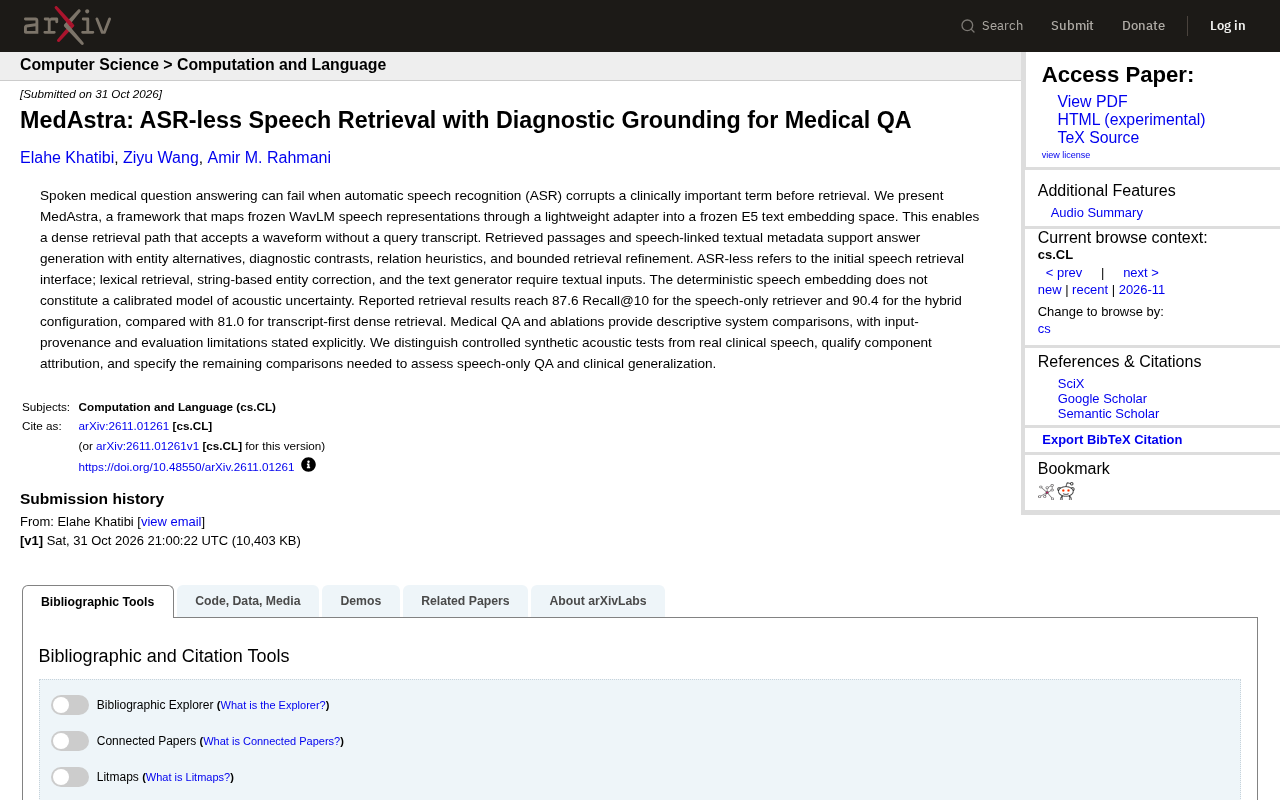
MedAstra addresses ASR error propagation in medical voice QA by skipping transcription and mapping speech directly to text embedding space. Using frozen WavLM and a lightweight adapter aligned to frozen E5, it achieves 87.6 Recall@10 (hybrid 90.4) versus 81.0 for transcription-first. Diagnostic grounding mechanisms structure medical knowledge use. Authors limit ASR-less to the initial retrieval interface, note synthetic speech limits and lack of uncertainty quantification, positioning it as a descriptive comparison.
Medical voice question-answering systems have an easily overlooked weak link: automatic speech recognition (ASR). When ASR misrecognizes a critical clinical term, subsequent retrieval and generation are built on a false premise. MedAstra proposes a different path—skipping ASR and mapping speech directly into a text embedding space for retrieval.
Core Idea: Voice Embeddings Route Directly into the Text Retrieval Space
MedAstra's architecture is not complex, but its design trade-offs are worth a closer look. It uses a frozen WavLM model to extract speech representations, then maps those representations into a frozen E5 text embedding space via a lightweight adapter. This way, the system can accept raw waveform input directly and perform dense retrieval without first obtaining query text.
The authors strictly define "ASR-less" as limited to the initial voice retrieval interface, not the entire system. The retrieved passages and text metadata associated with the speech still participate in downstream processing as text; lexical retrieval, string-based entity correction, and the text generator all require text input. This candid boundary statement is uncommon in papers, but it is crucial for understanding the system's actual positioning.
WavLM is a self-supervised speech pre-training model proposed by Microsoft, built on the HuBERT framework with improvements that introduce denoising mask prediction and mixed speech data during pre-training, giving it strong performance on tasks such as speaker recognition and speech separation. Its frozen features are often used as general-purpose speech representations. E5 is a family of text embedding models trained via weakly supervised contrastive learning that map sentences into a dense vector space and are widely used for retrieval tasks. The key to MedAstra is using a lightweight adapter to establish a mapping between two frozen spaces, avoiding reliance on large-scale annotated data while preserving each model's generalization capability. This "freeze-and-adapt" paradigm is increasingly popular in cross-modal retrieval because it significantly reduces training costs and overfitting risk.
Retrieval Performance: Direct Voice Retrieval Outperforms Transcription-First
The retrieval results reported in the paper provide a direct comparison: the pure voice retriever achieves 87.6 Recall@10, the hybrid configuration reaches 90.4, while transcription-first dense retrieval scores 81.0. The advantage of the hybrid configuration shows that voice and text signals are complementary—when ASR transcription introduces noise, voice embeddings provide an independent retrieval channel.
However, these numbers need to be understood in context. The authors explicitly state that these are descriptive system comparisons, not rigorous clinical validation. Limitations in input sources (synthetic speech vs. real clinical speech) and evaluation methodology are noted in the paper.
Recall@10 is a commonly used metric in retrieval evaluation, referring to the proportion of queries for which at least one relevant document appears among the top 10 returned results. In medical QA scenarios, it measures whether the system can recall the correct knowledge passages from a limited candidate set, which is critical for downstream generation. Hybrid retrieval typically refers to fusing dense retrieval (based on embedding vectors) and sparse retrieval (such as BM25, based on term frequency) to leverage complementary strengths. Transcription-first dense retrieval relies on ASR to first convert speech to text before embedding-based retrieval, and its performance is directly affected by ASR error rates. MedAstra's comparison shows that skipping ASR can avoid error propagation, but note that these metrics were obtained on a specific dataset with synthetic speech; noise and accents in real clinical environments may change the conclusions.
Diagnostic Grounding: Giving Generation a Basis
Another design point of MedAstra is the mechanism supporting answer generation after retrieval. The system leverages retrieved passages and text metadata associated with the speech to provide entity alternatives, diagnostic contrasts, relational heuristics, and bounded retrieval refinement for the generation process.
The value of the term "diagnostic grounding" lies in its attempt to make the generation stage not merely concatenate retrieval results, but to make structured use of medical knowledge relationships. Entity alternatives handle terminology variants, diagnostic contrasts help distinguish similar conditions, and relational heuristics provide constraints on associations between entities. Together, these mechanisms form a lightweight reasoning scaffold.
In medical QA, grounding refers to anchoring generated content to external knowledge sources to reduce hallucination. Diagnostic grounding further emphasizes using the structured relationships of medical knowledge (such as symptom–disease associations and differential diagnosis logic) to constrain generation. Entity alternatives refer to substituting synonyms or hypernyms/hyponyms when retrieved entities do not exactly match query entities, to cover terminology variants. Diagnostic contrasts help the model distinguish easily confused diseases by contrasting key features of similar conditions. Relational heuristics encode common relationship patterns between medical entities (such as "treats" or "complication"), serving as soft constraints during generation. Bounded retrieval refinement refers to limited query expansion or re-ranking based on generation needs after initial retrieval, to improve context relevance. These mechanisms together form a lightweight reasoning layer, but do not introduce a full medical knowledge graph.
Honest Limitations: The Gap Between Synthetic Speech and Real Clinical Settings
The MedAstra paper is quite restrained in its limitations statement. The authors clearly distinguish controlled synthetic acoustic tests from real clinical speech, qualify component attribution, and list the remaining comparative experiments needed to evaluate pure voice QA and clinical generalization capability.
Another key statement is that deterministic voice embeddings do not constitute a calibrated acoustic uncertainty model. This means the system cannot tell the user "some part of this speech may be unreliable." In medical scenarios, uncertainty quantification is no less important than retrieval accuracy itself—a problem that future work needs to address.
Implications for Medical Voice QA
MedAstra's contribution is not in claiming to have solved medical voice QA, but in demonstrating a technical route worth exploring: when ASR becomes a bottleneck, bypassing it rather than improving it may be an effective alternative strategy. The combination of frozen models plus lightweight adapters also lowers training costs, making the system easier to deploy in resource-constrained environments.
From a broader perspective, this work reports a system-level design trade-off—replacing explicit transcription with embedding space alignment, compensating for single-channel shortcomings with hybrid retrieval, and controlling generation risk with bounded refinement. The long-term value of these trade-offs depends on subsequent validation results on real clinical speech.
One-line Summary
MedAstra bypasses ASR, mapping speech directly into a text embedding space for medical retrieval, and introduces a diagnostic grounding mechanism.
Paragraph Summary
Aiming at the fragile link of ASR error propagation in medical voice QA, MedAstra proposes a retrieval scheme that skips transcription and maps speech directly into a text embedding space. The system uses frozen WavLM to extract speech representations and aligns them to a frozen E5 text embedding space via a lightweight adapter, enabling end-to-end dense voice retrieval. Experiments show pure voice retrieval achieves 87.6 Recall@10, the hybrid configuration reaches 90.4, outperforming transcription-first's 81.0. The generation stage introduces diagnostic grounding mechanisms such as entity alternatives, diagnostic contrasts, and relational heuristics to make structured use of medical knowledge. The authors explicitly limit ASR-less to the initial retrieval interface and honestly point out the limitations of synthetic speech testing and the lack of uncertainty quantification in deterministic embeddings, positioning the work overall as a descriptive system comparison.
Related articles

GPT-Image 2.6 Dual Release: A Double Upgrade in Speed and Precision
OpenAI releases GPT-Image 2.6 with Flare for faster generation and Sunburst for complex prompts and dense infographics. API adds markup editing, SVG, and GIF support.

Robert Caro: How to Get Insiders to Talk and Uncover the Hidden Logic of Johnson's Money Politics
Pulitzer winner Robert Caro shares how he interviewed John Connally, revealing how pressing on Johnson's funding annotations got insiders to explain political money logic.

Showing This Video to Someone in 2014: The Stunning Evolution of AI Video
From the viral Reddit post "Show this AI video to someone from 2014," we look back at a decade of AI video generation's leap from academic research to indistinguishable reality, analyzing the cognitive impact and trust challenges amid the flood of synthetic content.