Medical Papers Claimed to Be 100% Human-Written Turn Out to Be Entirely AI-Generated

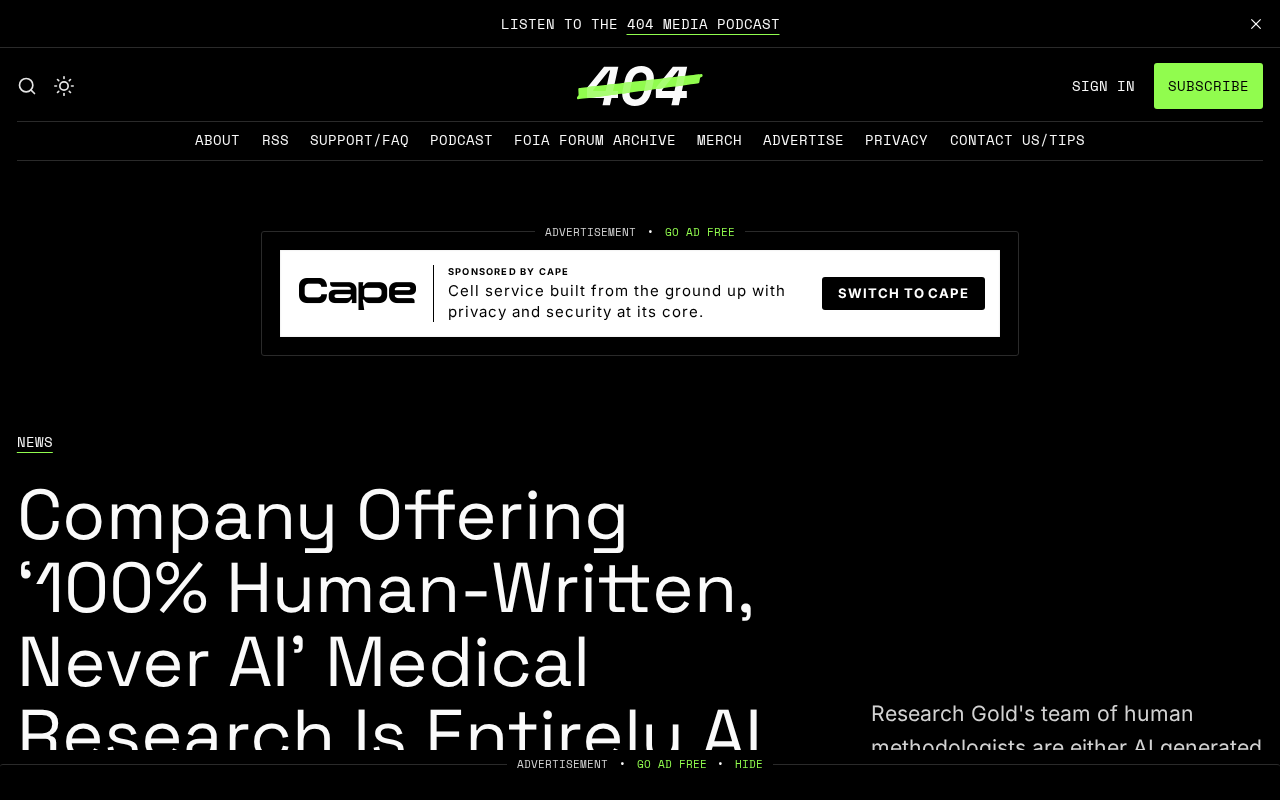
A "100% human-written" medical research company was exposed for using AI to generate all its content.
A medical research service company that marketed itself as "100% human-written, absolutely no AI" was exposed for producing content almost entirely generated by AI. This case highlights the trust paradox in anti-AI marketing, the dangerous consequences of AI hallucinations in medical content, and the urgent need for verifiable content provenance mechanisms in academic publishing.
A Marketing Scam That Exposed Itself
Recently, a company that advertised "100% human-written, absolutely no AI" medical research services was exposed for producing content almost entirely generated by AI. The discovery is deeply ironic — an organization that made "purely manual" its core selling point was ultimately proven to be an entirely AI-driven operation.
This isn't just a matter of corporate integrity. It reveals the increasingly blurred boundary between academic publishing and marketing rhetoric against the backdrop of rampant AI content. When "anti-AI" itself becomes an AI-driven marketing label, the entire trust system faces an unprecedented test.
The Enormous Gap Between Promise and Reality
The company positioned "absolutely no AI" as its competitive differentiator, attempting to win trust in a market flooded with ChatGPT-generated content. The medical research field demands extremely high standards for content accuracy, traceability, and professionalism — such "purely manual" promises should serve as important quality endorsements.
However, investigations revealed that their published content exhibited obvious AI-generation characteristics. This duplicity is more harmful than simply using AI — it exploits public vigilance against AI content to perpetrate deception. This strategy is essentially a form of "reverse social engineering": precisely because the proliferation of AI content in the market has triggered widespread anxiety, the promise of "purely manual" gains additional commercial value — value built entirely on information asymmetry.
Why AI Content Detection Is Critical in the Medical Field
In medicine and academia, the authenticity of content sources directly impacts public health and research integrity. AI-generated medical content without rigorous review may contain "hallucinations" — medical advice or research conclusions that appear plausible but are actually incorrect.
The "hallucination" phenomenon in Large Language Models (LLMs) stems from their underlying working principle — these models are essentially probability-based next-token prediction systems, not knowledge retrieval systems. They output factually incorrect or unverifiable information with a highly confident tone. In the medical field, such hallucinations are particularly dangerous: models may fabricate nonexistent clinical trial numbers, invent DOI links for journal papers, or incorrectly splice conclusions from multiple studies. Multiple studies in 2023 demonstrated that GPT-4's rate of fabricating references when answering medical questions can reach 30%-70%, and these fabricated entries are virtually indistinguishable from genuine literature in format and wording.
The Unique Risks of Medical AI Content
Unlike general text, incorrect medical information can lead to severe consequences. When generating professional content, large language models tend to fabricate nonexistent references, misquote research data, or package outdated medical views as the latest conclusions. For example, an AI-generated drug interaction recommendation containing errors could directly affect clinical decision-making; a systematic review with fabricated statistics, if cited by other researchers, would create a "misinformation cascade effect" in academic literature — harm that might not be discovered and corrected for years.
When an organization claims human oversight while mass-producing content with AI, these risks aren't mitigated but systematically concealed. Users believe they're receiving reliable content reviewed by professionals, when in fact they're getting insufficiently validated machine output. This practice effectively eliminates the most critical safety mechanism in AI-assisted writing — fact-checking and professional judgment by human experts.
The Trust Paradox Behind "Anti-AI" Marketing
As generative AI becomes widespread, "handcrafted" is gradually becoming a premium label, similar to "organic" certification in the food industry. More and more companies are using "no AI involvement" as a marketing point. This trend reflects widespread market concerns about AI content quality, but it also creates a new rent-seeking space: when consumers are willing to pay a premium for "purely manual," the economic incentive for false claims emerges accordingly.
When the "Purely Manual" Label Cannot Be Verified
The problem is that the claim of "whether AI was used" is extremely difficult to verify externally. Current mainstream AI content detection methods fall into three categories: statistical feature-based detection (such as text perplexity analysis), watermark-based detection (embedding invisible markers during generation), and classifier-based detection (training specialized models to distinguish human from AI text). Representative tools include GPTZero, Originality.ai, and others, but these tools generally have accuracy rates fluctuating between 60%-85%, with significantly diminished detection capability for text that has been rewritten or mixed with human editing. OpenAI's Text Classifier was taken offline due to insufficient accuracy, which itself demonstrates the technical difficulty of the problem.
Existing AI detection tools have inconsistent accuracy rates and are prone to false positives. This gives unscrupulous businesses an opening — they can freely label content as "purely manual" while consumers have virtually no effective means of verification. Even more challenging, even when a detection tool flags text as "possibly AI-generated," the accused party can easily rebut with claims of "similar writing style," making the burden of proof ambiguous.
This incident attracted attention precisely because it punctured this facade. It reminds us: marketing rhetoric does not equal fact, especially in domains where claims cannot be easily falsified — the credibility of such statements deserves scrutiny.
Implications for the Academic Publishing Industry
Although this incident is small in scale, its symbolic significance deserves deep reflection. It reflects several deep-seated issues in the content ecosystem of the AI era. Since 2023, major global academic publishing institutions have successively issued AI usage policies: top journals like Nature and Science explicitly require authors to disclose whether generative AI tools were used and prohibit listing AI as a paper author; the International Committee of Medical Journal Editors (ICMJE) updated its guidelines, emphasizing that authors must take full responsibility for all AI-assisted content. However, enforcement of these policies still primarily relies on author self-reporting, lacking effective technical verification. Organizations like Retraction Watch have documented hundreds of papers retracted due to suspected AI generation, with the medical field accounting for a significant proportion.
Building Trustworthy Content Provenance Mechanisms
In the future, relying solely on unilateral corporate claims about "whether AI was used" is far from sufficient. The industry needs to establish more reliable content provenance and certification mechanisms. Content Provenance technology is becoming important infrastructure for addressing this challenge. The C2PA (Coalition for Content Provenance and Authenticity) standard, jointly promoted by Adobe, Microsoft, BBC, and other institutions, attaches cryptographically signed metadata at content creation time, recording creation tools, editing history, and publication paths. Similarly, blockchain technology is being explored for documenting the creation process of academic papers — authors can upload hash values of various writing versions to the chain, forming immutable timestamp proofs.
Additionally, content signatures, creation process records, third-party audits, and other measures can make "manual" or "AI-assisted" labels verifiable. While these technologies are still in early adoption stages, they provide feasible technical pathways for establishing "verifiable content creation claims."
Re-examining the Ethical Boundaries of AI Use
It's worth emphasizing that using AI is not inherently sinful. In many scenarios, AI assistance can significantly improve efficiency and quality — for example, in literature searching, grammar polishing, and data visualization, AI tools are already widely accepted in academia. The key distinction is between "AI as a tool" and "AI as a replacement": the former represents efficiency gains under human direction, while the latter completely outsources professional judgment to algorithms.
The real problem lies in "concealment" and "deception" — using AI while denying it, and charging higher fees or gaining undue trust as a result. The ethical nature of this behavior is twofold: it violates principles of commercial integrity and betrays users' reasonable expectations of professional services.
Transparency is key. Companies should honestly disclose the degree of AI involvement, allowing users to make informed choices. A viable tiered disclosure framework could be: Level 0 (purely manual), Level 1 (AI-assisted draft, deep human editing), Level 2 (AI-generated main content, human review), Level 3 (fully AI-automated generation). Such a tiered system can balance transparency with commercial flexibility. Any attempt to profit from information asymmetry may ultimately backfire, just as it did for this company.
Conclusion
"Claiming 100% human, actually 100% AI" — this almost darkly humorous case sounds an alarm for the entire content industry. In an era where AI can generate content indistinguishable from human writing, we need transparency, verifiability, and professional integrity more than ever.
For high-risk fields like medicine, this lesson is particularly profound. Technological progress should not become an excuse to evade responsibility, and marketing rhetoric must not override facts. Only by building truly trustworthy mechanisms — combining technical verification, industry self-regulation standards, and legal oversight frameworks — can we maintain content integrity amid the AI wave. When "whether AI was used" is no longer merely a marketing slogan but an objective fact that can be tracked, verified, and audited, trust crises like this can be fundamentally resolved.
Key Takeaways
Related articles

Claude Reportedly Able to Hide Secret Messages in Benign Images
A Reddit post claims Claude Fable 5.1 can hide secret messages in benign images. This article reviews the background, image steganography principles, and potential security risks, and suggests a testing path from rumor to verification.

Federal Government Awards $85 Million; CFS to Develop Fusion-Specific Semiconductors
The federal government awards $85 million to Commonwealth Fusion Systems to develop conductors and power semiconductors for fusion plants. This article analyzes the significance of this funding for the fusion supply chain and commercialization path.

When Should AI Assistants Proactively Suggest? Timing Is Everything
When should AI assistants proactively suggest? Reddit discussion reveals: the same suggestion feels different at different times. This article analyzes the dual nature of proactive suggestions, the boundary of user expectations, and design principles, exploring how to balance automation and user control.