Medieval Clockwork: Maintenance, Metaphor, and the Machine Mind in the Age of AI

Medieval clock maintenance practices gave rise to mechanical metaphors and systems thinking that still shape AI's cognitive frameworks today.
The article starts from an obscure Hacker News discussion about late medieval clockwork mechanics, maintenance, and metaphors, pointing out that clocks were not merely timekeeping tools but a cognitive framework: the universe, the body, and society were all compared to machines that need care. Clockmakers, as the first "system maintenance engineers," developed holistic, documented maintenance practices that can be seen as the distant ancestors of modern operations culture. This lineage of mechanical metaphors continues to this day, profoundly shaping core vocabulary and mental models in AI such as "training," "tuning," "alignment," and "maintenance." The article emphasizes that maintenance rather than invention is the normal state of the human–machine relationship, while also reminding us of the limitations of the mechanical metaphor when explaining large models: gears can be disassembled and replaced, but the internal representations of neural networks remain difficult to interpret layer by layer.
From Clock Towers to Neural Networks: The Long Echo of the Mechanical Metaphor
A discussion thread titled Clockwork Mechanics, Maintenance, and Metaphors in the Late Middle Ages appeared on Hacker News. Though it garnered only 5 points and zero comments, the title itself points to a thread often overlooked by the tech community: the way modern people use "machines," "gears," and "clockwork" to understand the world is not a product of the Industrial Revolution, but rather took shape gradually through the practices of clockmaking and maintenance in the late Middle Ages.
The article's core argument is that clocks were not merely timekeeping tools—they served as an entire cognitive framework. People used the workings of clocks to analogize cosmic order, social structure, and even the human body and soul. When clockmakers needed to regularly replace ropes on clock towers, lubricate gears, and calibrate escapements, the act of "maintenance" itself took on moral and theological significance: the world is a sacred machine that must be cared for.
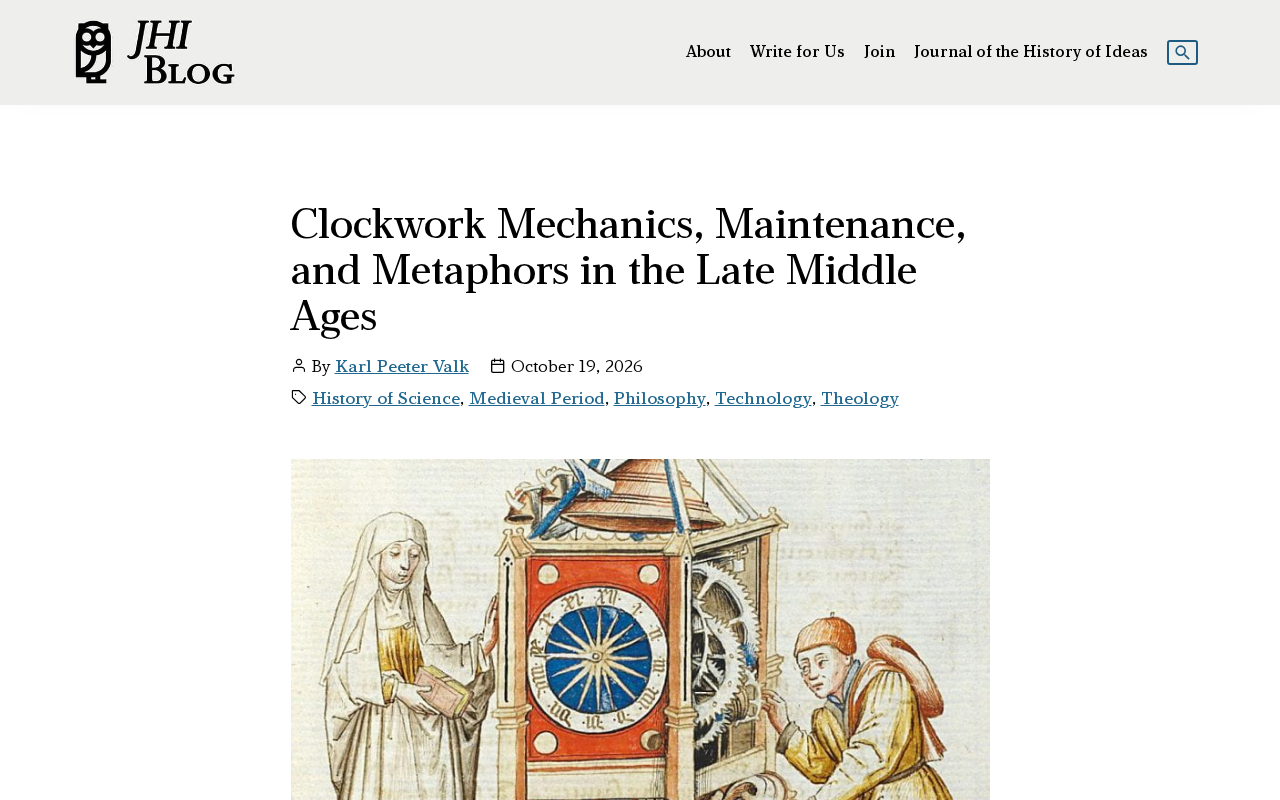
For those working in AI and software engineering today, this history is no mere anecdote. The terms we commonly use to describe large models—"black box," "pipeline," "alignment," "tuning," "system maintenance"—all continue the same lineage of mechanical metaphors. Understanding where this lineage comes from helps us see what mental models we are using to understand the systems we build.
The Clockmaker as the First "System Maintenance Engineer"
The public clock tower of the late Middle Ages was a complex system: power came from weights, transmission relied on gear trains, the escapement controlled the rhythm, and the striking mechanism coordinated multiple mechanical figures. If any single component failed, the entire tower would stop. Thus specialized clock maintainers emerged, who needed to record faults, stock spare parts, and adjust lubrication schedules seasonally.
The original article points out that this maintenance practice gave rise to an early form of "systems thinking": maintainers no longer saw the clock as a collection of parts, but as an interdependent whole in which any local change would affect the whole. This forms an interesting echo with modern software engineering concepts such as observability, dependency management, and fault isolation.
More crucially, maintenance work was recorded, discussed, and written into contracts. Maintenance contracts between clockmakers and municipal authorities often specified inspection cycles and boundaries of responsibility in detail. This practice of "constraining system behavior through documentation" can be seen as the distant ancestor of DevOps culture.
Escapement is the most critical and ingenious component of a mechanical clock. Its function is to convert the continuous power provided by a weight or mainspring into periodic, countable pulses, so that the clock "ticks" forward. The earliest escapements appeared in European tower clocks in the late 13th century, such as the ratchet escapement recorded by Richard of Wallingford. By alternately locking and releasing the escape wheel and the pallet fork (or similar components), it controls the rotational speed of the gear train, making timekeeping accuracy far higher than that of earlier water clocks or sundials. The introduction of the escapement not only laid the technical foundation for mechanical clocks but also paved the way for later pendulum clocks and balance-spring timepieces. On the metaphorical level, the escapement symbolizes "order constraining chaos"—it cuts an irregular flow of power into regular beats, an image often used to analogize how social norms or divine providence discipline secular time.
The Power of Metaphor: The World as a Machine
The word "metaphors" in the title points to the most insightful part of the article. In the late Middle Ages, the clock became the most popular source of analogy:
- The universe was compared to a giant clock wound by God, with planetary motions like meshing gears;
- The body was compared to a precision machine, with doctors needing to "repair" imbalanced humors like clockmakers;
- Society was compared to a clock tower, with each class performing its role like large and small gears working together.
The article reminds readers that such metaphors are not neutral rhetoric. When the world is described as a machine, the responsibility for maintenance shifts from divine providence to human beings—humans have an obligation to keep the machine in good condition. This implication recurs repeatedly in today's AI governance discussions: when a model is called a "system," people naturally ask who is responsible for monitoring, who is responsible for fixing it, and who is responsible for pressing the stop button when it goes wrong.
Mechanical metaphor in the history of science and cognitive linguistics refers to the use of the structure and operation of machines (especially clocks, levers, gears, etc.) to analogize natural, social, or mental phenomena. This metaphor was extremely prevalent from the late Middle Ages to the early modern period. Representative figures include Boyle, who compared the universe to "God's clock," and Descartes, who viewed the human body as an "automaton." The epistemological value of the mechanical metaphor lies in its ability to decompose complex systems that are difficult to observe directly into understandable functional components, suggesting that overall behavior can be derived from local mechanisms. However, it also presupposes that "systems are closed, decomposable, and predictable," and thus may be misleading when applied to systems characterized by emergence, self-organization, and nonlinearity (such as neural networks). The contemporary debate in cognitive science between "computationalism" and "embodied cognition" is, in a sense, a continuation of the question of the applicable boundaries of the mechanical metaphor.
Why Technologists Should Reread This History
Most AI practitioners are familiar with the computational tradition from Turing, Shannon, and von Neumann onward, but often have only a vague impression of the history of clockwork. Yet the mechanical metaphor has profoundly shaped the way we describe intelligence: we call reasoning "computation," learning "training," failures "bugs," and fixes "patches." Behind these words lies a whole set of assumptions about "machines that can operate like humans and can also fail like machines."
An implicit argument of the original article is that maintenance, rather than invention, is the normal state of the human–machine relationship. Clockmakers spent most of their time wiping, calibrating, and replacing worn parts, not building new clocks. In today's AI systems, compute and training may attract attention, but what truly determines long-term reliability are "maintenance" tasks such as data pipelines, monitoring and alerting, and rollback mechanisms.
From Mainsprings to Weights: The Continuation and Limits of the Metaphor
Comparing large models to clocks has explanatory power, but also obvious limitations. Every gear in a clock can be taken apart, understood, and replaced; the internal representations of neural networks, however, remain difficult to interpret layer by layer. A clockmaker can judge which gear is worn by experience, while a model engineer often has no idea where to start when faced with a bizarre output.
This precisely shows that the mechanical metaphor both illuminates and obscures. It can help us build the intuition that "systems need maintenance," but it may lead us to underestimate the fundamental difficulty of interpretability in AI systems. The original article's emphasis on "maintenance" reads today more like a reminder: rather than insisting on fully disassembling the model, it is better to first establish reliable observation and intervention mechanisms so that the system can be safely cared for even when it is not fully understood.
Although the Hacker News discussion was quiet, it brought to the surface a thread often overlooked in tech narratives: our understanding of machines is never just a technical matter, but also a matter of metaphor. The next time you write "this needs maintenance" in a code comment, perhaps you might pause and think: this sentence has already echoed through European clock towers for hundreds of years.
Interpretability in the AI field refers to the degree to which humans can understand a model's internal representations and the basis for its decisions, often divided into "global interpretability" (understanding the model's overall logic) and "local interpretability" (explaining a single prediction). For deep neural networks, especially large language models, the nonlinear interactions among billions of parameters make layer-by-layer, neuron-by-neuron semantic interpretation extremely difficult, which stands in sharp contrast to the "decomposability" of clock gears. Current mainstream approaches include post-hoc attribution methods (such as attention visualization and SHAP) and mechanistic interpretability (such as sparse autoencoders and circuit analysis), the latter attempting to locate identifiable "feature circuits" at the level of neuron activations. The difficulty of interpretability directly constrains AI governance: when the model's interior cannot be fully understood, regulators and engineers can only rely on external behavioral monitoring and intervention mechanisms. This is precisely the technical reality the original article refers to as "can still be safely cared for even when not fully understood."
One-line Summary
Medieval clock maintenance practices gave rise to mechanical metaphors and systems thinking that still shape AI's cognitive frameworks today.
Paragraph Summary
The article starts from an obscure Hacker News discussion about late medieval clockwork mechanics, maintenance, and metaphors, pointing out that clocks were not merely timekeeping tools but a cognitive framework: the universe, the body, and society were all compared to machines that need care. Clockmakers, as the first "system maintenance engineers," developed holistic, documented maintenance practices that can be seen as the distant ancestors of modern operations culture. This lineage of mechanical metaphors continues to this day, profoundly shaping core vocabulary and mental models in AI such as "training," "tuning," "alignment," and "maintenance." The article emphasizes that maintenance rather than invention is the normal state of the human–machine relationship, while also reminding us of the limitations of the mechanical metaphor when explaining large models: gears can be disassembled and replaced, but the internal representations of neural networks remain difficult to interpret layer by layer.
Related articles

Is the Agent Harness Dead? Cursor's Early Engineer Breaks Down the Real Architecture of AI Coding Agents
Cursor early engineer Jediah breaks down the real architecture of the agent harness: why "the harness is dead" is only half right, how the data flywheel lets the harness obsolete itself, and how Grokbot, software factories, and primitive design open new frontiers for agents.

Python Visitor Pattern and Better Alternatives Explained
A deep dive into Python's visitor pattern and four alternatives: method pattern, pattern matching, dictionary mapping, and functools.singledispatch. Choose the best decoupling design by change frequency.

357 Days of Deep Experience: Why Omarchy Made Me Stop Distro-Hopping
A 357-day deep dive into Omarchy: 59-second install, out-of-the-box audio and GPU support, the Quattro QuickShell rewrite migration pains, and why Arch users should try it.