MeetStream AI: Unified API Building Infrastructure for Meeting AI Agents

MeetStream AI provides unified API infrastructure for building AI Agents that actively participate in meetings.
MeetStream AI positions itself as Agent-first infrastructure for meetings, offering a single API to connect Zoom, Google Meet, and Microsoft Teams with 50+ real-time data points. Its built-in voice infrastructure enables AI Agents to join meetings as visible participants—listening, speaking, and acting. While opening exciting possibilities for real-time assistants, sales agents, and automated workflows, it faces challenges including platform dependency risks, multi-layered competition, and complex compliance requirements.
When Meetings Enter the Agent Era
Video conferencing has long been standard for modern collaboration, and AI is evolving from a passive "recorder" to an active "participant." Most meeting AI tools in the past were limited to post-meeting transcription and summary generation—essentially playing the role of a "bystander." MeetStream AI, which recently debuted on Product Hunt with 103 votes and a #5 ranking, proposes a more radical positioning: providing unified API and infrastructure for meeting AI Agents.
Its core tagline—"Unified API & Infra for AI Meeting Agents"—targets a rapidly forming market: enabling AI to join meetings as a "participant," listening, speaking, and acting in real time, rather than merely summarizing after the fact.
The AI Agent concept mentioned here is one of the most closely watched technical paradigms in artificial intelligence today. What distinguishes it from traditional AI tools is its autonomy—an Agent can perceive its environment, formulate plans, execute actions, and adjust behavior based on feedback, forming a complete perception-decision-action loop. Since large language models (LLMs) have matured, Agents are seen as the key transition for AI moving from "tool" to "assistant" and even "colleague." Since 2024, leading companies like OpenAI, Google, and Anthropic have all made Agent capabilities a core strategy, while Agent applications in vertical domains (such as customer service, programming, and data analysis) have begun generating real commercial value.
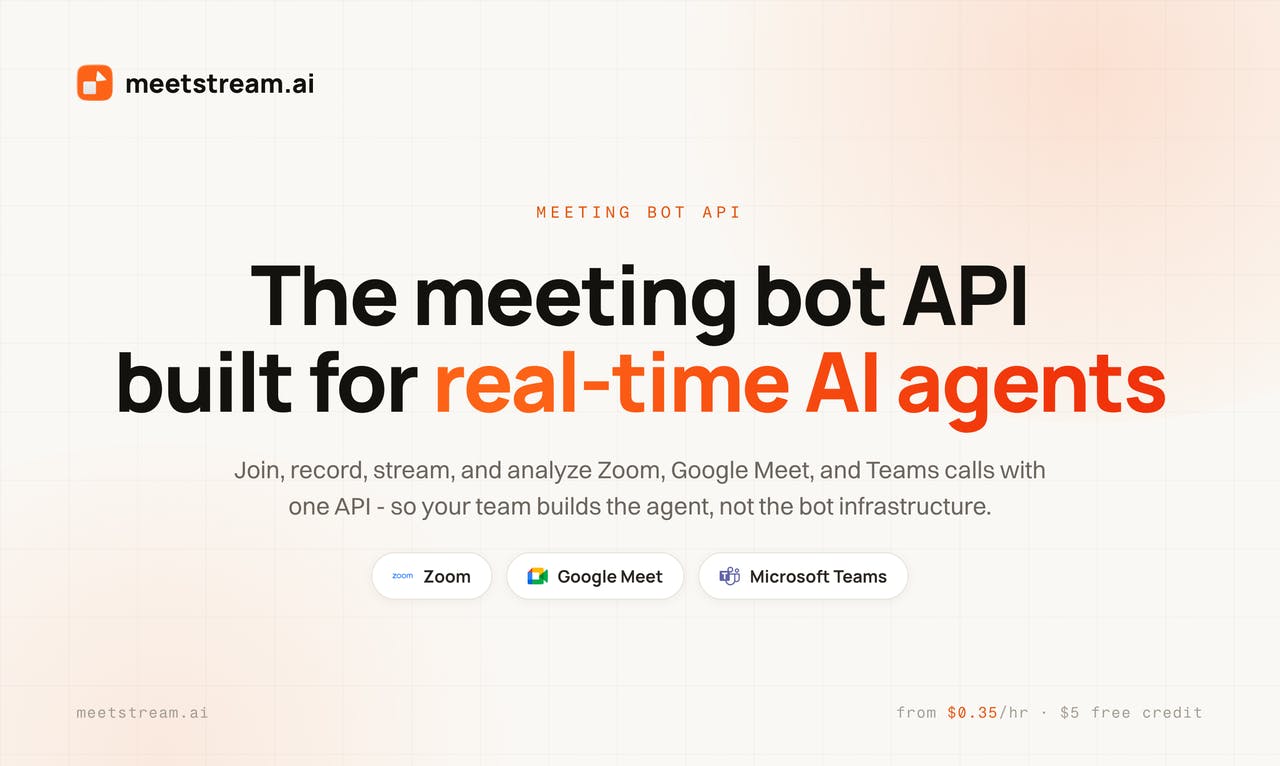
One API to Connect Zoom, Google Meet, and Microsoft Teams
MeetStream AI's most direct value proposition is using a single API to simultaneously connect with Zoom, Google Meet, and Microsoft Teams—the three major meeting platforms. For developers, this solves a very real pain point: each platform has its own independent SDK, authentication mechanism, and data model. Building a cross-platform meeting Agent typically requires separate integrations and repeated debugging.
To understand the depth of this pain point, consider the technical ecosystem differences among the three platforms. Zoom offers Video SDK and Meeting SDK based on its proprietary multimedia transport protocol. Google Meet relies on the Google Workspace ecosystem, integrating through Google Calendar API and Meet REST API, though real-time media stream access has long been restricted. Microsoft Teams is deeply bound to the Microsoft 365 and Azure ecosystem, using Graph API for data interaction—its Communications API supports real-time media streams but is complex to configure. The three platforms differ in authentication mechanisms (OAuth flows), webhook event models, and audio/video encoding formats, causing cross-platform development complexity to multiply.
According to official documentation, the API can capture over 50 real-time data points from meetings. This means developers can access not only audio streams and transcription text, but potentially participant status, speaking sequences, screen-sharing events, and other structured information. These data points serve as the "sensory input" for building intelligent meeting Agents—for an Agent to understand what's happening in a meeting, it first needs sufficiently rich, real-time context.
From "Recording" to "Real-Time Perception"
Traditional meeting assistants mostly operate in asynchronous mode: processing recordings and generating minutes after the meeting ends. MeetStream AI emphasizes real-time capability. When data is captured as a stream during the meeting, the Agent can potentially intervene at the right moment—answering questions in real time, retrieving materials, recording action items, or even speaking on behalf of an absent participant.
Behind real-time processing is an entire stream computing architecture. In traditional batch processing, audio is fully recorded before being sent to a speech recognition engine. Stream mode requires audio data to be processed frame by frame as it's generated, with speech recognition results output incrementally. This places strict requirements on end-to-end latency control—for an Agent to interact naturally in conversation, end-to-end latency must be kept within 200-500 milliseconds, covering every stage from audio capture, automatic speech recognition (ASR), language model inference, to text-to-speech (TTS).
Built-in Voice Infrastructure: Making Agents True Meeting Participants
The most imaginative aspect of MeetStream AI is its built-in voice infrastructure. According to official descriptions, with this capability, your Agent can "join as a participant, listen, speak, and act while the call is happening."
Building an AI Agent that can "listen and speak" in meetings requires integrating multiple voice technologies into a complete tech stack. At the ASR (Automatic Speech Recognition) layer, current mainstream solutions include OpenAI Whisper, Google Speech-to-Text, and Deepgram Nova, each with different trade-offs between accuracy and latency. At the TTS (Text-to-Speech) layer, ElevenLabs, Play.ht, and OpenAI TTS provide near-natural voice synthesis, but achieving low-latency streaming output still presents technical challenges. At the dialogue management layer, issues like turn-taking detection, barge-in handling, and silence detection must be addressed in real time. Additionally, there are audio engineering challenges including Acoustic Echo Cancellation (AEC), noise suppression, and Speaker Diarization, as well as WebRTC protocol stack adaptation. The integration quality of these components directly determines whether the Agent's meeting interaction experience feels natural and fluid.
This fundamentally differs from most meeting AI products on the market today. Most products are "invisible" background services, while MeetStream aims to have AI appear as a visible, interactive identity in the meeting participant list—it can hear conversations, speak up, and execute specific actions. This effectively pushes meeting AI from "tool" territory toward "digital colleague" territory.
Typical Use Cases for Meeting AI Agents
This combination of "can listen, can speak, can act" opens up numerous new scenarios:
- Real-time meeting assistant: Can be @mentioned during discussions to search internal documents and verbally respond.
- Sales/customer service Agent: Joins client meetings on behalf of the company, responding in real time and recording key information.
- Multilingual real-time translation Agent: Provides simultaneous interpretation as a participant.
- Automated workflow triggers: When someone mentions "create a ticket" or "schedule a meeting," the Agent automatically executes follow-up actions.
Agent-First Architecture: Infrastructure Positioned for Developers
Interestingly, MeetStream AI is categorized under API, Meetings, Developer Tools, positioning itself as "Agent-first infrastructure for meetings." This indicates it's not a finished application for end users, but rather a foundational capability platform for developers.
This positioning is quite representative of the current AI startup wave. As AI Agents become a hot direction, more teams are choosing to build "shovels" rather than mine for "gold"—providing infrastructure, APIs, and SDKs that let downstream developers build diverse specific applications. Meetings are a high-frequency, high-value scenario with relatively standardized data structures, making them a natural entry point for Agent infrastructure.
Why Choose the Infrastructure Layer
Building a system that can stably connect to multiple platforms, process real-time audio/video streams, and support bidirectional voice interaction has a very high technical barrier. It involves real-time audio encoding/decoding, low-latency transmission, platform adaptation, and integration of speech synthesis and recognition—complex engineering challenges. If every application team had to build from scratch, costs would be extremely high. MeetStream AI encapsulates this complexity into a unified API, theoretically significantly lowering the development threshold for meeting Agents.
In this space, MeetStream AI is not alone. Recall.ai similarly provides meeting bot infrastructure, allowing developers to connect Bots to major meeting platforms for real-time data. Nylas entered through calendar and communication APIs, gradually extending into meeting scenarios. This "infrastructure-as-a-service" model has mature precedents in the developer tools space—just as Stripe is to payments and Twilio is to communications, meeting Agent infrastructure could potentially give rise to similar platform-level companies.
Opportunities and Challenges: A Sober Assessment of MeetStream AI's Prospects
Despite the appealing direction, products like this face significant real-world challenges.
Platform dependency risk is the primary concern. Zoom, Google, and Microsoft are all heavily investing in their own meeting AI (such as Zoom AI Companion, Google Gemini for Meet, and Microsoft Copilot). The degree to which third-party infrastructure can maintain stable platform API access remains uncertain.
The current meeting AI market has formed a multi-layered competitive landscape. The first layer is platform-native AI: Zoom AI Companion provides meeting summaries and smart Q&A, Microsoft Copilot deeply integrates with Teams for real-time captions and content generation, and Google Gemini is adding notes and follow-up action items for Meet. The second layer is independent applications: Otter.ai, Fireflies.ai, Grain, and other SaaS tools focused on meeting notes and summaries already have large paying user bases. The third layer is infrastructure/API: Recall.ai, Nylas, and others provide meeting bot infrastructure, and MeetStream AI targets precisely this layer. This layered competition means infrastructure players need to find sustainable value between platform-native capability expansion and independent applications building their own capabilities. Historically, platforms tightening API access is not uncommon (e.g., Twitter/X's restrictions on third-party clients), representing a systemic risk for such startups.
Compliance and privacy are equally critical. Having AI join meetings as a participant, recording and processing conversation content, involves a series of compliance requirements around recording notification, data storage, and cross-border transfer—especially important in enterprise and regulated industry scenarios. Specifically, U.S. states differ in recording consent requirements (one-party consent vs. all-party consent), the EU's GDPR has strict lawful basis and data minimization requirements for personal data processing, and industries like finance and healthcare have additional data protection regulations. An AI Bot appearing as a "participant" in meetings faces more complex data collection scope and notification obligations than traditional background recording tools.
Additionally, looking at the Product Hunt data, 103 votes and 7 comments represent a moderately high level of attention, indicating the product has gained some traction. However, validating genuine market demand and technical maturity still requires time.
Conclusion: Meeting AI Moves from Bystander to Participant
MeetStream AI represents a clear evolutionary direction for meeting AI: from post-meeting recording to real-time participation, from end-user applications to Agent infrastructure. It attempts to use a unified API and built-in voice capabilities to enable developers to quickly build AI Agents that "know how to attend meetings."
For teams exploring AI Agent deployment scenarios, infrastructure tools like this are worth watching—they lower the barrier to entry and signal that meeting rooms may genuinely gain a "digital participant" in the future. Of course, whether it can ultimately succeed depends on its long-term performance in platform ecosystem relationships, stability, and compliance. From a broader perspective, meeting Agents are just one microcosm of AI Agents permeating workflows entirely—when Agents can participate in meetings, handle emails, manage projects, and write code, the boundaries of human-machine collaboration will be fundamentally redefined.
Related articles

Asakiri Studio: A Detailed Look at the Open-Source, Local-First Language Course Creation Tool
Asakiri Studio is a free, open-source, local-first language course creation platform enabling teachers and creators to build courses combining textbook depth with interactive exercises.

AI Boosts Homework Scores by 18% but Tanks Exam Performance by 20%: The Cost of False Efficiency
Research shows students using AI score 18% higher on homework but 20% lower on closed-book exams. This article analyzes how AI creates a 'grade illusion' and erodes real learning ability.

DeepSeek Harness Hands-On Review: Deep Dive into the "Everything is a Plugin" AI Agent Framework
Hands-on review of DeepSeek Harness (DSH), the open-source AI Agent framework with a fully plugin-based architecture. Covers installation, plugin ecosystem, custom plugin creation, and comparison with Codex.