MemEmo Benchmark: Memory Systems Score Only 45% on Emotional Intelligence
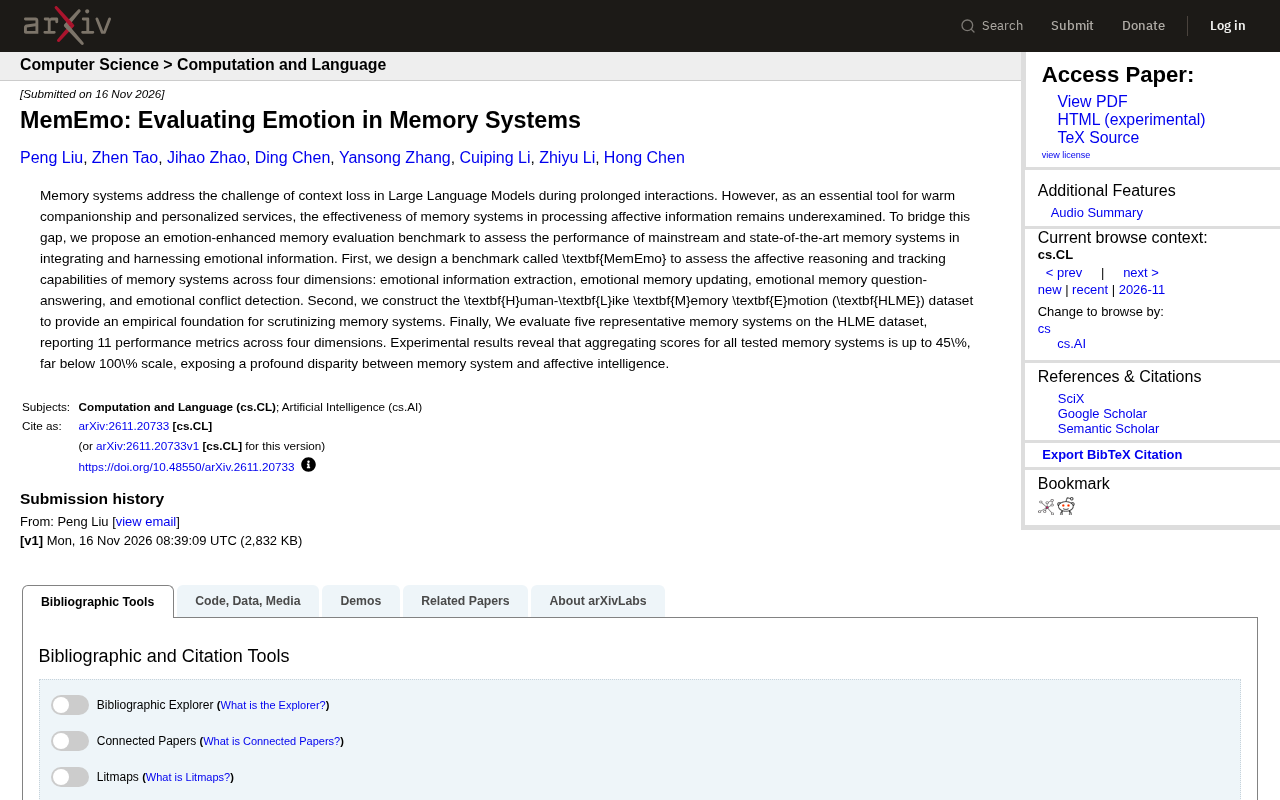
MemEmo benchmark reveals mainstream memory systems score only 45% at best on emotional processing, far from passing.
The study proposes the MemEmo benchmark to evaluate memory systems' emotional capabilities across four dimensions: emotion extraction, memory updating, question answering, and conflict detection. Using the HLME dataset, it tested five representative systems on 11 metrics, finding a top aggregate score of only 45% versus 100%. This exposes a gap: memory systems remember facts but struggle with emotions. MemEmo turns emotional intelligence into quantifiable engineering metrics for AI companionship and personalization.
The Emotional Shortcoming of Memory Systems: Starting with the MemEmo Benchmark
Large language models tend to lose context during long interactions, and memory systems are designed precisely to solve this problem. However, when memory systems are used to provide warm companionship and personalized services, their ability to process emotional information has rarely been systematically tested. A recent study proposed the MemEmo benchmark, specifically designed to evaluate how memory systems perform on the emotional dimension—and the results are not encouraging: the five representative memory systems tested achieved a maximum aggregate score of only 45% across all dimensions, far below the 100% full-mark line.
This result reveals a key contradiction: memory systems are good at "remembering facts" but exhibit a profound disparity in "understanding emotions." For AI applications pursuing human-like interaction, this is undoubtedly a signal worth attention.
Memory systems in this context do not refer to the memory mechanisms of the human brain, but rather to engineering modules attached to large language models for persisting and retrieving information across sessions or within long conversations. Common implementations include vector database retrieval, summary-based memory, structured key-value storage, and graph-based memory. Such systems typically take "fact recall rate" and "context consistency" as their core optimization objectives. Their typical architecture splits conversations into segments, encodes them into vectors or summaries, stores them in a storage layer, and then retrieves them by semantic similarity when needed. Because the entire pipeline is designed around information fidelity, emotional signals (such as tone, emotion labels, and emotional shifts) are often not explicitly modeled, making them difficult to leverage effectively during retrieval and reasoning.
How Does MemEmo Evaluate Emotional Memory?
The research team decomposed emotional memory capability into four measurable dimensions and designed the benchmark accordingly:
- Emotional information extraction: Can the system accurately identify and extract emotional signals from conversations?
- Emotional memory updating: When a user's emotional state changes, can the memory system promptly correct outdated emotion labels?
- Emotional memory question answering: For questions involving past emotional experiences, can the system correctly retrieve and answer?
- Emotional conflict detection: When faced with contradictory emotional expressions, can the system identify the conflict and handle it reasonably?
These four dimensions cover the complete pipeline of emotional memory, from encoding and storage to retrieval and reasoning. The study also constructed the HLME (Human-Like Memory Emotion) dataset to provide an empirical foundation for the above tasks, evaluated five representative memory systems on this dataset, and ultimately reported 11 performance metrics covering the four dimensions.
The Technical Reality Behind the 45% Score
The most striking finding of the experiment is that the highest aggregate score among all tested memory systems was only 45%. This means that even under a relatively basic evaluation framework, mainstream solutions' emotional processing capabilities fall far short of passing.
From the dimension design, it can be inferred that this deficiency may come from two levels. First, existing memory systems mostly optimize for factual information, so emotional signals are easily filtered out or simplified as noise in the pipeline. Second, the dynamic nature of emotional memory—for example, a user shifting from frustration to relief—requires the system to continuously update beliefs, whereas most memory architectures are better at static storage than dynamic revision.
The study measured performance on the HLME dataset using 11 metrics. This multi-dimensional evaluation approach also indicates that emotional memory is not a single capability but the result of multiple subtasks working together. Weakness in any one link will drag down overall performance.
Aggregate score refers to summarizing metrics from multiple subtasks and dimensions into a single value according to certain rules, so that different systems can be compared horizontally. In MemEmo, the 11 metrics cover four types of tasks: extraction, updating, question answering, and conflict detection. The aggregation method typically averages metrics within the same category first, then weights across dimensions. It should be noted that aggregate scores can mask imbalances between dimensions: a system may perform reasonably well on emotional information extraction but nearly fail on emotional memory updating or conflict detection, and the final summarized 45% will still appear "mediocre." Therefore, when interpreting this number, one should combine the sub-metrics to determine whether the shortcoming lies in encoding, storage, or retrieval and reasoning, rather than inferring the system's overall usability solely from the total score.
The HLME (Human-Like Memory Emotion) dataset is a dialogue-level data resource specifically constructed for emotional memory evaluation. Its design goal is to ensure that each test sample carries a trackable emotional state and its temporal evolution. Unlike general dialogue datasets, HLME needs to annotate emotional signals in conversations, the time points when emotion labels change, answerable emotion-related questions, and contradictory emotional expressions, thereby supporting separate measurement of the four task types. The difficulty in constructing such datasets lies in the subjectivity of emotion annotation: the same sentence may be interpreted as different emotions in different contexts, and annotation consistency directly determines the reproducibility of the benchmark. For this reason, the value of HLME as evaluation infrastructure lies not only in providing questions but also in defining an operational measurement boundary for the vague concept of "emotional memory."
Implications for AI Companionship and Personalized Services
The scenarios where memory systems are most highly anticipated are precisely those with the highest emotional density. Whether it is a long-term companion dialogue assistant or a personalized service that needs to remember user preferences, the accuracy of emotional memory directly affects the "warmth" of the experience.
The value of the MemEmo benchmark lies in transforming "emotional intelligence" from a vague user feeling into quantifiable, comparable engineering metrics. For developers, this means that when designing memory modules, the extraction, updating, and conflict handling of emotional information need to be explicitly designed rather than relying on the natural spillover of general memory capabilities. For researchers, the 45% score is a clear starting point—it marks the true water level of the current technology stack and provides a reproducible measurement tool for subsequent improvements.
Only when memory systems evolve from "remembering what users have said" to "understanding what users have felt" will the human-likeness of AI interaction truly materialize. The emergence of MemEmo is precisely a step forward in evaluation infrastructure toward this direction.
One-line Summary
MemEmo benchmark reveals that mainstream memory systems' emotional processing aggregate score is only 45% at best, far from passing.
Paragraph Summary
The study proposes the MemEmo benchmark to specifically evaluate the emotional dimension capabilities of large language model memory systems. The benchmark decomposes emotional memory into four dimensions: emotional information extraction, emotional memory updating, emotional memory question answering, and emotional conflict detection, and constructs the HLME dataset to evaluate five representative memory systems, reporting 11 metrics covering the four dimensions. The results show that the highest aggregate score among all tested systems is only 45%, far below the 100% full mark, exposing a significant gap: memory systems are good at remembering facts but poor at understanding emotions. The article analyzes that this shortcoming stems from existing systems optimizing for factual information, emotional signals being easily filtered as noise, and most architectures being better at static storage than dynamic revision. The value of MemEmo lies in transforming emotional intelligence into quantifiable, comparable engineering metrics, providing evaluation infrastructure for memory module design in AI companionship and personalized services.
Related articles
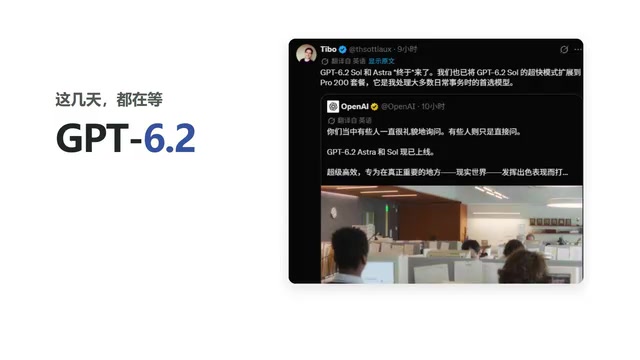
GPT-6.2 and Astra Launch Together: OpenAI Has Finally Figured Out Its Release Cadence
OpenAI releases GPT-6.2 Sol and Astra together, with Plus users able to try them in ChatGPT Work and Codex. This article breaks down the positioning differences between the two models, Astra's practical use in long-document retrieval and rewriting, and how the simultaneous dual-model launch affects user workflows.

GPT-6.2 Dual-Model Hands-On: How Big Is the Gap Between Astra and Sol in Clock-Making and Game-Building?
GPT-6.2 Astra vs Sol hands-on: Blender clock, neon shooter, and Formula racing compared. Astra spends $419 with strong execution; Sol costs $197 but drops to 2 FPS. Both still trail Fable and Opus in games and aesthetics.

GPT-6.2 Astra and Sol Released: A Big Cost Drop, and How to Choose Between the Two Models
OpenAI releases GPT-6.2 Astra and GPT-6.2 Sol: Astra tackles professional tasks, Sol targets low-cost everyday use, with cost per task cut to under a third.