MeMo Open-Source AI Agent Platform In-Depth Review: Long-Term Memory + MCP Protocol + Multi-Bot Collaboration in Practice

MeMo is a fully open-source, feature-rich AI Agent platform with long-term memory and MCP support
MeMo is a fully open-source AI Agent platform supporting macOS, Windows, and Linux with extremely low installation barriers. Key highlights include: a cross-session long-term memory system that helps AI understand users better over time; MCP protocol support and a skills marketplace for tool ecosystem expansion; multi-Bot containerized isolation ensuring security and flexibility; and omni-channel integration covering platforms like WeChat and QQ. Compatible with major LLM providers and local deployment options, it's suitable for both individual users and enterprise-grade custom development.
What is MeMo: A Truly Fully Open-Source AI Agent Platform
AI Agent platforms are popping up everywhere, but truly fully open-source products that are both feature-complete and deliver an excellent experience remain scarce. MeMo (affectionately called "Lobster" in the community) is one such noteworthy open-source agent platform. It has evolved from an early web-based project to a desktop client, now supporting macOS, Windows, and Linux. It demonstrates impressive capabilities in long-term memory systems, MCP protocol integration, and multi-Bot collaboration.
An AI Agent refers to an AI system capable of autonomously perceiving its environment, making decisions, and executing tasks — fundamentally different from traditional single-turn Q&A chatbots. Agents possess capabilities like tool invocation, task planning, multi-step reasoning, and persistent memory. Since 2023, as large language model capabilities have advanced rapidly, the AI Agent space has heated up significantly, with products like AutoGPT, LangChain, Dify, and Coze emerging in succession. However, many platforms are either closed-source commercial products (like Coze) or lack feature completeness. Against this backdrop, MeMo aims to provide a truly "full-featured + fully open-source" solution, filling a gap in the market.
If you're looking for an open-source AI Agent solution, MeMo offers a feature-complete, highly extensible starting point that's worth investing time to explore.
Installation & Basic Configuration: Building Your Agent from Scratch
One-Command Deployment
MeMo has an extremely low installation barrier — arguably one of the simplest among similar products. The Web UI version requires just a single command for deployment, and a recently released simplified installation method makes it even easier. The desktop client is even more straightforward — download the installer, double-click to run, and you're up with virtually zero configuration.
Model Integration & Search Engine Configuration
After installation, the first step is configuring your large language model in the Provider settings. MeMo is compatible with virtually all major LLM providers, including DeepSeek, OpenAI-compatible endpoints, and locally deployed models (such as Ollama). The configuration process is highly intuitive: select your model provider → paste your API key → enable — three steps and done.
It's worth elaborating on Ollama here. Ollama is a lightweight local LLM runtime framework that allows users to run open-source large language models like Llama, Mistral, and Gemma on their own machines without relying on cloud APIs. Through optimized model quantization and inference engines, it enables consumer-grade GPUs — or even CPU-only environments — to run fairly large models. For users who prioritize data privacy or want to reduce API costs, Ollama provides a completely offline, zero-cost alternative. MeMo's native support for Ollama means users can run agents in completely air-gapped environments, which is particularly important for data-sensitive enterprises.
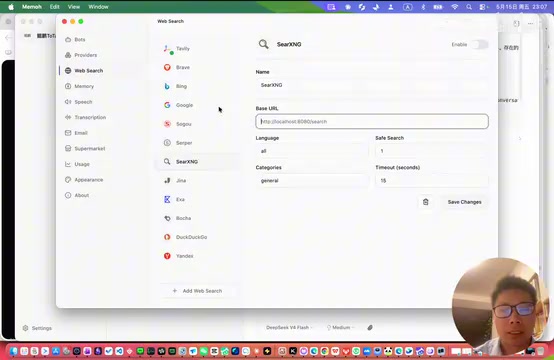
Notably, MeMo embeds web search capabilities directly into the platform. You can connect commercial search APIs like Tavily, or locally deploy open-source search engines like SearXNG for completely free internet search. This kind of flexibility is uncommon among open-source AI Agent projects.
SearXNG is an open-source metasearch engine that doesn't maintain its own search index. Instead, it simultaneously sends user queries to multiple search engines like Google, Bing, and DuckDuckGo, then aggregates and deduplicates the results. Its core advantage lies in privacy protection — users' search behavior isn't tracked by any single search engine. SearXNG can be deployed locally or on private servers with a single Docker command. When used with MeMo, the AI Agent's web search capability runs entirely on the user's own infrastructure — both free and privacy-preserving. This is particularly attractive for enterprise intranet deployment scenarios.
Deep Dive into Core Features
Long-Term Memory System: Making AI Truly "Remember" You
MeMo's built-in Memory feature is what fundamentally distinguishes it from ordinary AI chat tools. Long-term memory means your AI assistant can remember conversation content, user preferences, and important information across sessions, delivering more personalized and coherent responses in subsequent interactions.
From a technical perspective, AI long-term memory is one of the core research directions in the Agent field. Traditional large language models are constrained by context window length — even models supporting 128K tokens cannot remember conversations from weeks ago. Long-term memory systems work by extracting key information, vectorizing it, and storing it in external databases (typically vector databases like ChromaDB or Milvus). During subsequent conversations, relevant memory fragments are retrieved via semantic search and injected into the current conversation context, achieving "cross-session memory." This mechanism mimics the human brain's "hippocampus-to-neocortex" memory consolidation process, enabling AI to accumulate understanding of user preferences, historical decisions, and long-term goals — rather than just appearing smart within a single conversation.
Each Bot can independently configure its memory system, truly achieving the effect of "getting to know you better over time." This is especially practical for scenarios requiring continuous interaction, such as personal assistants or customer service.
MCP Protocol Support & Skills Marketplace
MeMo supports the MCP (Model Context Protocol), enabling interoperability with the broader AI tools ecosystem.
MCP is an open standard protocol proposed by Anthropic in late 2024, designed to establish a unified communication interface between large language models and external tools and data sources. Before MCP, every AI platform had to write custom integration code for each tool, leading to severe ecosystem fragmentation. MCP defines a standardized JSON-RPC communication format, including tool descriptions (Tool Schema), parameter passing, and result returning specifications, allowing any MCP-compliant tool to be called plug-and-play by any MCP-supporting Agent platform. This is similar to what the USB protocol did for hardware devices — with MCP, developers only need to write a tool adapter once for it to run across all compatible platforms. MeMo's MCP support enables it to tap into the rapidly growing MCP tool ecosystem, dramatically expanding the platform's capabilities.
The platform includes a built-in Supermarket (Skills Marketplace) where users can install various skill extensions on demand:
- Tool-type skills: DLC, PVX, PUT, and other common tools
- Document processing skills: PDF parsing, spreadsheet analysis, etc.
- Custom Skills: Support for creating your own skills
- Third-party compatibility: Any standards-compliant Skills can be installed and used
MCP protocol integration transforms MeMo from a closed chat box into an intelligent agent runtime platform capable of calling external tools and connecting to various services.
Multi-Bot Collaboration & Container Isolation
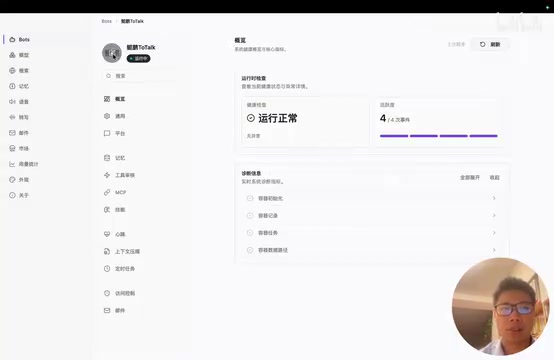
MeMo supports creating multiple Bots, each running in an independent container environment, achieving containerized isolation.
Containerization is an OS-level virtualization technology, with Docker being the most well-known implementation. Containers provide applications with isolated runtime environments, including independent file systems, network stacks, and process spaces. Unlike traditional virtual machines, containers share the host OS kernel, resulting in fast startup times and low resource overhead. In MeMo's context, each Bot running in an independent container means: a code execution error in one Bot won't affect others; a Bot compromised by malicious prompt injection cannot access other Bots' data; different Bots can install different versions of skills and dependencies without conflicts.
This architecture delivers two core advantages:
- Security assurance: Each Bot runs in an independent container without mutual interference, effectively mitigating potential security risks. This is particularly important in enterprise multi-tenant scenarios, effectively preventing data leakage and privilege escalation.
- Scenario-specific customization: You can create dedicated Bots for different purposes — for example, a "Product Manager" Bot for requirements analysis and a "Technical Assistant" Bot focused on code issues, each with independent skill configurations, memory data, and conversation history.
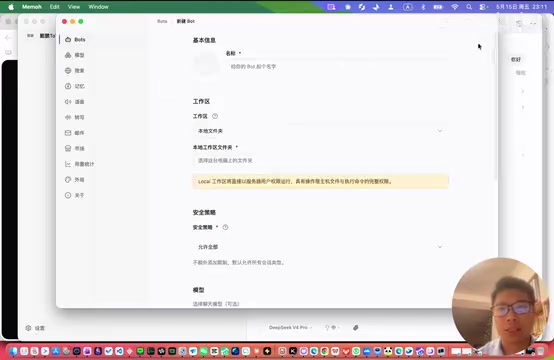
Creating a new Bot is straightforward: click Create → set name, permissions, and memory configuration → done. In just seconds, you have a brand-new independent agent.
Omni-Channel Integration & Practical Features Overview
Multi-Platform Deployment
MeMo supports omni-channel integration, covering major Chinese social platforms like WeChat and QQ. You can deploy trained Bots across various channels with unified management and multi-endpoint reach — extremely practical for teams needing to provide AI services across multiple platforms.
Omni-channel integration is typically implemented through the Adapter Pattern — the platform core maintains unified Agent logic and conversation management, with message format conversion layers written for each channel. The challenge lies in the varying message formats, rich media support, API limitations, and moderation rules across different platforms. MeMo's omni-channel capability provides value to enterprise users by eliminating the need to develop separate Bots for each platform — configure once, deploy everywhere, significantly reducing operational costs and consistency management complexity for AI services.
More Practical Features
| Feature | Description |
|---|---|
| Voice interaction | Supports voice input and speech synthesis |
| Email integration | Configurable email for analysis, summarization, and organization |
| Usage statistics | Local tracking of LLM API calls for cost management |
| Scheduled tasks | Support for scheduled tasks enabling automated workflows |
| File management | Built-in file management with attachment upload and processing |
| Interface customization | Supports Chinese language switching and UI personalization |
Real-World Usage Experience & Interface Design
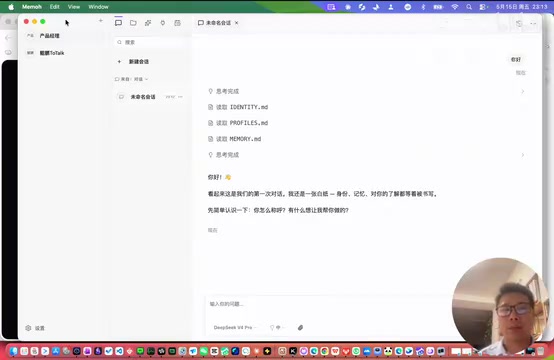
MeMo takes a minimalist approach to its interface, with a clear and logical split-panel layout. The left side displays user identity, Memory, Profile, and other information, while the right side is the conversation area. The overall visual design is clean and sharp, with intuitive interaction patterns. The Dashboard is beautifully designed, with all features clearly accessible at a glance.
As a fully open-source project, MeMo's value lies not only in free usage but also in its high degree of customizability. Enterprises can perform secondary development on MeMo to build proprietary internal AI Agent applications — this openness provides ample room for enterprise-grade deployment scenarios.
Choosing the Right Tool Matters More Than Constantly Switching Tools
AI Agent products are iterating at breakneck speed, and many people fall into the loop of "constantly trying new tools." But ultimately, what we lack isn't tools — it's ideas, execution, and product sense. Choosing a platform that suits your needs and continuously deepening your usage through iteration is far more valuable than frequently switching tools.
The three capabilities truly worth developing are:
- Product thinking: Clearly define what you want to accomplish with AI Agents and plan the implementation path
- Execution ability: Have the capability to turn ideas into reality and actually get your Bot running
- Operations ability: Continuously optimize after launch to ensure your AI Agent delivers long-term value
Conclusion: Is MeMo Actually Worth Using?
As a fully open-source AI Agent platform, MeMo excels in feature completeness, user experience, and extensibility. The long-term memory system makes AI smarter over time, the MCP protocol connects the tool ecosystem, multi-Bot containerized isolation ensures security and flexibility, and omni-channel integration solves deployment and distribution challenges.
Whether you're an individual user building a daily AI assistant or an enterprise team doing deep custom development, MeMo is an open-source choice worth serious consideration. If you're looking for a reliable AI Agent platform, start with MeMo, find the usage pattern that works for you, and let AI truly integrate into your daily workflow.
Key Takeaways
- MeMo is a fully open-source AI Agent platform supporting macOS, Windows, and Linux, with one-command installation
- Built-in long-term memory system (Memory) and MCP protocol support, with a rich marketplace of third-party skill extensions
- Supports multi-Bot creation with containerized isolation — each Bot has its own independent runtime environment, skill configuration, and memory data
- Supports omni-channel integration (WeChat, QQ, etc.), compatible with virtually all major LLM providers and locally deployed models
- Being fully open-source means enterprises can perform secondary development to build proprietary internal AI Agent applications
Related articles
 Product Reviews
The Programmer's Desk Setup Guide: Building a Workspace That Feels Like Home
Discover how programmers build productive, comfortable workspaces. From multi-monitor setups to ergonomic design, explore the desk philosophy that drives focus and flow.
 Product Reviews
Qoder vs Cursor Real-World Comparison: Which $20/Month AI IDE Is Better?
Hands-on comparison of Qoder vs Cursor AI IDEs: Agent autonomy, human interaction count, and architecture decisions. Qoder needed only 2 interactions vs Cursor's 8.
 Product Reviews
Cursor Cloud Agent Demo: Eliminating Bottlenecks Across the Entire Software Development Lifecycle
Deep analysis of Cursor's Cloud Agent demo showing how cloud VMs, automated test artifacts, and a full-chain control plane systematically eliminate human bottlenecks across the software development lifecycle.