MemoryOps: An AI Incident Response Agent That Learns from Past Failures

MemoryOps is an open-source AI ops agent with persistent memory that accumulates incident resolution experience across tasks.
MemoryOps is an open-source AI incident response agent whose core innovation is a persistent memory layer called Hindsight. Through a four-step RECALL→REFLECT→RECOMMEND→RETAIN loop, the agent writes resolution experience back to memory after each incident, enabling progressively more targeted recommendations on similar future problems. Using database connection pool exhaustion as its demo scenario, the project shows how accumulated memory evolves generic troubleshooting into validated, specific fixes. Built on a lightweight React + FastAPI + Groq + Hindsight stack, it remains a demo-level prototype — but raises important open questions about memory granularity, similarity judgment, and stale memory expiration that must be solved before such agents can reach production.
One of the most frustrating scenarios for ops engineers is when the same class of production incident keeps recurring — and every time, the team has to start the investigation from scratch. An open-source project called MemoryOps was built to address exactly this pain point. It's an AI incident response agent with persistent memory, built around a core idea: when handling an incident, the agent should draw on past experience rather than treating every event as a brand-new problem.
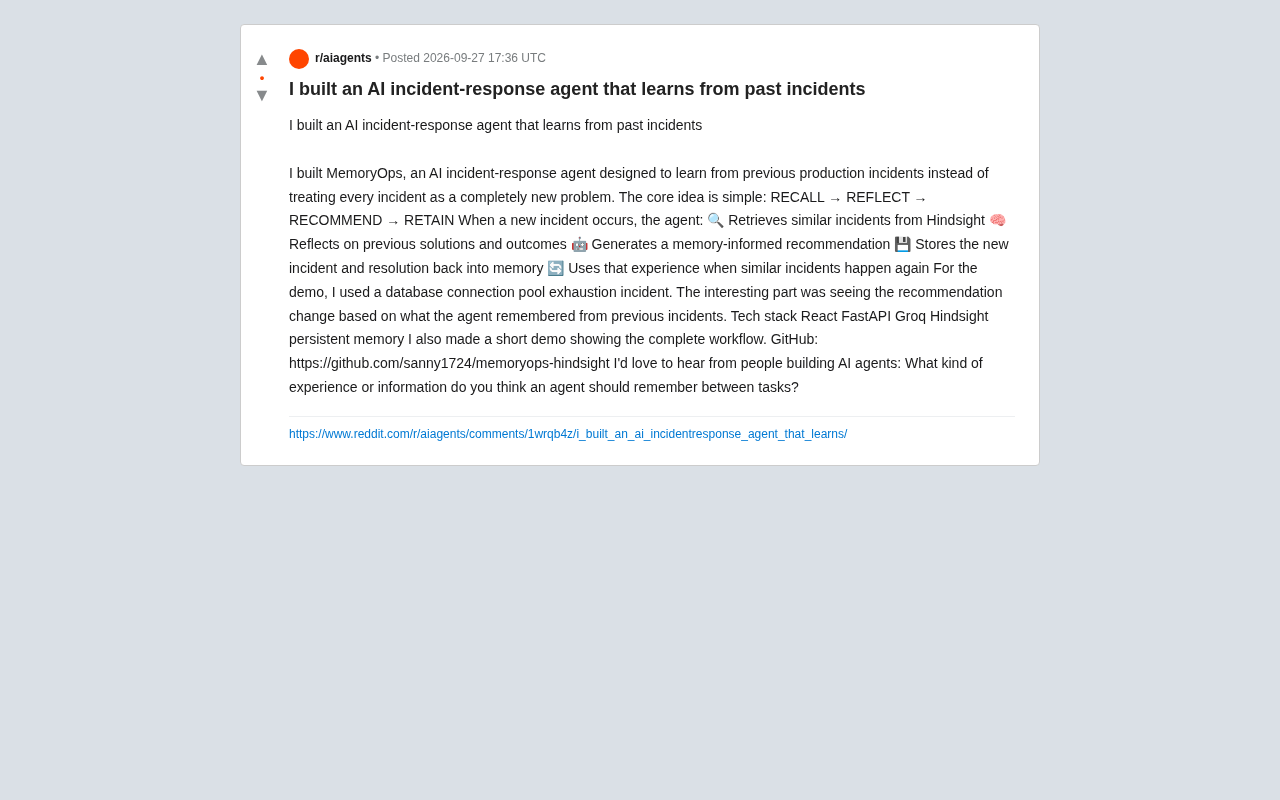
The Core Loop: RECALL → REFLECT → RECOMMEND → RETAIN
Most traditional alerting systems and automation scripts are stateless: an incident arrives, rules are applied, it gets resolved, and everything resets. The next time the same issue appears, the whole process starts over. MemoryOps reimagines this as a closed loop with memory, captured in four verbs:
- RECALL: When a new incident occurs, retrieve similar historical events from the Hindsight memory store.
- REFLECT: Analyze the solutions applied to those past events and their outcomes.
- RECOMMEND: Generate an experience-backed remediation suggestion based on retrieved memories.
- RETAIN: Write the current incident and its resolution back into the memory store for future reuse.
The most valuable step is the fourth one. Every time an incident is handled, the system's accumulated "experience" grows. When a similar problem surfaces again, the agent's recommendation evolves based on what it remembers about the last resolution — instead of outputting the same generic answer every time.
Demo Scenario: Database Connection Pool Exhaustion
For the demo, the author chose a classic ops scenario: database connection pool exhaustion. This type of failure can stem from many causes — connection leaks, slow query pile-ups, traffic spikes, misconfigured pool limits — and the right fix is highly dependent on the specific system's history.
According to the author, the most interesting part of the demo is watching the agent's recommendations evolve as it "remembers" previously handled incidents. The first time it encounters connection pool exhaustion, it may only offer a generic troubleshooting direction. But after accumulating historical resolution records, its suggestions converge toward solutions that have actually been validated in that specific environment. This is the fundamental difference between memory-driven reasoning and a traditional rules engine.
A connection pool is the mechanism that allows application services to reuse existing database connections, avoiding the high-latency cost of establishing a new TCP connection on every request. Pools have a maximum connection limit — when all connections are occupied and none are returned in time, new requests queue up until they time out, causing "connection pool exhaustion." This scenario makes an ideal demo for a memory-driven agent precisely because its root causes are so varied (connection leaks, slow queries, misconfiguration, etc.) that a pure rules engine can't cover all cases, while historical resolution experience effectively shortens the diagnosis path.
Technology Stack Breakdown
MemoryOps is built around a lightweight, iteration-friendly stack:
- React: Frontend UI for displaying the incident workflow and recommendations.
- FastAPI: Backend framework responsible for orchestrating agent logic.
- Groq: LLM inference interface, known for low-latency inference.
- Hindsight: The persistent memory layer, handling historical event storage and similarity retrieval.
Hindsight is the soul of the entire system. The agent's memory isn't simply a log dump into a database — it needs to support similarity-based retrieval and outcome-aware reflection. This kind of persistent memory component is one of the hottest areas of exploration in the AI Agent space right now, because enabling agents to retain valuable context across tasks is what determines their practical usefulness.
Hindsight typically relies on a vector database to power similarity retrieval. The basic mechanism: historical incident events are converted into high-dimensional vectors via an embedding model and stored in a vector index. When a new event arrives, it's converted the same way, and cosine similarity or approximate nearest neighbor (ANN) algorithms identify the most relevant historical records. This is fundamentally different from keyword search — even if two incidents are described in completely different words, they can still be matched if they're semantically close. This "semantic memory" capability is a direct extension of RAG (Retrieval-Augmented Generation) applied to agent workflows, and is a core feature area actively supported by frameworks like LangChain and LlamaIndex.
Why Memory-Driven Agents Matter — and the Open Questions
MemoryOps is a demo-level open-source project, but it touches on a central challenge in deploying AI Agents at scale: accumulating experience across tasks.
Most current AI assistants perform reasonably well within a single session, but reset completely when it ends. For highly repetitive domains like ops, customer support, or code repair, an agent that remembers "this approach worked last time, that one failed" delivers exponentially more value the longer it's used. MemoryOps translates this idea into a runnable prototype using a concrete incident response scenario.
The author also closes with a question worth the entire community's consideration: What experiences or information should an AI agent actually retain between tasks? Behind this question lies a set of engineering challenges that don't yet have standard answers:
- At what granularity should memories be stored — full events, structured summaries, or key decision points?
- How do you determine whether a historical event is "similar" to the current one?
- How do you expire or invalidate stale or incorrect memories so the agent isn't misled by outdated information?
- How should memory retrieval and LLM reasoning work together to produce responses that are accurate without being verbose?
For developers building AI Agents, MemoryOps offers a minimal, concrete reference implementation. The project is open-sourced on GitHub at sanny1724/memoryops-hindsight — interested readers can explore the full workflow demo there.
The "forgetting" side of memory management is an equally unavoidable engineering challenge. Human ops experts naturally discount stale experience over time, but without deliberate intervention, an AI agent may treat a five-year-old fix with the same weight as last week's verified solution. Approaches the industry is exploring include: attaching timestamps to memories and applying decay weights, introducing manual or automated "memory review" mechanisms to flag incorrect conclusions, and using outcome feedback (e.g., whether the incident was actually resolved) to boost or demote the retrieval priority of corresponding memories. These mechanisms aren't fully present in MemoryOps' current demo — but they're exactly the problems that must be solved before a prototype like this becomes production-ready.
Summary
MemoryOps isn't trying to replace mature observability and alerting platforms. Instead, it demonstrates an approach to embedding "memory" into the ops feedback loop. Its RECALL → REFLECT → RECOMMEND → RETAIN cycle is a clean, minimal expression of what a memory-driven agent looks like in practice. As persistent memory technologies like Hindsight continue to mature, AI agents capable of learning from history have a real shot at becoming the next frontier of ops automation.
Related articles

Felix Rieseberg Personal Homepage
Felix Rieseberg's personal homepage sparks attention on Hacker News. This article covers the Slack engineer's technical background, the rise and fall of nativefier, and the value of a developer homepage as a tech calling card.

@ai-sdk/vue 3.0.306 Patch Release Syncs with [email protected] Update
@ai-sdk/vue 3.0.306 released, synced with [email protected]. A routine patch release for the Vercel AI SDK ecosystem with no public API changes; the Vue adapter layer stays version-aligned with the core package.

Gemini 4 Argon API Launches: The Era of Million-Token Output Begins
Google launches Gemini 4 Argon with sparse MoE architecture, up to 1M output tokens, and a 68.90% Vals Index score, available across API, AI Studio, and the Gemini app.