Menlo Ventures Raises $3 Billion New Fund: How a Bold Bet on Anthropic Is Reshaping the AI Investment Landscape

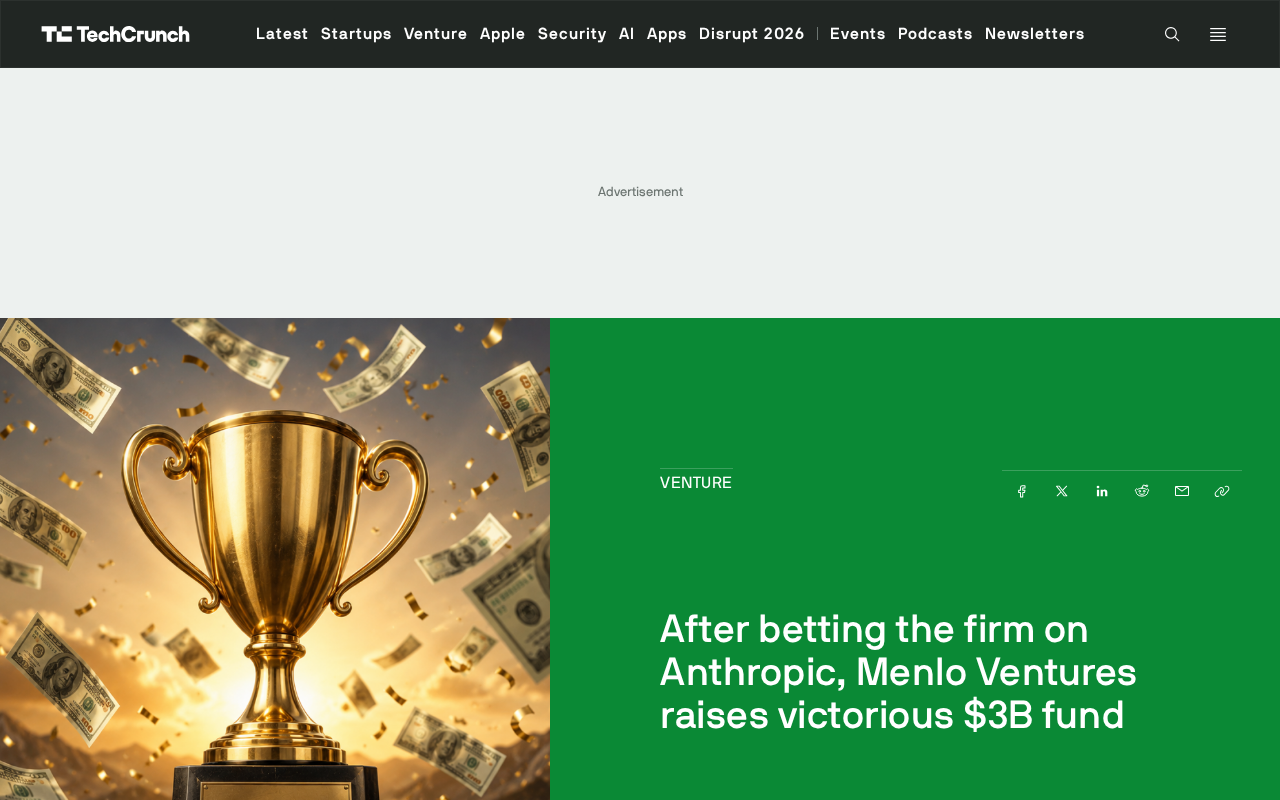
Menlo Ventures parlays its $750M Anthropic bet into a $3B fund, reshaping AI venture capital.
Menlo Ventures leveraged a bold $750 million investment in Anthropic to establish itself as a top-tier AI investor, successfully raising a $3 billion new fund despite a challenging fundraising environment. The case highlights the return of concentrated investment strategies in winner-take-all AI markets, an escalating VC arms race driven by soaring model training costs, and the critical importance of deep technical understanding as an investment edge.
A Bold Bet That Crowned an AI Investment King
Menlo Ventures, a storied Silicon Valley venture capital firm, has successfully positioned itself as one of the most prestigious investors in AI — all thanks to a daring $750 million bet on Anthropic. Now, the payoff from that gamble has materialized: the firm has raised a massive $3 billion new fund.
Founded in 1976 and headquartered in Menlo Park, California, Menlo Ventures is one of the longest-standing VC firms in Silicon Valley. Over nearly five decades, the firm has backed well-known tech companies including Uber, Roku, and Tumblr. Yet before the AI wave arrived, Menlo had a relatively modest profile in the industry and hadn't broken into the top tier alongside firms like Sequoia and a16z. It was the Anthropic bet that thrust this veteran firm back into the spotlight.
The $750 Million "All-In" Moment
In venture capital, the phrase "betting the firm" is usually hyperbole — but for Menlo Ventures, committing $750 million to Anthropic was genuinely a near-all-in move.
The sheer scale of this investment is extraordinarily rare in traditional VC. Conventional venture capital follows Portfolio Theory — reducing overall risk through diversification. A typical VC fund invests in 20 to 40 companies, expecting one or two to generate outsized returns that cover the losses from the rest. Under this model, a single investment usually accounts for just 2%–5% of total fund size. Menlo's $750 million investment shattered that convention, resembling the playbook of a hedge fund or growth-stage private equity firm — a testament to how the AI era is upending traditional VC methodology.
Most venture funds spread their capital across dozens or even hundreds of deals, with no single investment exceeding 10% of the fund. Menlo's decision to concentrate such an enormous sum in one company demonstrated extreme conviction in their AI thesis.
Anthropic: Why It Was Worth the Bet
A Deep Technical Moat
Founded by former core members of OpenAI, Anthropic and its Claude model family have achieved continuous breakthroughs in both safety and capability, establishing the company as one of the AI Big Three alongside OpenAI and Google.
More specifically, Anthropic was founded in 2021 by siblings Dario Amodei and Daniela Amodei, who previously served as OpenAI's VP of Research and VP of Safety & Policy, respectively. Their departure from OpenAI was driven primarily by philosophical differences over AI safety — they believed OpenAI was not prioritizing safety sufficiently amid its commercialization push. Anthropic's "Constitutional AI" approach enables AI systems to self-supervise and self-correct based on a set of explicit principles, rather than relying entirely on human feedback. This represents a differentiated technical path from OpenAI's RLHF (Reinforcement Learning from Human Feedback). This deep investment in safety alignment technology has given Anthropic a significant competitive edge in the enterprise market — for clients in highly regulated industries like finance, healthcare, and law, an AI system's controllability and safety often matter more than raw performance.
Soaring Valuations Validate the Investment Thesis
From the valuation at the time of Menlo's investment to Anthropic's latest funding round, the growth has been staggering. This directly validates the Menlo team's forward-looking judgment in AI — they not only picked the right race, but also backed the right horse.
The $3 Billion New Fund: Pressing the Advantage
Successfully raising a $3 billion fund carries enormous significance for Menlo Ventures:
First, a virtuous cycle of brand equity. The Anthropic success story has given LPs (Limited Partners) deep confidence in Menlo's AI investment capabilities, making fundraising considerably smoother. LPs are the actual capital providers behind venture funds, typically including pension funds, university endowments, sovereign wealth funds, and family offices. Notably, between 2023 and 2024, the global VC fundraising environment deteriorated significantly due to rising interest rates, public market valuation corrections, and a closed IPO window. According to PitchBook data, total U.S. VC fundraising fell by more than 30% year-over-year in 2023. Against this backdrop, Menlo's ability to raise $3 billion against the tide speaks volumes about the decisive impact of track record on LP decision-making.
Second, a larger war chest. A $3 billion fund gives Menlo the firepower to continue making large-scale AI investments, participate in follow-on rounds, or discover the next Anthropic-caliber opportunity.
Third, elevated industry influence. When a VC firm is recognized as a top-tier AI investor, the best AI startups proactively seek its backing, creating a winner-take-all virtuous cycle.
Three Key Implications for the AI Investment Landscape
Menlo's success story reveals several critical trends in AI investing today:
The Return of Concentrated Investment Strategies
In winner-take-all markets like AI, diversification may be less effective than concentrated bets on leading players. Menlo's case proves that when an investment team has sufficiently deep understanding of a technology's direction, concentrated investing delivers returns far exceeding the traditional spray-and-pray approach. This logic aligns perfectly with Warren Buffett's "circle of competence" theory — when you truly understand a domain, concentrated bets are more rational than diversification.
An Escalating VC Arms Race
AI foundation model companies routinely require billions of dollars in funding, making it increasingly difficult for traditionally sized VC funds to compete for top-tier deals. The cost of training large language models is growing exponentially — GPT-4's training cost is estimated at over $100 million, and next-generation models could cost billions. These costs stem primarily from three areas: GPU compute procurement (NVIDIA H100/B200 chips), data acquisition and processing, and compensation for top AI researchers (whose annual salaries often exceed $1 million). This means only investors capable of writing large checks can participate in these premier funding rounds, and traditional VC funds in the $500 million to $1 billion range risk being marginalized. A $3 billion fund size is a direct response to this reality.
Cognitive Advantage Is the Ultimate Investment Edge
In AI, investors who truly understand the trajectory of technological evolution can make correct judgments early. Menlo's success wasn't just luck — it was the monetization of their team's deep understanding of AI technology. This cognitive advantage manifests across multiple dimensions: understanding the potential of the Transformer architecture, conviction in Scaling Laws, the judgment that AI safety could serve as a competitive differentiator, and precise assessment of founding teams' technical capabilities.
Conclusion
From a $750 million "bold bet" to the successful raise of a $3 billion new fund, Menlo Ventures has proven through action that in the AI era, the combination of courage and insight can generate outsized returns. This case also offers the entire venture capital industry a thought-provoking lesson: at pivotal moments of technological transformation, those who dare to place concentrated bets often reap the richest rewards.
Related articles

Disaster and Glory of the Apollo Program: The History We Must Revisit Before Returning to the Moon
From the fatal Apollo 1 fire to Apollo 8's daring lunar orbit to Apollo 11's successful landing—revisiting the disasters, fears, and compromises of the Apollo program and their lessons for today's return to the Moon.
Netflix Trust Exercise Turns Into Firing Trap: Where Are the Boundaries of Corporate Trust?
A Netflix employee was fired after sharing private info in a trust exercise. We analyze the risks of corporate trust exercises and how employees can protect themselves.

AMD CDNA5 Architecture Deep Dive: Technical Evolution and the AI Computing Competition Landscape
Deep analysis of AMD's CDNA5 architecture covering Chiplet packaging upgrades, HBM memory evolution, and low-precision compute optimization, examining how AMD challenges NVIDIA's AI chip dominance.