Mesh API: One Gateway to 1,000+ Models, Slashing AI Bills by 2-4x

Mesh API offers auto routing, discounts, and failover as an AI gateway, claiming 2-4x cost savings.
Mesh API is an AI gateway launched on Product Hunt for teams calling multiple model providers, solving multi-key management, separate billing, and fragmented failure handling. Its cost optimization has three layers: auto routing to the cheapest qualifying model based on quality thresholds, up to 40% off list prices via provider partnerships, and auto failover to backup models. It claims support for 1,000+ models with a unified interface. The article notes gaps: routing algorithms, quality threshold definitions, and discount scope are undisclosed; auto routing may cause quality fluctuations, and the third-party gateway adds a data trust path. It received 90 upvotes, ranking 10th, in the emerging "AI cost middle layer" category.
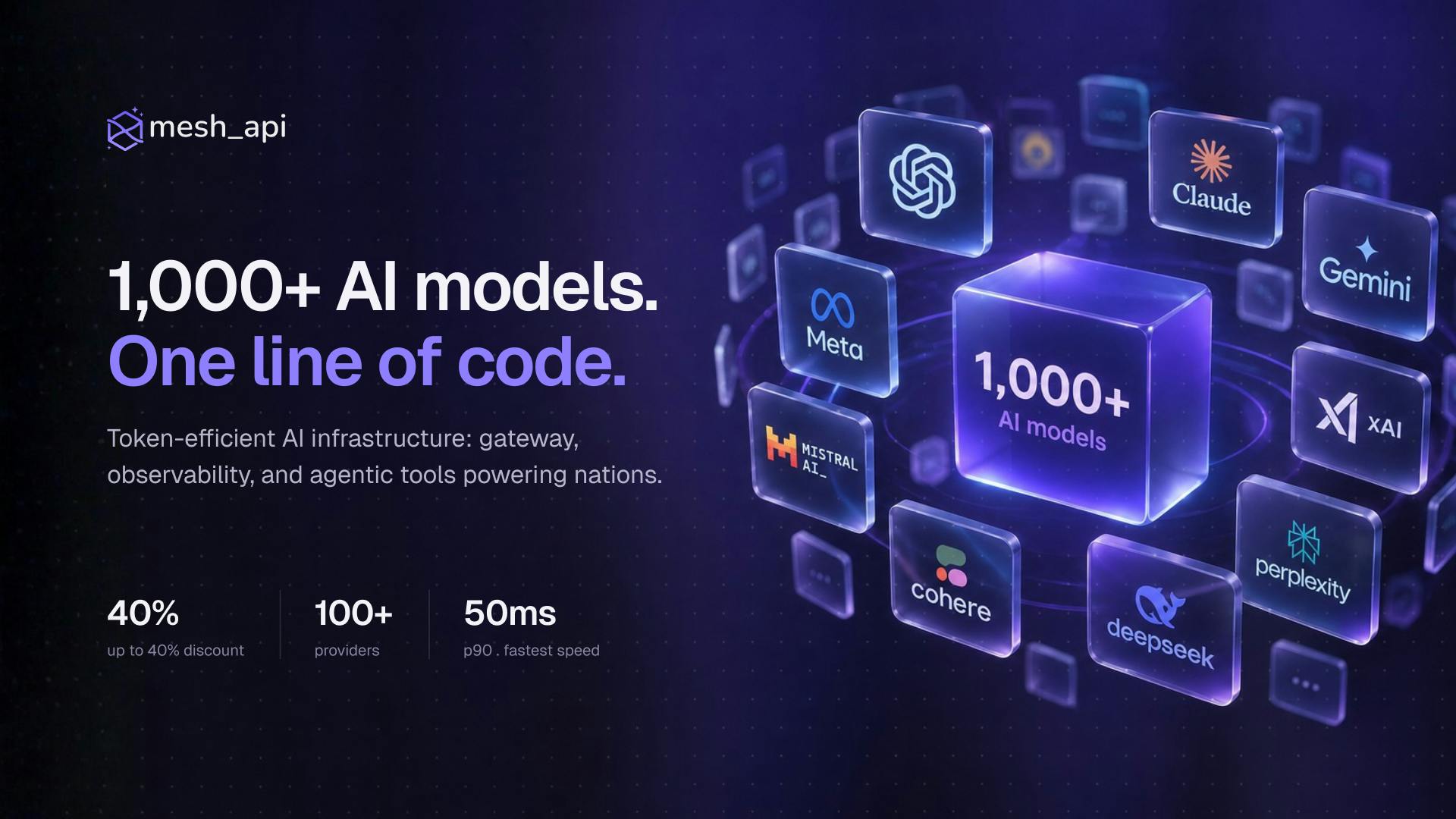
Using multiple models together has become standard practice in AI application development, but the resulting runaway bills and vendor lock-in are giving teams headaches. Mesh API launched an AI gateway product on Product Hunt that claims to solve these pain points, pitching "change one line of code, cut AI costs 2-4x," with support for over 1,000 models.
The Pain Point: Cost and Reliability Challenges in the Multi-Model Era
When your product calls models from different vendors like OpenAI, Anthropic, and Google simultaneously, you typically need to maintain multiple sets of API keys, handle billing separately, and deal with rate limiting and failover for each provider individually. What's more, different tasks have vastly different quality requirements—using a top-tier model for simple classification is wasteful, while a lightweight model won't cut it for complex reasoning.
Mesh API targets exactly this gap: it positions itself as an intelligent gateway layer that lets developers automatically route requests to models that are "just good enough" without changing their code, thereby cutting costs.
Core Mechanisms: Auto Routing + Direct Discounts + Failover
According to the official description, Mesh API's cost optimization comes from three layers.
Auto Routing selects the cheapest model that meets the quality threshold set by the developer. This means you don't need to manually maintain a "task-to-model" mapping table—the gateway handles the matching for you. The company claims this is the primary source of the 2-4x cost reduction.
Direct model discounts are another layer of savings. Mesh says that through partnerships with model providers, it can secure discounts of up to 40% off list prices. This saving doesn't depend on routing strategy—it's a procurement-level advantage.
Auto Failover addresses availability: when a model or provider goes down, requests are automatically switched to a backup model, and end users experience no interruption. For products that embed AI capabilities into core business processes, this is more valuable than simply saving money.
AI Gateway is a class of infrastructure that has emerged in recent years, sitting between applications and model providers and uniformly encapsulating cross-cutting concerns like authentication, billing, rate limiting, retries, and logging. Its key difference from traditional API gateways is that the "backend" for a request is semantically routed to different models rather than a fixed service; therefore, the gateway needs to understand task types and quality requirements and maintain metadata on model capabilities and pricing. Common open-source implementations include LiteLLM and Portkey, and cloud providers have also launched managed versions. The cost of introducing a gateway is an extra network hop and an additional dependency layer; the benefit is decoupling vendor lock-in from business code.
Failover here specifically refers to model-level rather than instance-level switching: when the target provider returns 5xx, times out, or triggers rate limiting, the gateway retries according to a preset backup model chain. The difference from traditional load balancing is that different models have inconsistent output formats, context windows, and token billing, so the gateway needs to normalize request and response formats. A common practice is to distinguish between "retryable errors" and "non-retryable errors," and to set a call-count limit for non-idempotent generation requests to avoid cost amplification during outages.
The Breadth of 1,000+ Model Integrations
Supporting over 1,000 models is another selling point of Mesh API. This order of magnitude likely means it covers mainstream closed-source models and a large number of open-source hosted models, allowing developers to switch under a unified interface. For teams that need to run model comparison tests or want to preserve multi-vendor negotiating leverage, this abstraction layer can reduce migration costs.
However, the product page does not disclose the specifics of the routing algorithm, how quality thresholds are defined, or which models the discounts apply to. This information is critical for evaluating the actual savings, so it's worth confirming with the company before integrating.
Model Routing has academic prototypes in LLM Routers (such as RouteLLM and FrugalGPT), whose core idea is to use a lightweight classifier or scorer to predict "whether a weaker model can meet the requirement," upgrading to a stronger model only when necessary. Industrial implementations typically follow two paths: rule-based static mapping (selecting models by task tag) and quality-assessment-based dynamic routing (scoring candidate outputs or using a reward model). The accuracy of the latter depends on the quality of the evaluation set and introduces additional judgment overhead, which is a major reason why gateway vendors are reluctant to disclose routing details.
Who It's For, and What to Watch Out For
Mesh API is best suited for teams that are already calling multiple models in production and are cost-sensitive. If your call volume is low or you only use a single provider, the extra abstraction of a gateway layer may not be worth it.
It's worth noting that while auto routing reduces costs, it can also introduce fluctuations in output quality—the quality threshold setting directly determines the boundaries of that fluctuation. Additionally, routing requests through a third-party gateway means adding another data path that needs to be trusted, so scenarios with high data compliance requirements should be carefully evaluated.
Mesh API received 90 upvotes on Product Hunt, ranking 10th—a small but targeted following. It represents a rising category of "AI cost middle layer" products: rather than training models, they save developers money through routing and procurement optimization. Whether such tools can endure long-term depends on whether they can continuously build moats in discount advantages and routing intelligence.
One-line Summary
Mesh API offers auto routing, discounts, and failover as an AI gateway, claiming 2-4x cost reduction.
Paragraph Summary
Mesh API is an AI gateway product launched on Product Hunt, aimed at teams calling multiple model providers simultaneously, solving the problems of multi-key maintenance, separate billing, and fragmented failure handling. Its cost optimization consists of three layers: auto routing to the cheapest qualifying model based on developer-set quality thresholds, securing up to 40% off list prices through provider partnerships, and automatically switching to backup models when a model or provider fails. The product claims support for over 1,000 models, with a unified interface reducing migration costs for multi-vendor switching and comparison testing. The article also points out information gaps: routing algorithms, quality threshold definitions, and discount scope are all undisclosed; auto routing may cause output quality fluctuations, and the third-party gateway introduces an additional data trust path. The product received 90 upvotes and ranked 10th, belonging to the emerging "AI cost middle layer" category.
Related articles

From 0 to 1: Vibe Coding an AI Knowledge Base — A Practical Retrospective and Tech Stack Breakdown
A retrospective on building the AI knowledge base OilBook from scratch with Vibe Coding: Next.js+Neon stack, Oil Dev Skill workflow, Stripe paywall security, interview-style writing, AI-flavor control, and Vercel deployment.

GLM-5.4 Hands-On: Native Vision Meets a New Vibe Coding Workflow
Hands-on with Zhipu GLM-5.4: native vision tested across a 3D product demo, pure-code video generation, and remote-control Vibe Coding, compared with GPT-6.2 and Gemini Neon.

AI and Humans Claim to Prove the Riemann Hypothesis: Machine-Verified, Yet Nobody Can Understand It
Anthropic mathematician and AI Claude claim to prove the Riemann Hypothesis with 17 million lines of Lean code, machine-verified but unreadable by humans. This article analyzes the event, the zero proportion record from 41.6% to 67.2%, and the gap between machine verification and human understanding.