Mesh LLM: Pool Multiple Old Computers Into a Virtual Super GPU for Running Large Models
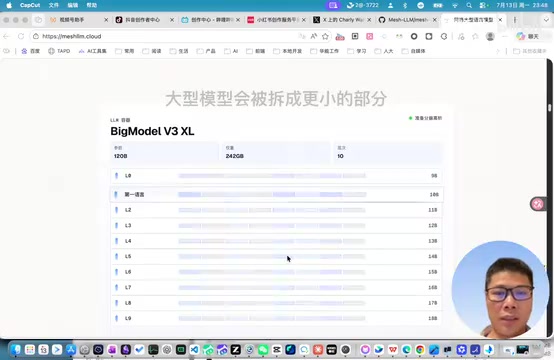
Mesh LLM pools multiple ordinary devices into a virtual GPU to run massive language models locally.
Mesh LLM is an open-source distributed inference framework that splits Transformer model layers across multiple machines — a Mac, a gaming PC, a mini PC — forming a virtual super GPU. It enables running 600GB+ quantized models on consumer hardware that individually lacks sufficient VRAM. The key caveat: network bandwidth is a hard physical bottleneck that significantly limits inference speed compared to a single high-end device.
The Pain Point of Running LLMs Locally: Not Enough VRAM
More and more developers and AI enthusiasts are choosing to deploy large models locally — only to hit the same wall: insufficient hardware resources. A large language model's VRAM requirements scale directly with its parameter count. To put it in concrete terms: a 70B-parameter model stored in FP16 (half-precision floating point) requires roughly 140GB of VRAM, and even after INT4 quantization it still needs around 35GB — far beyond the 8GB to 24GB ceiling of most consumer-grade GPUs. A high-end workstation with 512GB of RAM can effortlessly run models hundreds of gigabytes in size, while the average user's laptop, mini PC, or gaming GPU often can't even load the model in the first place.
An open-source distributed inference framework called Mesh LLM aims to solve this long-standing problem for individual users. Its core idea is straightforward: aggregate all the computing devices around you into a single "virtual super GPU", so that old machines that would otherwise sit idle can participate in inference on massive models.
In short, it's "many hands make light work" — a Mac, a desktop with a gaming GPU, a mini PC, and even a few rented cloud GPUs can all be pooled together to jointly handle inference for the same model.
How Mesh LLM Works
Layer-Based Splitting and Distributed Loading
The technical core of Mesh LLM lies in model layer splitting. Modern large language models universally adopt the Transformer architecture, whose backbone consists of dozens to hundreds of identical decoder layers stacked on top of each other. Each layer contains two main components: a Self-Attention mechanism and a Feed-Forward Network (FFN). During inference, the activation values of input tokens flow sequentially through each layer, with strict data dependencies between them — this serial nature makes Pipeline Parallelism the natural choice for layer-based deployment.
Mesh LLM is built on exactly this principle: it splits these layers apart and loads them onto different devices. For example, layer 7 (L7) of the model runs on a GPU in one desktop, layer 8 (L8) runs on a laptop, and layer 9 (L9) runs on a hosted node. During inference, data flows sequentially through these layers distributed across different machines, ultimately completing a full forward pass.

The benefit of this approach is obvious: no single device needs to hold the entire model. Each machine only bears the VRAM cost of a few layers, enabling a cluster of low-VRAM GPUs to run models that would otherwise be impossible to load.
Elastic Networking and Hot-Swappable Nodes
Mesh LLM connects nodes via the Cloud, unifying distributed compute resources into a single "network space." It supports hot-swappable node management — you can add new devices to the cluster at any time, or remove a node whenever needed, giving it a high degree of flexibility.

Take Kimi's Q4 quantized model as an example: it weighs in at over 600GB across 61 layers. Through Mesh LLM's layer-splitting mechanism, multiple ordinary machines could theoretically collaborate to run it. The GGUF format used here is the widely adopted quantization storage standard in the llama.cpp ecosystem, supporting precision levels from Q2 to Q8 — striking a balance between accuracy loss and resource savings, which further lowers the hardware bar.
Cross-Platform Support and Installation Experience
Similar to EXO, but Cross-Platform
If you're familiar with the local LLM community, you might think of EXO — an open-source project that emerged in 2024, designed specifically for LAN clusters made up of Apple devices. It lets multiple Macs, iPhones, and iPads pool their compute for LLM inference, with a focus on Mac-based networking. Similar projects include petals (decentralized inference inspired by BitTorrent), all of which represent the emerging direction of "edge collaborative inference," tackling engineering challenges like load balancing, node fault tolerance, and heterogeneous hardware normalization. Mesh LLM occupies a similar niche to EXO, but its key advantage is cross-platform capability: both Mac and Linux machines can join the same cluster, enabling collaborative inference across heterogeneous devices.
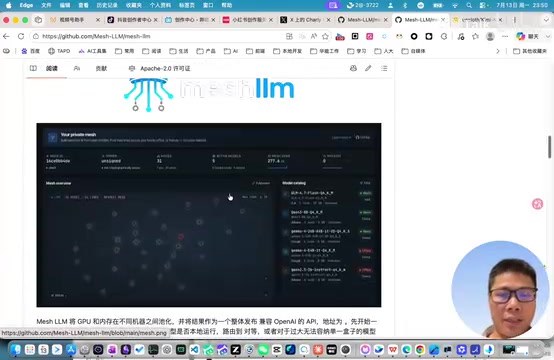
The installation process is quite straightforward — essentially copy-paste a single command — making it relatively beginner-friendly. On Windows support: the Mac3 library actually includes a Windows build, so in theory all three platforms (Windows, Mac, Linux) can run it. Check the official documentation for the latest details.
The Physical Reality: Running ≠ Running Fast
This is the part of the story that demands the most sober assessment. "Being able to run doesn't mean running fast" — this statement cuts directly to the biggest pitfall of distributed inference in practice.

Network Bandwidth Is an Unavoidable Bottleneck
The fatal weak point of distributed inference is communication speed between devices. With the model's layers distributed across different machines, data must travel over the network between each layer. If you're on a 100Mbps connection, the entire inference process will be throttled by that pipe.
Understanding this bottleneck requires appreciating the orders-of-magnitude gap between memory bandwidth and network bandwidth. Apple Silicon chips use a Unified Memory Architecture (UMA), where CPU and GPU share the same high-bandwidth memory pool — the M2 Ultra delivers up to 800GB/s of memory bandwidth, and the M3 Max exceeds 400GB/s. By contrast, 10 Gigabit Ethernet (10GbE) has a theoretical bandwidth of only around 1.25 GB/s, and even enterprise-grade InfiniBand HDR tops out at roughly 25GB/s — tens to hundreds of times slower than local memory bandwidth.
This is a hard physical limit that no software architecture can fundamentally overcome. In other words, Mesh LLM lets you run large models, but inference speed (measured in tokens/s) will be significantly lower than what a single high-end machine delivers natively.
Who Is Mesh LLM For?
All things considered, Mesh LLM's value proposition is very clear:
- Not for users who prioritize speed. If you already have sufficient hardware — say, a high-end Mac or a multi-GPU server — there's no reason to go through the hassle of setting up a network cluster.
- Great for users who want to experiment despite limited hardware. If you only have a few idle older machines and want to explore running massive models, pooling them into a virtual GPU is a low-cost path to discovery.
As an open-source project, Mesh LLM has accumulated a considerable number of GitHub stars and maintains a lively community. For tinkerers who enjoy squeezing value out of idle hardware, it offers an interesting experimental direction.
Overall, Mesh LLM represents a "resource aggregation" approach to local LLM deployment — it doesn't create more powerful hardware, but makes dispersed hardware produce collaborative value. Understanding its limits, especially the bandwidth bottleneck, is what lets you truly make the most of this "assembled GPU."
Key Takeaways
Related articles

Disaster and Glory of the Apollo Program: The History We Must Revisit Before Returning to the Moon
From the fatal Apollo 1 fire to Apollo 8's daring lunar orbit to Apollo 11's successful landing—revisiting the disasters, fears, and compromises of the Apollo program and their lessons for today's return to the Moon.

Netflix Trust Exercise Turns Into Firing Trap: Where Are the Boundaries of Corporate Trust?
A Netflix employee was fired after sharing private info in a trust exercise. We analyze the risks of corporate trust exercises and how employees can protect themselves.

AMD CDNA5 Architecture Deep Dive: Technical Evolution and the AI Computing Competition Landscape
Deep analysis of AMD's CDNA5 architecture covering Chiplet packaging upgrades, HBM memory evolution, and low-precision compute optimization, examining how AMD challenges NVIDIA's AI chip dominance.