#distributed LLM inference
364 related articles
Mesh LLM: A Practical Exploration of B…
·3 min
Mesh LLM: A Practical Exploration of Building a P2P Distributed AI Inference Network with iroh
Mesh LLM leverages the Rust P2P framework iroh to integrate compute from scattered nodes, exploring a viable path for decentralized LLM inference. This article analyzes its architecture, challenges, and prospects.
Read more →
·3 min
Deep Dive into Inkling: The First Frontier Open-Source Multimodal LLM from the West
Thinking Machines releases Inkling, an open-source multimodal LLM with near-trillion MoE parameters, 1M token context, Apache 2.0 license. Deep dive into architecture, benchmarks, and pricing.
Read more →

·5 min
Running GPT-5.6 Inside Claude Code: Best Practices for Subagent Orchestration and System Prompts
Deep dive into running OpenAI GPT-5.6 inside Claude Code: comparing Codex vs Claude Code on subagent orchestration, workflow design, and system prompt quality, revealing how harness engineering determines model output.
Read more →

·3 min
Gemini 3.1 Pro Rate Limiting Exposed: Why Paying Users Can't Actually Use Their Full Quota
Deep analysis of Google Gemini 3.1 Pro's rolling window rate limiting, revealing the massive gap between paper quotas and actual usability for paying subscribers.
Read more →

·3 min
Gemini 3.1 Pro Rate Limiting Exposed: Why Paid Users Can Never Use Their Full Quota
Deep analysis of Google Gemini 3.1 Pro's rolling window rate limiting, revealing the gap between paper quotas and real usability for paid AI subscribers.
Read more →

·2 min
Gemini Always Crashes on the 16th Turn? Error 1076 Root Cause Analysis and Workarounds
Google's Gemini consistently triggers Error 1076 on the 16th conversation turn, regardless of context size. Analysis points to a session state management defect, with three workarounds provided.
Read more →

·3 min
The Real Daily Life of MLE and MLOps Engineers: Key Differences Between Three Roles and Career Paths
An in-depth look at the real daily work of data scientists, MLEs, and MLOps engineers — covering responsibilities, essential tools, and career paths to help you find your direction in AI.
Read more →

·3 min
A Beginner's Guide to AI Agents: Two Learning Paths for Developers and Practitioners
How to learn AI Agents from scratch? This guide covers two clear paths: developers go from Python to LLMs to open-source framework source code; practitioners use Claude Code or similar tools to get results fast.
Read more →
·3 min
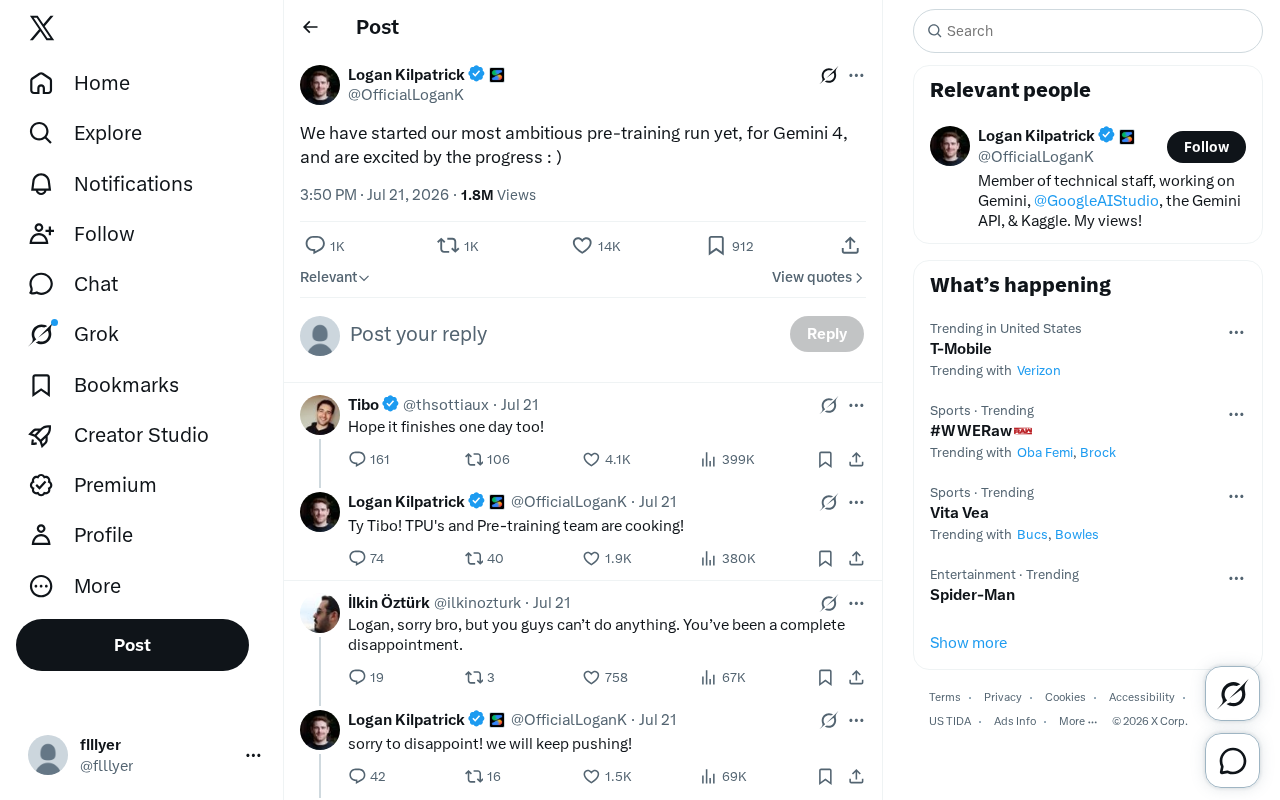
Google Launches Gemini 4 Pre-training: Its Most Ambitious AI Model Training Yet
Google DeepMind announces Gemini 4 pre-training has begun, calling it their most ambitious training yet. A deep dive into its technical direction, compute scale, multimodal breakthroughs, and competitive impact.
Read more →
·3 min
The Open-Weights Model Debate: Balancing Safety and Openness
An in-depth analysis of the open-weights model debate: public release brings transparency and innovation, but raises safety and misuse risks. Exploring tiered release, red-teaming, and governance challenges.
Read more →
·3 min
The Open-Weights Model Debate: Balancing Safety and Openness
An in-depth analysis of the open-weights model debate: publicly releasing model weights enables transparency and innovation but raises safety risks. Explores tiered release, red-teaming, and the industry dynamics behind open AI governance.
Read more →

·3 min
Poolside Laguna Model Launch: Can Silicon Valley's Open-Source Push Catch Up to China's AI?
Poolside launches Laguna open-weight model after 18 months of silence, pitting 118B parameters against Kimi K3's 2.8 trillion. Can Silicon Valley's open-source push close the gap with Chinese AI?
Read more →

·5 min
Complete Breakdown of Core Competencies for AI Agent Engineers: From Demo to Production-Grade Systems
Deep breakdown of 4 core AI Agent engineer competencies: business decomposition, multi-Agent architecture, quantitative evaluation, and engineering delivery—bridging the gap from Demo to production.
Read more →

·5 min
The Complete Guide to AI Agent Development: A Four-Stage Progressive Roadmap
A systematic guide to AI Agent development across four stages: LLM fundamentals, ReAct paradigm, memory & tools, and multi-agent collaboration for developers.
Read more →

·3 min
Poolside Laguna Model Release: Can Silicon Valley Open Source Catch Up with Chinese AI?
Poolside releases its Laguna open-weight model after 18 months of silence, challenging Moonshot's Kimi K3 with 118B vs 2.8T parameters. Can Silicon Valley close the gap with Chinese AI?
Read more →

·3 min
Ollama Prepares for Trillion-Parameter Open-Source Models as the Open-Source Ecosystem Heats Up
Ollama scales up for trillion-parameter open-source models like Kimi K3 and Qwen 3.8. Hugging Face demands $100M from OpenAI, Alibaba Coder goes mobile, and DeepSeek pauses fundraising.
Read more →

·3 min
Getting Started with Codex: A Beginner's Guide to AI Agentic Coding Tools
A detailed guide to getting started with Codex and Claude Code AI agentic coding tools, from environment setup to hands-on practice, helping beginners master AI programming assistants.
Read more →

·3 min
Deep Dive into the Kimi-K3 Technical Report: A Comprehensive Analysis of Architecture, Long-Context Processing, and Reasoning Capabilities
Deep dive into Moonshot AI's Kimi-K3 technical report, analyzing its long-context processing, MoE architecture, reasoning improvements, and its position in global AI competition.
Read more →
·3 min
Deep Dive into the Kimi-K3 Technical Report: Architecture, Long Context, and Reasoning Capabilities
Deep analysis of Moonshot AI's Kimi-K3 technical report covering long context processing, MoE architecture, reasoning capabilities, and China's position in the global AI competition.
Read more →

·3 min
API Mock vs. Sandbox in Agent Testing: A Detailed Layered Strategy Guide
API Mock is fast but misses bugs; Sandbox is realistic but costly. This article analyzes their core differences and provides a layered testing strategy for building reliable Agent test systems.
Read more →