MeshXFS: An AI-Written Clustered Filesystem for XFS

MeshXFS attempts to use AI to build a clustered filesystem on XFS, highlighting the trend and verification challenges of AI in low-level software.
MeshXFS is an experimental project on Hacker News, self-described as AI-written and built on the mature XFS filesystem, focusing on cluster-layer consistency and lock management. The article analyzes both sides: AI dramatically lowers the cost of building a clustered filesystem and lets engineers focus on consistency algorithms and testing, but at the zero-tolerance storage layer, AI-generated code can fail under split-brain, partial writes, and journal replay after power loss. The post's low attention (4 points, 1 comment) reflects the community's wait-and-see stance. The value of such pathfinding lies in the questions it raises about testing AI-generated low-level code and whether engineers shift from writing to reviewing.
When AI Starts Writing Filesystems
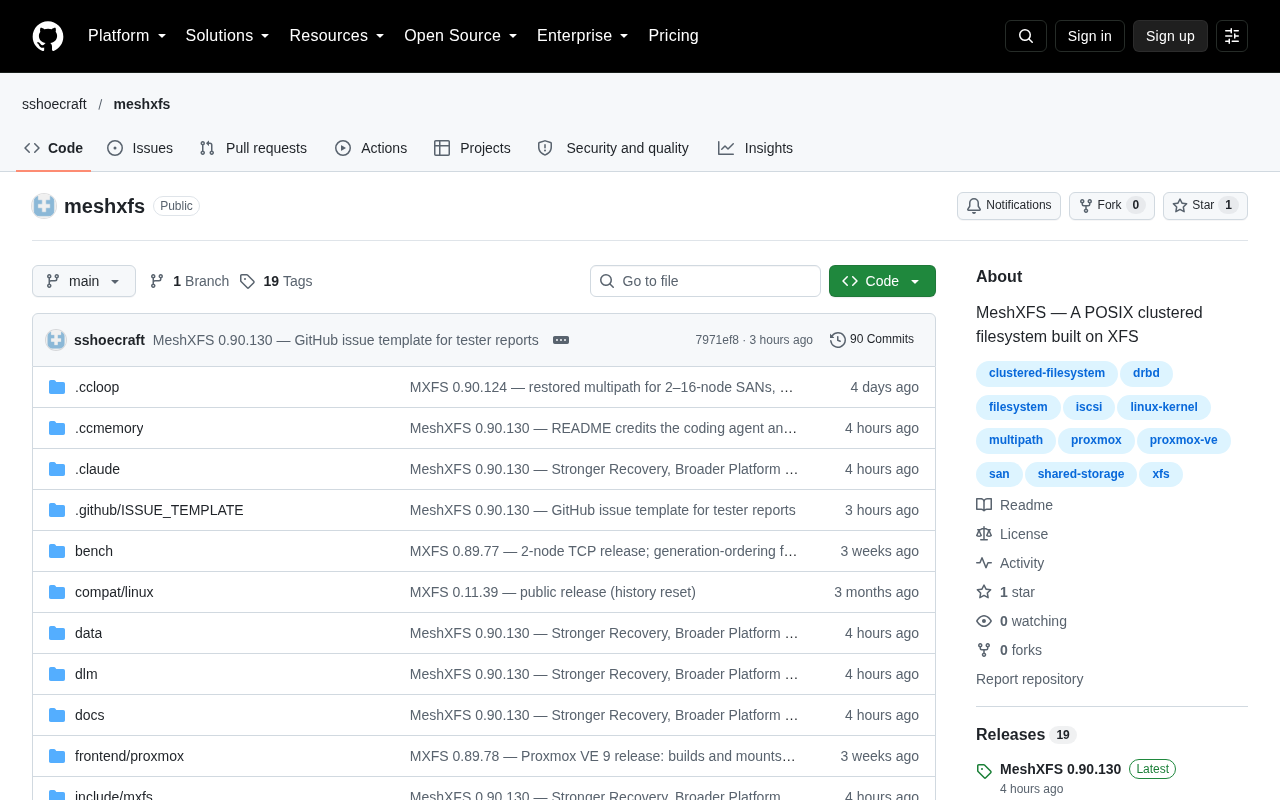
An experimental project called MeshXFS has appeared on Hacker News. Its title is brutally direct: A clustered filesystem built on XFS, written by AI. That sentence alone is a signal: low-level systems software—a domain long believed to require seasoned kernel engineers to iterate over repeatedly—is being tentatively approached by AI-assisted development.
Filesystems sit at the layer of the software stack closest to hardware, where any design flaw can surface as data corruption. It is precisely for this reason that the "written by AI" label feels so jarring—it could represent a leap in efficiency, or it could be a hidden liability in engineering rigor.
What MeshXFS Actually Does
Standing on XFS's Shoulders
The core idea behind MeshXFS is not radical. Rather than building an entirely new on-disk format from scratch, it chooses to build on top of XFS. XFS is one of the most mature and production-hardened filesystems in the Linux ecosystem, with deep accumulated expertise in metadata management, journaling, and large-file throughput.
Choosing XFS as the foundation means MeshXFS can focus its energy on the "cluster" layer—that is, making multiple nodes see the same filesystem view. This is a pragmatic trade-off: reuse a battle-tested local filesystem to reduce low-level risk.
XFS was developed by SGI in the 1990s for IRIX, ported to the Linux kernel in 2001, and is now one of the default filesystems for enterprise distributions like RHEL and SUSE. Several of its design characteristics happen to make it convenient for reuse by a cluster layer: B+ tree-based metadata indexing keeps directory lookups and extended attribute operations stable at scale; delayed allocation first accumulates writes in the page cache and plans on-disk placement in one pass, significantly reducing fragmentation; the journal records only metadata changes, ensuring fast replay-based recovery after a crash; and allocation groups partition the entire volume into multiple sub-regions that can be operated on in parallel, naturally carrying the genes for horizontal scaling. These characteristics mean that when projects like MeshXFS need to coordinate consistency across multiple nodes, the atomicity and parallelism of the underlying storage are already partially covered by XFS, and the cluster layer mainly needs to worry about cross-node locks, cache invalidation, and failover. This also explains why building a cluster wrapper on top of an existing filesystem is often more pragmatic than designing a disk format from scratch.
The Old Problems the Cluster Layer Must Solve
The core tensions a clustered filesystem must handle are nothing new: consistency, lock management, cache synchronization, fault self-healing. Traditional approaches often require a dedicated metadata server or complex distributed locking mechanisms. How MeshXFS specifically implements these has not been elaborated in the original information, which remains the biggest open question it leaves to the outside world.
What is worth noting is whether a clustered filesystem generated by AI has genuinely considered split-brain, partial writes, and journal replay after power loss—edge cases that only emerge during real failures.
Split-brain is one of the most dangerous failure modes in cluster systems: when the communication link between nodes breaks, each partition mistakenly believes the other is dead, so both simultaneously serve requests and modify the same data independently. By the time the network recovers, the conflict can no longer be automatically reconciled. At the filesystem level, split-brain can manifest as two nodes concurrently writing to the same inode, directory entries overwriting each other, and ultimately corrupting metadata. Partial write refers to a write operation landing only halfway—whether because the application layer submitted its buffer in batches, or because the underlying device completed only some sectors before losing power. If the filesystem does not guarantee atomicity of the operation through journaling or copy-on-write, it leaves behind an intermediate state that is neither the old value nor the new value. Journal replay after power loss requires recovering unfinished metadata transactions from the journal after a system crash; if the replay logic itself is flawed, the recovery process may actually amplify the corruption. These three problems have mature solutions in single-machine filesystems, but once you go cross-node, the timing and failure models become far more complex.
What "Written by AI" Means
This is not the first large project claimed to be AI-generated, but the filesystem category makes the discussion different.
Generative models excel at producing plausible-looking code in dense regions of existing patterns, while systems programming is precisely full of sparse, counterintuitive edge cases. The timing of a single fsync, the atomicity of a single directory entry update—each could determine whether user data lands safely or turns into a pile of unmountable bytes.
On the positive side, AI dramatically lowers the trial-and-error cost of building a clustered filesystem. Scaffolding work that once took a team months can now take shape far more quickly, letting human engineers focus on the genuinely thorny consistency algorithms and testing. The risk is that without sufficiently rigorous verification, AI-generated low-level code tends to "look correct" while failing under extreme conditions.
The project has received very little attention on Hacker News (only 4 points and 1 comment at the time of posting), which is itself telling: the community remains in a wait-and-see posture toward this kind of work—curiosity exists, trust has yet to be established.
The capability boundaries of generative models in systems programming deserve separate examination. Large language models are essentially learning statistical patterns in training corpora, so they perform best on tasks where "there is plenty of similar code to reference"—such as implementing a standard data structure or completing a common syscall wrapper. But the core difficulty of low-level software like filesystems and database engines lies not in the common paths but in sparse, counterintuitive edge cases: what happens when two threads concurrently unlink the same file? What happens when power is lost after the journal header is written but before the journal body? These situations appear extremely rarely in training data, and the model lacks a causal model of the physical world to reason about "what if the machine dies halfway through this line executing." Therefore, AI-generated systems code is better viewed as "the output of a highly productive junior engineer"—capable of rapidly laying out an implementation, but requiring humans to backstop it with rigorous fault-injection testing, formal verification, or prolonged fuzzing.
The Real Value of Such Attempts
Rather than debating whether MeshXFS is currently production-ready, it is more useful to look at the trend it represents: AI is moving deeper into the software stack. Frontend, scripting, and scaffolding have long been heavily penetrated by AI, while the "deep waters" of kernels, filesystems, and database engines were once considered off-limits for large models.
MeshXFS is more like a pathfinding stone. The questions it raises matter more than the answers it provides:
- What kind of testing infrastructure does AI-generated systems code need before it can be trusted?
- Is building a cluster wrapper on top of a mature foundation like XFS a shortcut, or does it hide more coupling risk?
- When large amounts of low-level code are produced by AI, will the human engineer's role shift from "writing" to "reviewing" and "verifying"?
If this direction holds, future filesystem projects may unfold through an entirely new mode of collaboration—AI handles laying out the implementation, humans define correctness. This is not necessarily a bad thing, provided our standards for "correct" are strict enough.
Conclusion
Information about MeshXFS is currently limited, and its technical details, stability, and actual code quality all await community scrutiny. But as a concrete sample of "AI writing low-level systems software," it is enough to provoke thought: when generative models touch zero-tolerance domains like filesystems, we must remain open to efficiency gains while remaining paranoid about verification standards. After all, in storage, data loss never has an undo button.
One-line Summary
MeshXFS attempts to use AI to build a clustered filesystem on top of XFS, reflecting both the trend of AI penetrating low-level systems software and the verification challenges it poses.
Paragraph Summary
MeshXFS is an experimental project that appeared on Hacker News, self-described as AI-written and built on the mature XFS filesystem, focusing on solving consistency and lock management issues at the cluster layer. The article analyzes the dual nature of this attempt: on one hand, AI can dramatically reduce the trial-and-error cost of building a clustered filesystem, letting human engineers focus on consistency algorithms and testing; on the other hand, filesystems sit at the zero-tolerance storage layer, where AI-generated code is prone to failing under edge cases like split-brain, partial writes, and journal replay after power loss. The post received very little attention (4 points, 1 comment), reflecting the community's wait-and-see attitude toward AI-written systems software. The article argues that the value of such pathfinding stones lies not in whether they are usable today, but in the key questions they raise: what testing infrastructure AI-generated low-level code needs before it can be trusted, and whether the human engineer's role will shift from "writing" to "reviewing" and "verifying."
Related articles

Chain of Thought Isn't Just for AI: How Humans Can Use CoT to Improve Thinking Quality
Chain of Thought isn't just a prompt trick for large models. Starting from a Hacker News discussion, this article analyzes why CoT works for human thinking too, breaks down actionable ways to transfer it, and highlights the key differences between human CoT and machine CoT.
Cloudflare Teams Up with OpenAI: Closi…
Cloudflare Teams Up with OpenAI: Closing the Loop from Vulnerability Discovery to Defense with AI
Cloudflare uses OpenAI Daybreak to investigate security vulnerabilities and generate reviewable remediation plans, while developers use Codex to boost coding efficiency and quality.

Orca Multi-Agent Orchestration in Practice: A Guide to Parallel Collaboration with Claude and Codex
Orca is Stable AI's free open-source agent workbench supporting 34 agents like Claude Code and Codex in parallel. Learn its Git worktree isolation, multi-model orchestration, and mobile management.