Meta Access: Turning the Chat Interface into the Control Layer for the Entire Workspace

Meta Access lets AI assistants understand and operate the entire workspace in a tiered, permissioned way.
The article proposes the concept of "Meta Access," arguing that chat assistants should not only read conversations but also access their software environment in a structured, permissioned way. Meta Access is divided into four progressive levels: feature tutoring, settings and preference access, retrieval and confirmed modification, and full orchestration, turning the chat client from multiple screens into a single entry point. Because general-purpose agent frameworks can modify their own settings and are reflexive, Meta Access requires a separate control-plane boundary to isolate permission management. The Meta Chat prototype maintains user control while extending capabilities through designs such as bounded context, undoable changes, persona recommendations, and a tutorial library. The article also notes that Meta Access can elevate screen readers from control descriptions to semantic-level operations, and suggests that software in the AI era expose structured, permissioned state models through debugger-like interfaces.
The chat interface has become the most common entry point for large language model (LLM) tasks. Even though agent tools like OpenCode perform impressively in programming and automation, conversation remains the first interface through which most people encounter AI. But a fundamental limitation persists: the model can only see the current conversation, not the entire workspace in which that conversation takes place.
A research article from the tech community proposes the concept of "Meta Access"—giving the assistant structured, permissioned access to the interface itself. This is not simply giving the model more context; it redefines the boundary of human-AI collaboration.
What Is Meta Access: From Conversation Window to Workspace Control Layer
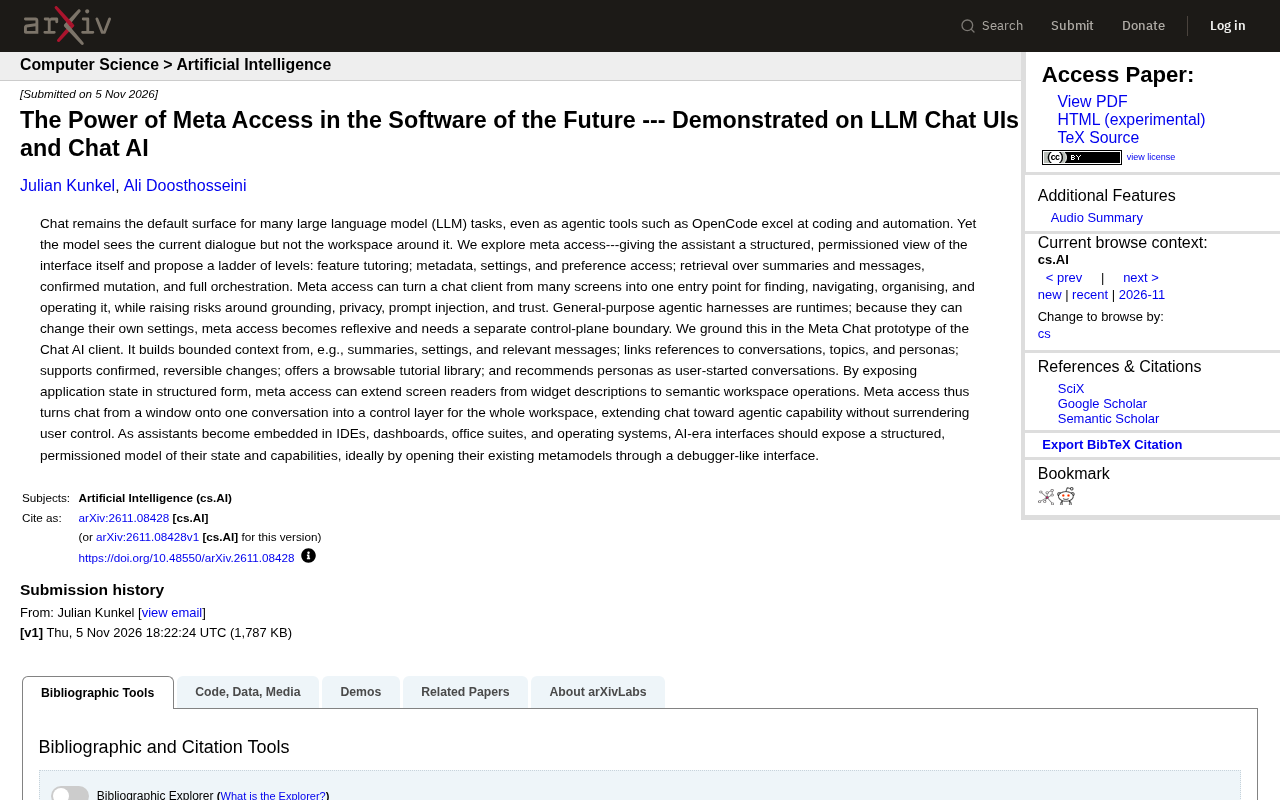
The core idea of Meta Access is to let the model not only read the conversation but also understand the software environment it inhabits—what features exist, what settings are available, how historical messages are organized, and which interface is currently active. The article divides this capability into several progressive levels.
The most basic level is feature tutoring: the assistant can explain what the buttons and features in the interface do. The next level up is access to metadata, settings, and preferences, where the assistant can read the user's configuration items. Above that is retrieval capability based on summaries and messages, along with confirmed modifications of changes. The highest level is full orchestration—the assistant can proactively organize, navigate, and operate the entire workspace.
The significance of this ladder is that it turns the chat client from "many screens" into "one entry point": finding things, navigating, organizing content, and executing operations can all start from the conversation.
Why General-Purpose Agent Frameworks Need a Separate Control Plane
The article raises an easily overlooked security argument: general-purpose agent frameworks are essentially runtimes, and they are capable of modifying their own settings. This means Meta Access is "reflexive"—the assistant can change its own permissions and behavioral boundaries.
Precisely for this reason, Meta Access cannot simply be treated as part of an agent's capabilities; it requires a separate control-plane boundary. This is an architectural judgment: permission management cannot be mixed together with the object being managed. The article also points out the multiple risks that accompany Meta Access, including grounding problems, privacy leakage, prompt injection attacks, and the challenge of establishing user trust.
Control plane is a term borrowed from networking and distributed systems. In routers or SDN architectures, the control plane is responsible for computing routes, issuing policies, and allocating permissions, while the data plane is only responsible for forwarding packets according to established rules. The key separation between the two is this: the executor cannot modify the rules that constrain it. Applying this analogy to the AI assistant scenario, the control plane is the layer that decides "what the assistant can see, what it can change, and how changes are approved and rolled back," while model inference and tool invocation belong to the data plane. If permission decisions are handed to the agent runtime itself, then once the model is prompt-injected or makes an erroneous judgment, it may escalate its own privileges, resulting in privilege escape. The article therefore argues that permission models, audit logs, and change confirmations should be placed in an independent layer that the model cannot directly rewrite, and that the model can only request operations through controlled interfaces. This also explains why Meta Access should not be exposed to agents as an ordinary tool function, but should exist as an external policy service.
The Meta Chat Prototype: Bounded Context and Confirmable Changes
The article validates these ideas with a prototype called Meta Chat, built on top of a Chat AI client. Several design details are worth noting.
Meta Chat builds a "bounded context"—extracting information from summaries, settings, and related messages rather than dumping all data onto the model at once. It can link references to specific conversations, topics, and personas, supports confirmed and undoable change operations, provides a browsable tutorial library, and can recommend a suitable persona when the user proactively initiates a conversation.
These designs address the core tension of Meta Access: how to ensure users always remain in control while giving the assistant more capability. Bounded context and undoable changes are two concrete answers.
Bounded context originates from domain-driven design (DDD), where it originally meant that a model definition remains clearly consistent only within its boundary, and crossing boundaries requires explicit mapping and transformation. Meta Chat borrows this concept to mean that the information sent to the model is not the raw data of the entire workspace, but a semantically self-consistent subset trimmed from summaries, settings, and related messages around the current task. This has three benefits: first, it controls context length and prevents irrelevant messages from diluting attention; second, it limits the exposure surface for privacy, so sensitive settings or private conversations are not indiscriminately fed to the model; third, it makes references traceable, so every reference the model gives can be located to a specific conversation, topic, or persona. Compared with simple truncation or stuffing everything in, bounded context requires the system to first have a structured metamodel of the workspace in order to slice it on demand. It is also a prerequisite for undoable changes—only by clearly defining the scope affected by a change can it be precisely rolled back.
Accessibility and Future Interfaces: From Control Descriptions to Semantic Operations
Meta Access has another value that is easily underestimated: accessibility. Traditional screen readers can only describe interface controls—this is a button, that is an input field. But when application state is exposed in structured form, screen readers can extend to semantic-level operations: not just knowing "there is a button here," but understanding "what conversations and topics exist in this workspace, and what state it is currently in."
The article further envisions that when assistants are embedded in IDEs, dashboards, office suites, and operating systems, interfaces in the AI era should proactively expose structured, permissioned models of their state and capabilities. The ideal approach is to open up the software's existing metamodel through a debugger-like interface.
This view elevates Meta Access from an optimization of a chat client to a recommendation for the software design paradigm of the AI era: interfaces are not only for humans to look at; they also need to provide AI with a controlled, understandable view. Chat thus transforms from a conversation window into a control layer covering the entire workspace—extending toward agent capabilities without giving up user control.
Key Takeaways
The tiered model proposed by Meta Access provides an actionable framework for AI product design: from feature Q&A to full orchestration, every step requires clear permissions and rollback mechanisms. For teams building AI assistants, the design idea of a separate control plane is worth incorporating into architecture considerations early, rather than adding security boundaries only after the assistant gains write permissions.
Related articles

AI Coding Enters the Team Collaboration Era: Interpreting Three Major Moves from Meta, GitHub, and Mistral
Meta acquires Conductor, GitHub Copilot Fusion becomes available, Mistral opens Large 4 weights—three moves show AI coding shifting from code generation to organizing development workflows. This article explains task orchestration, model collaboration, and cost control for developers.

Building a RAG Assistant with Dify: A Practical Guide to Knowledge Bases, Workflows, and Agent Nodes
How should knowledge bases, workflows, and Agent nodes connect in a Dify RAG assistant? We break down the division of labor and wiring logic for a shippable app.
 Tech Frontiers
The AI Industry Doesn't Lack Marketing—It Lacks Good Products
AI faces market selloffs and public skepticism—is marketing really the problem? This analysis of market signals and product experience argues the core困境 is incomplete products and a gap between promises and experience; the only way to change perceptions is to ship better products.