Meta, Google, and TikTok Sue California Attorney General: The Battle Over Youth Social Media Law

Meta, Google, and TikTok jointly sue the California AG to block a state law restricting minors' social media use.
Meta, Google, and TikTok have rarely united to sue the California Attorney General, seeking to block a state law taking effect next year that would restrict how children under 16 access social media. The lawsuit is essentially the tech industry's frontal resistance to fragmented state-level regulation. Core disputes include whether state law conflicts with the federal framework, whether age verification violates privacy, and the boundaries of platform responsibility. As a tech hub, California's legislation has demonstration effects; if the law survives judicial review, other states may follow, which is why the giants chose to challenge it before enforcement. The outcome will shape youth social media regulation across the U.S.
Title
Meta, Google, and TikTok Sue California Attorney General: The Battle Over Youth Social Media Law
Meta Description
Meta, Google, and TikTok have jointly sued the California Attorney General in an attempt to block a state law restricting social media use by minors under 16. This article analyzes the background of the lawsuit, the core provisions of the law, and its potential impact on the tech industry's regulatory landscape.
Article Content
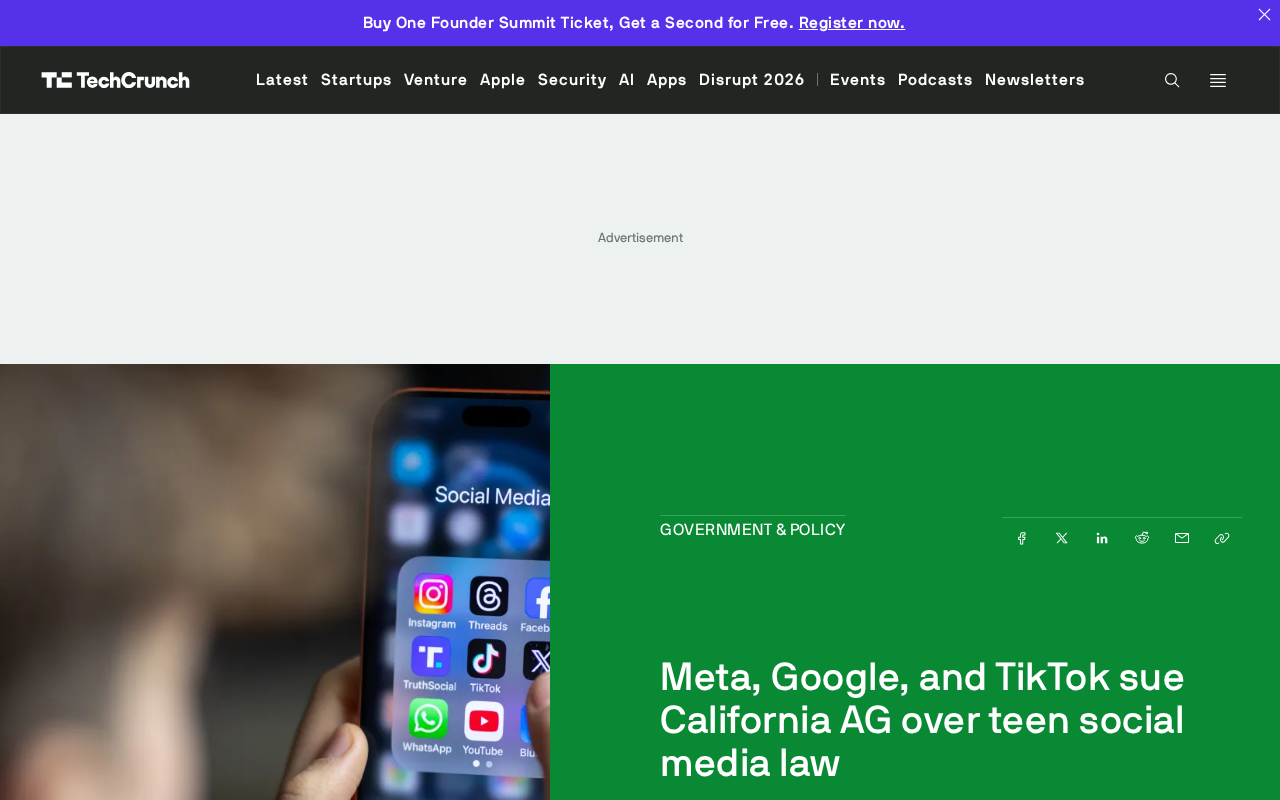
In a rare show of unity, three tech giants—Meta, Google, and TikTok—have joined forces to sue the California Attorney General, seeking to block a state law that restricts minors' use of social media from taking effect. This lawsuit concerns not only the online lives of millions of teenagers in California but may also set a judicial precedent for similar legislation in states across the country.
The Core of the Law: Setting Limits for Minors
According to the original report, if this California law takes effect as planned next year, it will restrict how children under 16 access social media. Although the source material does not disclose the specific age verification mechanisms and compliance details, the law's core intent is clear: to set a higher threshold for minors' access to social platforms through state-level regulation.
This legislative approach aligns with youth online safety bills advancing in multiple U.S. states in recent years—shifting the protection responsibility to the platform side, requiring companies to proactively identify underage users and restrict their usage behavior. For social platforms, this means restructuring existing registration and content distribution processes, with compliance costs that cannot be underestimated.
The youth social media legislation emerging across U.S. states in recent years is largely grounded in attempts to impose a "duty of reasonable care" on platforms. The specific name and provisions of California's law are not detailed in the source material, but comparable legislation includes California's previously passed Age-Appropriate Design Code Act (AADC), which requires data protection impact assessments for online services likely to be accessed by children and mandates the highest privacy settings by default. The AADC is also currently facing legal challenges from the tech industry, and its fate may be linked to this lawsuit. If the court in this case makes a constitutional ruling on state-level age verification requirements, it will directly affect the trajectory of the AADC and a batch of pending cases, making the judicial significance of this case extend beyond a single law.
Why the Three Giants Are Suing Together
Meta, Google, and TikTok compete fiercely in product form and business models, but they have chosen to act in coordination when facing state-level content regulation. Suing the California Attorney General is essentially the tech industry's frontal resistance to "fragmented legislation at the state level."
From an industry perspective, such lawsuits typically revolve around several core arguments: whether state law conflicts with the federal internet regulatory framework, whether age verification requirements violate user privacy, and whether platforms should bear primary legal responsibility for minors' usage behavior. Although the source material does not provide the specific claims in the complaint, the joint action of the three companies itself sends a clear signal—they believe the law has fundamental flaws in legal theory or implementation.
The Industry Gambit Behind the Lawsuit
Legal battles between tech companies and state regulators are nothing new, but the joint lawsuit by three major platforms over the same law is relatively rare. This reflects that youth protection has become one of the most politically consensual yet hardest-to-compromise areas in platform regulation. On one hand, platforms must respond to public concerns about youth mental health; on the other, they are reluctant to accept compliance standards that vary from state to state.
The legal weapon most frequently invoked by tech companies challenging state-level youth protection legislation is the First Amendment to the U.S. Constitution. The core argument is that forcing platforms to block or restrict content for minors constitutes government interference with platforms' editorial judgment and users' speech. Although the U.S. Supreme Court in Moody v. NetChoice (2024) did not directly rule on the constitutionality of such laws, it clarified that First Amendment standards should apply when reviewing social media content moderation laws, providing an important framework for subsequent litigation. Additionally, Section 230 of the federal Communications Decency Act is often invoked by platforms for immunity, but that provision primarily addresses liability for user-generated content, and its applicability to ex ante obligations such as age verification is disputed. The three giants' complaint is likely to center on these constitutional and federal preemption issues.
What Happens If the Law Takes Effect
If the law is successfully implemented, the most direct change will be a significant alteration in the social media experience for California users under 16. Platforms may need to introduce stricter age verification steps and impose restrictions on usage time, content recommendations, or feature access for minor accounts.
For tech companies, California—as a global tech industry hub—often has legislation with demonstration effects. Once the law withstands judicial review, other states are likely to follow suit, creating a chain reaction. This is precisely why the three giants chose to challenge it through litigation before it takes effect—they are trying to contain the spread of this regulatory model at its source.
Age verification is the enforcement core of such legislation and also the most contentious technical component. Current mainstream approaches include: requiring users to upload government-issued ID, using third-party age verification services for facial age estimation, or relying on device-level age signals (such as the on-device age range sharing standards being advanced by Apple and Google). Each approach faces privacy-accuracy trade-offs: ID upload raises data breach and over-collection concerns, facial estimation carries error and bias risks, and device signals depend on operating system vendors' willingness to cooperate. If platforms are required to implement strict verification in California, they may be forced to adopt a combination of methods, which would both raise compliance costs and potentially change the overall design of user registration processes, with impacts extending beyond minors.
The Contested Issues from Multiple Perspectives
Taken together, this lawsuit reflects the deep contradictions in youth social media regulation: legislators want to use hard age thresholds to cut off minors' risk of exposure to social platforms, while platforms prefer more flexible parental controls and content rating tools over blanket bans. The two sides diverge significantly on the fundamental question of "who should bear the responsibility for protection."
The outcome of the lawsuit is currently unknown, but what is certain is that the legal battle over youth and social media will continue to heat up for some time. For readers interested in AI and tech governance, this case is worth tracking—it is both a touchstone for the boundaries of platform responsibility and another manifestation of the tension between state power and federal regulation in the digital age.
One-line Summary
Meta, Google, and TikTok have jointly sued the California Attorney General in an attempt to block a state law restricting minors' social media use.
Paragraph Summary
Meta, Google, and TikTok have rarely united to sue the California Attorney General, aiming to block a state law set to take effect next year that would restrict how children under 16 access social media. The lawsuit is essentially the tech industry's frontal resistance to fragmented state-level regulation, with core disputes centering on whether state law conflicts with the federal framework, whether age verification violates privacy, and the boundaries of platform responsibility. As a tech hub, California's legislation has demonstration effects; if the law withstands judicial review, other states may follow, which is why the three giants chose to challenge it before it takes effect. The key tension lies in choosing between hard age thresholds and flexible parental control tools, and the lawsuit's outcome will shape the direction of youth social media regulation across the United States.
Related articles

Claude Sonnet 6 Suspected Leak: Anthropic's Internal Model Acceleration Is Astonishing
Anthropic suspected leak of Sonnet 6; Meter reports its AI R&D accelerated 1.9x; OpenAI releases GPT-6 Cyber, GPT-6.2 Astra may be coming; Google Gemini Omni 1.2 Flash tops video generation leaderboard; Meta stealth models and real-time avatars unveiled; despite market volatility, Google still invests $17 billion in data centers.

How Accurate Are Sci-Fi's Predictions About AI?
How accurate are sci-fi's predictions about AI? Drawing on a Hacker News discussion, this article analyzes sci-fi's foresight and blind spots in AI development, arguing its true value lies in inspiring thought rather than precise prediction.

SwarmEvolve: Latent-Space Agent Swarms Accelerate Evolutionary Search
SwarmEvolve lets hundreds of low-cost agents swarm-reason in latent space, sharing info via KV caches to achieve fast evolutionary search for math and science problems—reaching in a median of 3–8 minutes the best scores other frameworks need 60 minutes for.