Meta Launches Muse Agent: Trust Becomes the Biggest Challenge
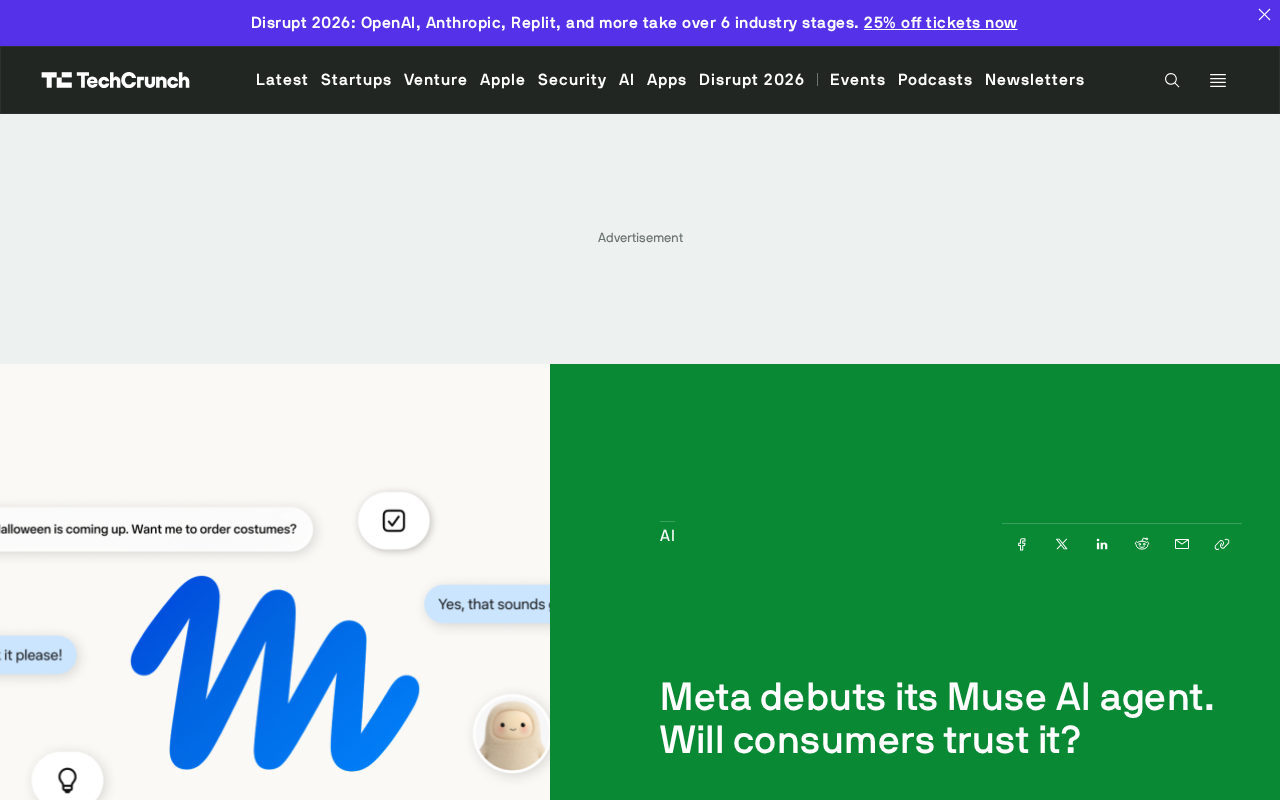
Meta's Muse agent demands vast personal data access, but can the company overcome its privacy past?
Meta's new personal AI agent Muse represents its biggest consumer AI bet, promising to integrate emails, calendars, payments, and health data. However, Meta's history of privacy controversies, especially Cambridge Analytica, creates a fundamental trust barrier that may determine Muse's fate more than its technical capabilities.
Meta Places Its Biggest Consumer AI Bet
Meta recently officially launched Muse, a personal AI agent, which the industry views as the company's largest bet to date in the consumer AI space.
AI agents represent a major milestone in artificial intelligence development, marking a paradigm shift from passive response to proactive execution. Traditional AI systems are primarily based on pattern recognition and prediction, while AI agents possess three core capabilities: perception, decision-making, and action. They use Large Language Models (LLMs) to understand user intent, leverage Function Calling technology to interact with external systems, and complete complex task chains through multi-step reasoning. Current mainstream AI agent architectures include patterns like ReAct (Reasoning-Action loop) and Plan-and-Execute, technologies that enable AI to handle complex cross-application, cross-scenario tasks like a human assistant.
Unlike most AI assistants on the market that can only handle single tasks, Muse's ambition is to become a true "universal butler" that permeates every aspect of users' digital lives.
To achieve this goal, Muse needs access to users' emails, calendars, payment information, health services, and other highly sensitive personal data. This deep integration means that Muse could theoretically help you automatically schedule meetings, manage bills, track health metrics, and even complete a series of complex cross-application operations on your behalf.
However, it's precisely this "omniscient" capability that pushes Meta toward an unavoidable core proposition: After years of data privacy controversies, are consumers still willing to entrust such intimate information to Meta?
Technical Logic and Data Dependency of AI Agents
Why Such Broad Permissions Are Needed
To understand why Muse requests so many permissions, we must first understand the fundamental difference between "AI agents" and traditional chatbots. Traditional chat assistants primarily focus on "conversation"—you ask, they answer. AI agents, however, emphasize "action," needing to execute tasks in the real world on behalf of users.
To complete an instruction like "book lunch with John next week and sync it to my calendar," the agent must simultaneously access your contacts, calendar, email, and even payment systems. In other words, the breadth of permissions directly determines the agent's capability ceiling. This is a common dilemma faced by all vendors building personal agents: the more powerful the functionality, the more data authorization required.
The Capability Leap from Data Integration
Data silos are a chronic problem of the digital age, referring to the lack of data interoperability mechanisms between different applications and services. Users' emails are stored in Gmail, schedules in Outlook Calendar, health data in Apple Health, and payment information across various banking apps—these data are scattered across different platforms, isolated from each other. For AI agents to achieve cross-scenario coordination, they must break through these data sources through OAuth authorization, API integration, and other technical means. However, this involves complex technical integration and security authentication; adding each data source requires establishing an independent authorization channel. This is why Muse needs such broad permissions—it must establish connections with dozens or even hundreds of third-party services to truly become the user's "digital butler."
If Muse can successfully break through these data silos, the experience it can provide will far exceed existing single-point AI tools. Imagine an AI that can automatically remind you of itineraries based on your flight emails, suggest schedules based on health data, and prompt payment before bills are due—this kind of cross-scenario intelligent coordination is the next-generation interaction portal that major tech companies are competing for.
For Meta, Muse is not just a product but a strategic pivot to redefine user relationships in the AI era. Whoever controls the user's personal agent portal controls the dominance of future digital life.
Trust: The Real Decisive Factor
Meta's Unavoidable Privacy History
The biggest obstacle Muse faces may not be technology, but trust. Meta (formerly Facebook) has a well-known track record on data privacy issues.
The Cambridge Analytica scandal exposed in 2018 is one of the most serious data privacy incidents in tech history. British political consulting firm Cambridge Analytica collected personal data from up to 87 million users without their knowledge through the Facebook app "thisisyourdigitallife," including like records, friend relationships, and private messages. This data was subsequently used for political advertising and voter psychological profiling, allegedly influencing the 2016 US presidential election and Brexit referendum. After the scandal broke, Facebook's stock price plummeted, CEO Zuckerberg was summoned to testify before the US Congress and European Parliament, and the company ultimately paid a $5 billion fine. This event permanently changed public perception of Facebook's (now Meta's) data handling practices, with the "data trust deficit" remaining an unhealed wound for the company to this day.
From the Cambridge Analytica incident to multiple privacy lawsuits, the public has always been wary of its data handling methods. Now Meta is asking users to hand over even more sensitive email, payment, and health data, which is undoubtedly a high-risk trust test. For many users, the question isn't what Muse can do, but "am I comfortable letting Meta see all this."
The Differentiation Challenge in a Competitive Landscape
You may not have noticed, but Meta isn't fighting alone. Google, Apple, OpenAI, Microsoft, and other giants are all positioning themselves in the personal AI agent space, each with different trust foundations.
In the personal AI agent race, major tech giants have adopted different strategic paths. Apple's Apple Intelligence emphasizes "on-device computing," with most data processing completed locally on devices, only uploading to its "Private Cloud Compute" system when necessary, consistent with its long-term privacy brand image. Google's Gemini deeply integrates Gmail, Google Calendar, and other productivity tools, leveraging its ecosystem advantages in search and cloud services. Microsoft's Copilot focuses on the enterprise market, deeply integrated with Office 365 and Teams. While OpenAI has launched GPTs and the upcoming Operator agent, it lacks hardware entry points and system-level permissions. In comparison, Meta has neither Apple's privacy reputation nor Google's productivity ecosystem—Muse must find a unique balance between functional innovation and trust rebuilding.
Apple has long used "privacy first" as a brand label, Google has deeply cultivated search and productivity ecosystems—these all constitute competitive pressures that Muse must face. In this landscape, Meta needs to prove not only that Muse "works" but that it's "trustworthy." If it cannot dispel users' concerns about data security, even the most powerful features may become mere paper tigers.
A Game About Data Sovereignty
The launch of Muse marks the entry of personal AI agent competition into a white-hot stage. It represents the inevitable trend of AI evolving from "conversational tools" to "action agents," and once again brings the fundamental contradiction of "capability versus privacy" to the forefront.
Data sovereignty refers to an individual's ownership and control rights over their digital information, a concept confirmed in regulations like GDPR (General Data Protection Regulation) and CCPA (California Consumer Privacy Act). But in the AI agent era, data sovereignty faces new challenges: When users authorize AI to access emails, calendars, and payment information, who owns the derivative value of this data (such as user profiles and behavioral prediction models)? Can AI companies use this data to train models? Do users have the right to demand "algorithmic transparency"? These questions remain unanswered. Meta's launch of Muse comes as global data regulation tightens, with the EU's AI Act and the US's draft Algorithmic Accountability Act imposing strict requirements on AI systems' data use. How to provide powerful functionality within a compliance framework will be a proposition that all AI agent developers must answer.
For Meta, the success or failure of Muse will largely depend on whether it can rebuild user trust. While technological leadership is important, in this era where data equals power, trust itself is the scarcest resource. Whether Muse is Meta's breakthrough in AI strategy or another beginning of trust overdraft will be answered by consumers through their actions.
Related articles

OpenAI Launches ChatGPT Images 2.5: A New Breakthrough in AI Image Generation
OpenAI launches ChatGPT Images 2.5, supporting sketch, reference image, and text multimodal input, significantly enhancing personalized image generation and refinement.
Devin's Parent Company Cognition Raises $2B, Valuation Soars to $48B
Cognition closes $2B funding round at $48B valuation, joining the ranks of highest-valued AI startups. Deep dive into Devin's technical positioning, capital logic, and competitive landscape.
AgentWall: A Security Interception Solution for LangChain Tool Calls
AgentWall provides pre-execution security interception for LangChain Agents through three-tier risk classification, human approval, and rollback hooks, addressing architectural risks of unchecked autonomous tool execution.