Meta Launches Muse Spark 1.1: Targeting Enterprise AI Coding and Agentic Automation

Meta enters the AI coding race with Muse Spark 1.1, focused on enterprise-scale automation and agentic workflows.
Meta has officially launched Muse Spark 1.1, an AI coding assistant targeting enterprise-grade use cases including large-scale agentic workloads, automated bug fixing, and code migration. Entering a market already dominated by GitHub Copilot, Cursor, and Anthropic Claude Code, Meta is betting on scaled enterprise automation as its key differentiator, backed by its own deep engineering history with massive internal codebases and the open-source CodeLlama model series.
Meta Officially Enters the AI Coding Race
The AI coding tools market is getting more crowded by the day, and Meta has finally joined the competition with its own product. Meta has officially launched Muse Spark 1.1, an AI coding assistant aimed squarely at enterprise development use cases.
With GitHub Copilot, Cursor, Anthropic Claude Code, and OpenAI-related tools already commanding significant market share, Meta's move signals that virtually every major tech giant has now staked a claim on the high-value battlefield of AI-assisted software development.
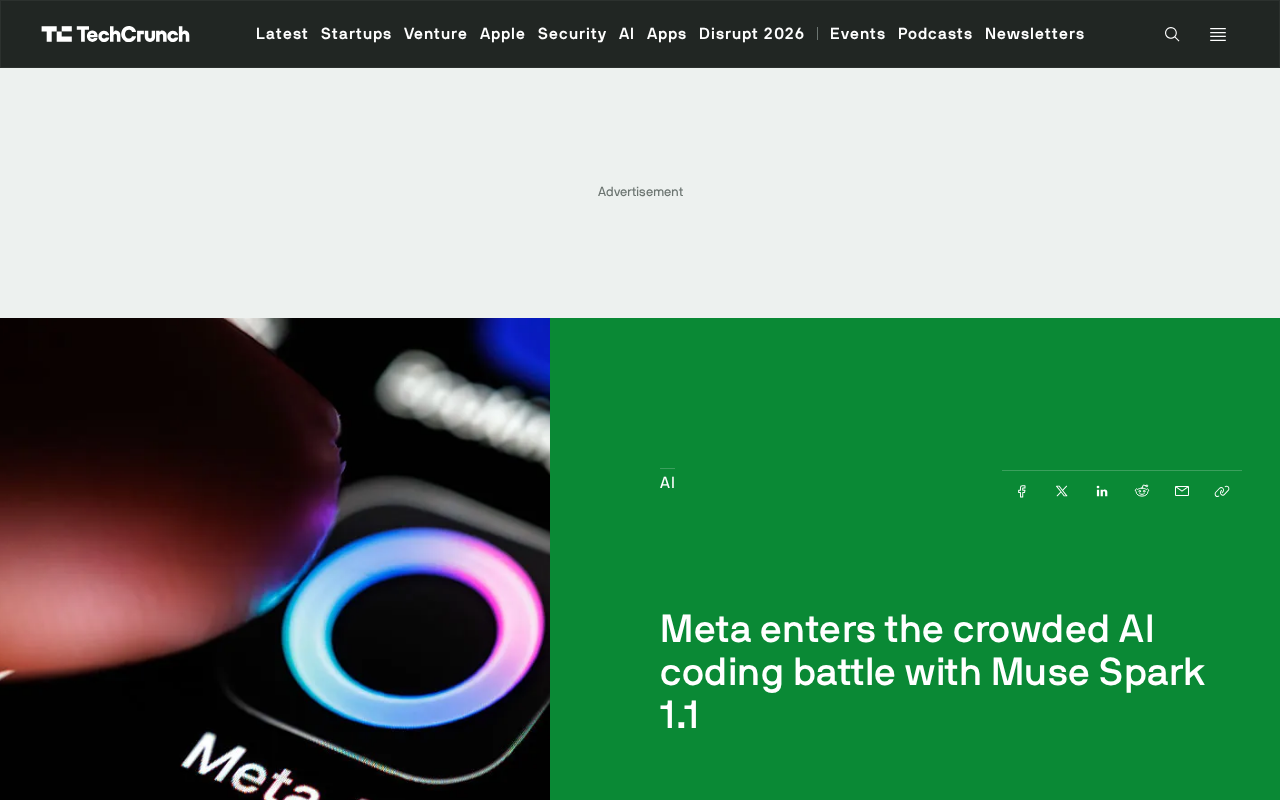
Meta's Core Value Proposition: Enterprise-Grade Agentic Workloads
According to Meta's official positioning, Muse Spark 1.1 focuses on three key capabilities:
- Handling large-scale agentic workloads: Rather than simply completing code snippets, the AI can autonomously plan and execute complex, multi-step tasks — representing the newest frontier of AI coding competition.
- Automated bug fixing: Helping developers precisely identify and resolve code defects, dramatically reducing the time spent on manual debugging.
- Assisting with large-scale code migration: Covering enterprise-typical pain points such as framework upgrades, language migrations, and cross-system refactoring.
All three capabilities directly address what enterprises are most willing to pay for in AI tooling — scaled automation. A growing number of organizations are offloading tedious, time-consuming, and error-prone engineering tasks to AI tools.
Why Meta Is Entering Now
Surging Demand for Enterprise Automation
Meta's product positioning sends a clear message: it's not targeting individual developers' everyday coding needs, but rather enterprise-scale automation. Large-scale code migrations, cross-repository bug fixes, and complex agentic task orchestration — these are high-value scenarios that simple code completion tools simply can't address.
For enterprises, a single successful automated code migration can save hundreds or even thousands of engineering hours. Take a typical framework version upgrade as an example: migrating a Java project with millions of lines of code from Spring Boot 2.x to 3.x involves thousands of API changes, dependency compatibility validation, configuration file refactoring, and full regression testing — a process that traditionally takes months when done manually, module by module.
It's also worth noting that Facebook/Meta has historically led several massive internal migrations, including the evolution from PHP to the Hack language — accumulating real-world experience handling migrations at the scale of hundreds of millions of lines of code. When translated into product capabilities, this engineering depth may give Muse Spark 1.1 a meaningful advantage over purely model-driven competitors in areas like identifying migration risk points and generating reliable batch change patches. This is fundamentally why the commercial value of the AI coding sector continues to attract strong investment — and why Meta clearly wants a seat at the table as enterprise adoption accelerates.
Agentic Capabilities Become the New Competitive Battleground
Notably, Meta places special emphasis on handling "large-scale agentic workloads," which aligns closely with the broader direction the industry is heading. The competitive center of gravity in AI coding has clearly shifted from "code completion" to "autonomous agents."
Agentic workloads refer to scenarios where AI understands a high-level goal (e.g., "migrate this project from Python 2 to Python 3"), then autonomously breaks it down into tasks, operates across files, runs tests, and iterates to correct errors. From a technical architecture standpoint, these systems typically rely on a "plan-execute-feedback" loop, underpinned by LLM chain-of-thought reasoning and function calling capabilities. They need to maintain long-context state, understand cross-file code dependency graphs, and invoke external tools such as code execution environments, testing frameworks, and version control systems.
This places extremely high demands on context window length, multi-step reasoning stability, and self-correction abilities — which is precisely why only the top-tier large model providers have the technical foundation to truly deliver on these capabilities in production, making this a critical dimension where major players are competing on raw technical merit.
Competitive Landscape: A Crowded AI Coding Battlefield
The Strong Competitors Meta Is Up Against
Meta is entering a market where the battle lines are already clearly drawn, with a well-defined competitive hierarchy:
- GitHub Copilot: Backed by the Microsoft and GitHub ecosystem, it holds the largest developer user base with over 1.8 million paying users. At $19/month for the enterprise tier, it dominates through deep IDE integration and distribution moats.
- Cursor: Rose rapidly with an AI-native editor experience, entering the market by replacing the traditional IDE rather than acting as a plugin. Its funding valuation has exceeded $2.5 billion, and it enjoys strong developer loyalty.
- Anthropic Claude Code: Stands out in complex multi-file refactoring tasks thanks to strong model capabilities, with a focus on pushing the upper limits of model performance.
- OpenAI-related tools: Continue to deepen their presence in code generation with a broad ecosystem footprint.
Facing this landscape, Meta — as a latecomer — needs to deliver sufficiently differentiated value. Its chosen angle of attack — enterprise-scale automation — has a clear commercial rationale: enterprise clients typically carry an average contract value 10 to 50 times higher than individual developers, with stronger retention and lower churn. This positioning effectively sidesteps a head-on war of attrition against individual developer tools, and mirrors Microsoft's strategic logic of using Copilot to deeply penetrate enterprise accounts.
Meta's Potential Differentiating Advantages
As a hyperscale tech company with a massive internal codebase and rich engineering practice, Meta has accumulated solid real-world experience in large-scale code migration and complex agentic task scenarios. Meta has also previously open-sourced the Llama model series and CodeLlama — an open-source model series built on the Llama 2 architecture and fine-tuned extensively on code data, offering multiple parameter scales from 7B to 34B, with support for code infilling and instruction-following instruct variants. It previously ranked among the top open-source models on standard code benchmarks like HumanEval.
This means Meta isn't starting from scratch. It is integrating mature code model capabilities with product engineering, backed by a strong technical foundation.
If Muse Spark 1.1 can effectively productize and externalize these internal capabilities, Meta has a real opportunity to establish a distinctive competitive position in the enterprise market.
Conclusion: AI Coding Competition Enters Deep Water
Meta's entry once again validates a clear industry trend: AI coding has evolved from a "nice-to-have" auxiliary tool into core infrastructure for enterprise digital transformation. The competitive focus has also shifted from simple code autocomplete to agentic capabilities capable of autonomously completing complex engineering tasks — a three-stage evolution from static completion, to context-aware dialogue, to autonomous planning and execution, that is redefining the industry's technical bar.
For developers and enterprises, there are more choices than ever — but that also demands more careful evaluation of how different tools actually perform under real-world workloads. Whether Muse Spark 1.1 can carve out a durable position in this crowded market remains to be proven in enterprise scenarios.
What is certain is that with another heavyweight player now in the game, the AI coding arms race will only intensify — and the ultimate beneficiaries will be the engineering teams that can leverage these tools to dramatically boost their productivity.
Related articles

DeepCell: One-Click AI Generation of Documents, Spreadsheets, and Slides
DeepCell tops Product Hunt with one-click generation of documents, spreadsheets, and slides, using the .deepcell format for linked updates, designed for System 2 tasks like modeling and sales reviews.

Doneas: 15-Minute Daily Accountability Calls That Keep Indie Developers From Procrastinating
Doneas is a daily accountability tool for indie developers: plan tasks on Monday, join a 15-minute call with five builders each day, and log deliveries on a public progress page. This article analyzes its core mechanics, effectiveness, and potential issues around retention and matching.

Fastlane 2.0: Fully Automated AI Ad Campaigns, From Creative to Optimization
Fastlane 2.0 is an AI ad automation tool: enter your website and it learns your brand, generates video and image ads, and runs and optimizes them on Meta, TikTok, Instagram, and YouTube.