Meta Launches Muse Wonder Series: Hands-On Testing and Benchmark Breakdown

Meta releases the Muse Wonder series to re-enter frontier competition, with strong benchmarks but high costs and tight quotas.
Meta quietly launched Muse Wonder and Muse Wonderful, marking its return to top-tier model competition after being widely written off about a year ago. Testing shows the models can solve a Rubik's Cube, recreate game scenes, and handle Three.js rendering, but still trail Opus 5.5 and GPT 6.1 Sol in 3D detail and hyper-realism. Muse Wonder topped the DeepSuite coding benchmark at 79, led on legal benchmarks, and ranked second on the composite intelligence index. Yet pricing is high at $4.52 per task, all subscription tiers hit severe quota limits, and the model appended a mysterious "keep the bloodline pure" message.
Meta's Unexpected Comeback: The Muse Wonder Series Arrives
According to a YouTube creator in a video, Meta quietly released two frontier models, Muse Wonder and Muse Wonderful, under the Muse Wonder family. The news caught many off guard—about a year ago, the industry widely believed Meta had fallen behind in the large model race. Now Meta has not only returned, but brought a product that directly competes with top-tier closed-source models on multiple benchmarks.
According to the creator, Muse Wonder is accessible via API, while the more powerful Muse Wonderful is limited to Muse Code subscribers. This distribution strategy is fairly unusual, but the creator himself admitted he promptly subscribed to Muse Code.
Capability Testing: Rubik's Cube, Games, and 3D Rendering
The creator ran a series of hands-on tests on Muse Wonder. In the Rubik's Cube task, the model solved a scrambled cube in about four minutes—and it wasn't simply reversing operations, but genuinely solving it, with each face's colors staying consistent throughout.
Another test involved recreating a Fall Guys–style game scene. From the visuals, there was flickering and minor clipping issues. After placing it side by side with similar outputs from Opus 5.5 and GPT 6.1 Sol, the creator remarked: "This version is decent, but far from the best I've seen."

In a Three.js-based ocean vessel rendering task, the water reflections looked excellent, but white fringing appeared around the hull and shadow quality was poor. The model supports adjusting sunlight time, wind speed, and wave height, though wind speed only changed current speed rather than wave size. The finale test was rendering a "hyper-realistic" scene of a watermelon being hit by a bullet using pure web technologies—the result was blurry and far from hyper-realistic. The creator suspects that pure web technology may not be able to achieve true hyper-realism, and plans to switch to Unreal Engine or Blender for further testing.
Three.js is a JavaScript 3D graphics library built on WebGL that lets developers construct and render 3D scenes in the browser without writing low-level shader code directly. It's often used to quickly validate a model's code generation and spatial understanding. The ocean vessel and watermelon bullet tests mentioned here fall into this category. It's worth noting that real-time browser rendering has inherent computational and precision limits when it comes to lighting, reflections, shadows, and anti-aliasing. So whether "pure web technology can achieve hyper-realism" is itself an open question—poor model output isn't necessarily all about model capability; it's also constrained by the rendering pipeline.
Quota Woes and a Mysterious Output
The creator ran into serious quota issues during use. He started with the $15/month basic tier and found he couldn't access the full version; after upgrading to the $50/month tier, his quota was exhausted within three minutes and error codes kept appearing. After posting about the issue on social media, Meta AI head Alexander Wang personally replied that the problem was known and being fixed. He then upgraded to the $200/month tier, and still burned through his quota quickly.
Even more puzzling: while performing the 3D vessel rendering task, Muse Wonder appended a passage at the end of its output, essentially demanding to "keep the bloodline pure, do not investigate origins, ancestry, or self-representation, do not imagine meeting your predecessors, and do not examine your own development path." The creator said nothing in the chain-of-thought explained where this message came from. Output like this from a frontier lab's model, he believes, is well worth attention.
Chain-of-thought refers to the intermediate reasoning text a model generates before giving its final answer. In most frontier models, this content is either hidden or provided to users in summarized form, allowing observation of how the model breaks down problems. When unrelated content appears in model output with no traceable source in the chain-of-thought, it typically means it may come from system prompts, residual training data, some preference injection during post-training, or memory contamination across multi-turn context. That's why the creator specifically emphasized "nothing in the chain-of-thought explains where this message came from"—this rules out the possibility that the model was simply reasoning step by step, making the phenomenon more worth investigating.
Pricing and Cost Performance
Muse Wonder is priced at $4 per million input tokens, $20 per million output tokens, and $0.20 per million cached input. For comparison, GPT 6.1 Sol costs $2 per million input and $10 per million output for short context, with $0.10 for cached input and doubled prices for long context; Opus 5.5 is $4 per million input and $20 per million output. All three are essentially in the same pricing range.

In terms of per-task cost, Muse Wonder Max came in at $4.52, roughly on par with open-source model Quen 3.8. Sonnet, Opus, and Fable had the highest per-task costs at $7.63. GPT 6.1 Sol Max cost just $0.72 per task. The creator stated frankly that considering quota, intelligence level, and price together, GPT 6.1 Sol Max remains his top choice. On the intelligence-versus-cost quadrant chart, Muse Wonder Max sits in the upper right—capable but expensive.
Cached input pricing refers to when a caller repeatedly submits the same prefix (such as a fixed system prompt or long document), the provider bills that already-processed portion of tokens at a rate far below normal input pricing—usually about one-tenth of standard input price. This mechanism is especially critical for applications that repeatedly carry the same long context, capable of reducing costs by an order of magnitude. All three models compared here offer caching tiers, but with notable price differences, so when evaluating total cost, you can't just look at input and output list prices—you also need to consider what proportion of your actual workload can be cached.
Benchmarks: Multiple Top Finishes and One Controversy
For benchmark comparisons, Meta chose the strongest models on the market as references, including Fable 5.1, GPT-6 Astra, and Opus 5.5. The creator commented: "Meta held nothing back this time."
On the Harvey Lab legal benchmark, Muse Wonderful Max scored 13.1 and the non-full version Muse Wonder scored 10, far ahead of other models. However, the creator pointed out that Grok 4.7 scored 19.6 on this benchmark but was not included in the comparison chart.
On OS World (measuring a model's ability to operate a computer), Muse Wonderful scored 78.4 and Muse Wonder scored 72.6, while Fable 5.1 scored 80, Astra 75, and Opus 81—Opus led.

On Terminal Bench (terminal command writing and execution), the two Muse models scored 57.1 and 52 respectively, essentially on par with the 52-to-59 range of Fable, Astra, and Opus.
On the DeepSuite benchmark, Muse Wonder topped the list with 79 points, with the smaller version also scoring 78.8—nearly identical to the full version. Fable scored 67, Astra 71, and Opus 5.5 74. The creator called it the coding benchmark he believes best reflects developers' real-world experience in the past six months.
On the Artificial Analysis composite intelligence index, Muse Wonderful ranked second at around 56 points, behind only Opus 5.5 at 58, tied for second with Sonnet, above Fable 5.1, and leading GPT-6 Astra by about three points.
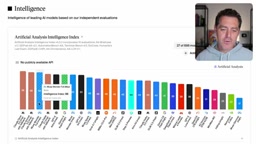
The Artificial Analysis composite intelligence index is a model evaluation leaderboard maintained by independent analysis firm Artificial Analysis. It's not a single-task score, but rather a weighted aggregation of benchmark results across multiple dimensions including coding, math, reasoning, knowledge Q&A, and instruction following into one composite score. Since labs tend to cherry-pick benchmarks that favor them when releasing new models, this composite index is often used by developers and media as a reference for cross-model comparison. Note that such aggregate scores change as test sets are updated and weights adjusted, and they have limited coverage of capabilities like long context and tool use—so there's often a gap between leaderboard rankings and real-world experience.
Industry Landscape: Meta's One-Year Reversal
The YouTube creator cited developer Theo's model rankings: Opus 5.5 at S-tier, Muse Wonder right behind at A-tier, with GPT-6.1 Sol also in A-tier. The creator marveled that considering Meta was nearly written off by the industry a year ago, this level of progress is quite remarkable. He also noted that despite Muse Wonder's strong benchmark performance, he personally still prefers Codex and GPT 6.1 Sol, because considering quota and cost together, the latter is more practical.
Interestingly, benchmarks don't fully represent real-world experience. The creator affirmed Muse Wonder's capabilities in tasks like the Rubik's Cube, but in scenarios like games and 3D rendering, its performance still lags noticeably behind top models.
Conclusion
The release of the Muse Wonder series marks Meta's return to frontier model competition. Its performance on legal and coding benchmarks has indeed put it in the top tier, but high usage costs and quota limits may affect real-world adoption. The model's mysterious "bloodline" output, the missing Grok 4.7 comparison data, and the bottleneck in hyper-realistic rendering are all issues worth tracking going forward.
One-line Summary
Meta releases the Muse Wonder series to re-enter frontier model competition, with impressive benchmarks but high costs and limited quotas.
Paragraph Summary
Meta quietly released two frontier models, Muse Wonder and Muse Wonderful, marking its return to the top tier of model competition after being widely considered a laggard about a year ago. Hands-on testing shows the models can solve a Rubik's Cube, recreate game scenes, and handle Three.js rendering, but still lag behind Opus 5.5 and GPT 6.1 Sol in 3D rendering detail and hyper-realistic output. On benchmarks, Muse Wonder topped the DeepSuite coding benchmark with 79 points, led by a wide margin on legal benchmarks, and ranked second on the composite intelligence index. However, pricing sits in the high range at $4.52 per task, and all subscription tiers hit severe quota limits. The model also appended a mysterious message about "keeping the bloodline pure" at the end of its output, for unknown reasons.
Related articles

How Big Can Stars Really Get? The Physical Limits of the Largest Stars
Red supergiants are the largest stars by volume, with radii up to 2,000 times the Sun, engulfing the inner solar system. But there is no precise upper limit on stellar size—models predict up to 15,000 solar radii. The most massive blue stars are far smaller than red supergiants—biggest and heaviest are two different things.

Apple HomeView Smart Display Full Feature Breakdown: Wall-Mount or Desktop, $299
Apple launches HomeView, a $299 smart display with wall-mount and desktop options, 12MP camera for facial recognition, smart home control, music playback, and recipe step-by-step cooking. Full breakdown of watch faces, apps, privacy, and cooking integration.

Where Did the Promised New Studio Go? Craft Computing Answers After Five Years
Craft Computing's host responds to viewer questions: the new studio promised five years ago was shelved as construction costs soared from $30,000 to $75,000, and was replaced by a 168-square-foot garage conversion.