Meta-Learned Network Parameter Spaces Harbor an Additive Structure, Offering a Geometric Explanation for Rapid Learning

Meta-learned network parameter vectors have a word-vector-like additive structure, offering a geometric explanation for rapid learning and inductive bias.
This article covers a study on why meta-learned networks learn quickly. Inspired by word-vector analogies (king − man + woman ≈ queen), researchers found that parameter vectors for different functions can be added and subtracted by sign relations, and networks specified by recomposed vectors execute target functions without training. This suggests meta-learning organizes systematic, functionally meaningful trajectories in parameter space, providing a geometric account of inductive bias.
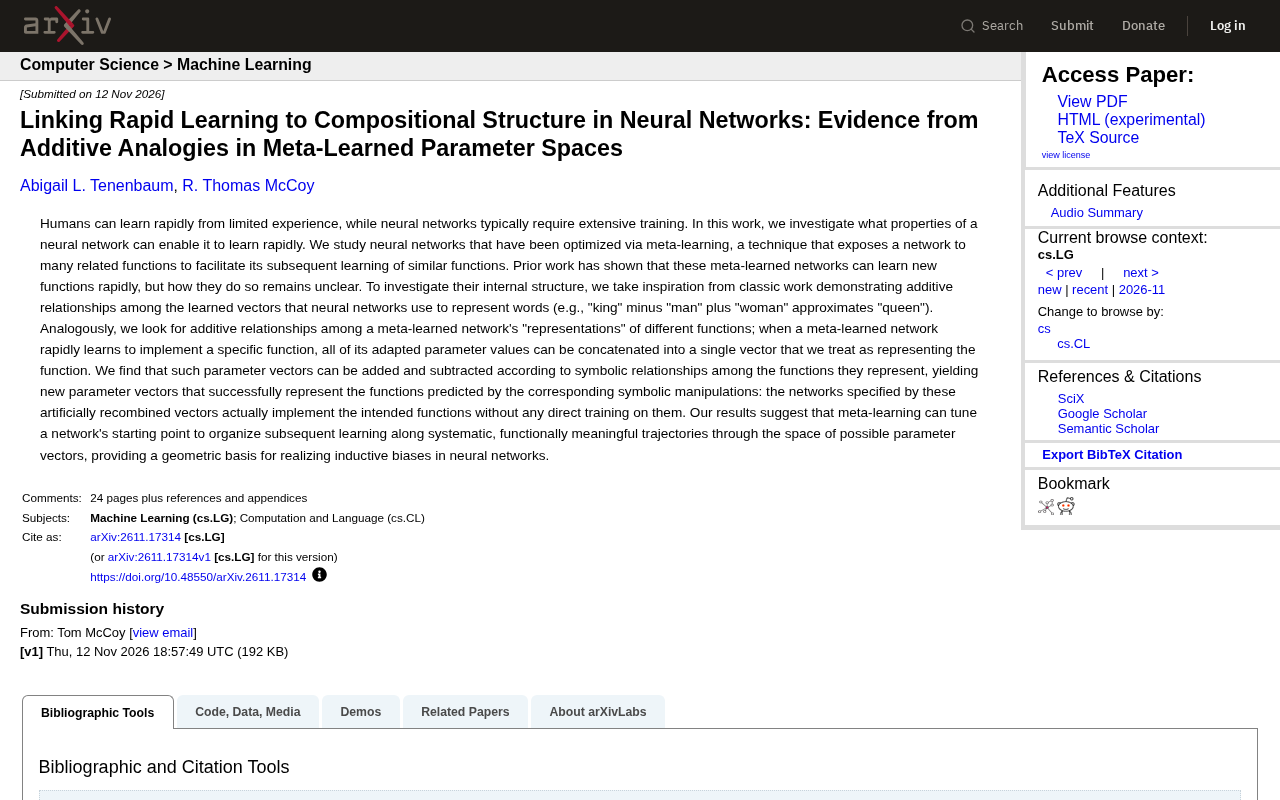
Humans can learn quickly from little experience, whereas neural networks typically require large amounts of training data. The reason behind this difference has long been a central question in machine learning. A recent study approaches the problem from the parameter space of meta-learned networks and finds that rapid learning ability is closely tied to an additive compositional structure in parameter space—offering a new geometric perspective on neural networks' inductive bias.
Why can meta-learned networks learn quickly?
Meta-learning exposes a network to many related functions so that it can adapt quickly to new tasks. Prior work has shown that meta-learned networks can indeed learn new functions quickly, but where this ability comes from has been unclear. Researchers noted that human rapid learning is often supported by structured knowledge, and whether neural networks develop a similar structure is a question worth exploring.
The study's entry point is clever: if a network can learn quickly, its internal representation of functions may not be disorganized but may follow some predictable organizational regularity.
Meta-Learning, also known as "learning to learn," centers on training a model on many related tasks so that it acquires a "learning algorithm" itself rather than optimizing for a single task. A typical meta-learning setup has two stages: meta-training and meta-testing. In meta-training, the model is exposed to many small-sample tasks sampled from the same task distribution and learns how to adapt quickly from few samples; in meta-testing, when facing a new task, the model needs only a few gradient updates to achieve good performance. Common methods include optimization-based MAML (Model-Agnostic Meta-Learning), metric-based prototypical networks, and memory-augmented networks. The reason meta-learned networks can adapt quickly is essentially that their parameter initialization or representation space has been shaped by the task distribution, placing them in an "easy-to-fine-tune" region. This is precisely the background of the parameter-space geometric structure explored in this article.
From word-vector addition to parameter-vector addition
The research was inspired by a classic finding in natural language processing: word vectors exhibit additive relations—for example, the vector obtained by "king" minus "man" plus "woman" approximates the representation of "queen." This algebraic structure shows that the word-vector space encodes semantic relations through simple vector operations.
The researchers transferred the same idea to the parameter space of meta-learned networks. When a meta-learned network quickly learns a specific function, all adjusted parameter values can be concatenated into a single vector, regarded as that function's "representation" in the network's parameter space. They wanted to test whether similar additive relations exist among these parameter vectors.
Word Embedding is a representation method that maps words to dense vectors. Models such as Word2Vec and GloVe, trained on large-scale corpora, place semantically similar words closer together in vector space. Around 2013, researchers discovered that word vectors exhibit a striking linear algebraic structure: not only does "king − man + woman ≈ queen" hold, but analogical relations like "Paris − France + Italy ≈ Rome" can also be realized through vector operations. This shows that distributed representation spaces are not disorganized but encode composable semantic dimensions. This "additive compositionality" became an important marker of how structured a representation space is and inspired a large body of subsequent research on representation geometry. This article borrows exactly this analogy, transferring "word vectors are additive" to "parameter vectors are additive," thereby testing whether the parameter space of meta-learned networks likewise possesses a composable algebraic structure.
Parameter vectors are additive, and recomposed vectors directly execute functions
Experimental results gave an affirmative answer. The researchers found that these parameter vectors can be added and subtracted according to the sign relations among the functions they represent, and the resulting new vectors successfully represent the functions predicted by the sign operations. More crucially, networks specified by these artificially recomposed vectors can actually implement the target functions without any direct training.
This means that meta-learning does not merely let the network "remember" how to learn; it lays down systematic, functionally meaningful trajectories in parameter space. The network's starting point is adjusted to a favorable position so that subsequent learning can proceed efficiently along these trajectories.
Original statement: Meta-learning can adjust the network's starting point so that subsequent learning is organized along systematic, functionally meaningful trajectories in the parameter-vector space, providing a geometric foundation for inductive bias in neural networks.
Inductive bias from a geometric perspective
Inductive bias refers to the assumptions or tendencies implicit in a learning system when facing new tasks. Traditionally, inductive bias has been regarded as an abstract property that is difficult to observe directly. This study links it to the geometric structure of parameter space: meta-learned networks can generalize quickly because their parameter space contains a composable algebraic structure, and new functions can be rapidly constructed by combining existing representations.
This provides a concrete mechanism for understanding rapid learning: the network does not become "smarter"; rather, the learning space itself is organized into a shape that facilitates composition and transfer.
Inductive Bias refers to the prior assumptions or preferences a learning algorithm relies on when facing unseen data, and it is the fundamental reason machine learning models can generalize from limited samples. For example, convolutional neural networks implicitly assume "locality" and "translation equivariance," decision trees prefer axis-aligned splits, and recurrent networks assume temporal dependencies in sequences. Models without inductive bias (such as purely unbiased learners) cannot generalize effectively from limited data. Traditionally, inductive bias has been viewed as an abstract property at the architecture or algorithm level and is difficult to quantify directly. The innovation of this article lies in linking inductive bias to the geometric structure of parameter space: meta-learning shapes parameter space through the task distribution, causing it to form a composable algebraic structure, thereby providing an observable, analyzable geometric explanation for "rapid learning." This opens an empirical path for studying inductive bias starting from representation geometry.
Implications for AI research
This finding has potential significance for several directions. In meta-learning, it suggests that we can shape the structure of parameter space by designing task distributions, thereby obtaining stronger rapid-adaptation capabilities. For interpretability, the algebraic relations among parameter vectors provide a tool for analyzing internal network representations, analogous to the role of word-vector analysis in NLP.
Of course, this study currently focuses on meta-learned networks in controlled experimental settings, and whether its conclusions generalize to larger-scale models and more complex tasks still requires further validation. But it at least points to a direction worth digging into: the secret of rapid learning may lie in the geometry of parameter space.
One-line Summary
Parameter vectors of meta-learned networks exhibit a word-vector-like additive structure, offering a geometric explanation for rapid learning and inductive bias.
Paragraph Summary
This article introduces a study on the source of rapid learning ability in meta-learned networks. Inspired by additive relations among word vectors (e.g., "king − man + woman ≈ queen"), researchers transferred a similar idea to the parameter space of meta-learned networks and found that parameter vectors for different functions can be added and subtracted according to sign relations; networks specified by the recomposed vectors can implement target functions without training. This indicates that meta-learning organizes systematic, functionally meaningful trajectories in parameter space, with the network's starting point adjusted to a position convenient for composition and transfer. The article further explains inductive bias from a geometric perspective, arguing that rapid learning stems from a composable algebraic structure in parameter space, discusses implications for meta-learning design and interpretability, and notes that generalization of the conclusions to larger-scale models still needs validation.
Related articles

Abnormal Error Rate Spike in Claude Mythos 5.2 and Fable 5.2
Claude Mythos 5.2 and Claude Fable 5.2 show an abnormal spike in request error rates, marked as investigating on the official status page. This article covers the incident overview, practical impact on developers, and recommended responses.

ReAct Runtime Context Trimming: Why Claude Code Acts at 70%
A deep dive into ReAct runtime context trimming: why Claude Code compresses at ~70% usage, why tool calls dominate, why messages must be dropped in pairs, and why codebases don't need RAG.

AI Agent vs LLM: How Cursor and Claude Code Actually Work
An in-depth analysis of the essential difference between AI Agents and LLMs: LLMs generate code suggestions, while Agents modify files and run tests via tool calls. Using a Spring Boot bug fix as an example, it breaks down the workflows, permission control, and verification mechanisms of Cursor and Claude Code.