Meta Muse Agent Hands-On Review: Impressively Proactive, But the Ecosystem Is Its Achilles' Heel

Meta Muse impresses with proactivity and a free tier, but its thin ecosystem limits power users.
Meta Muse is an AI agent built around the concept of a single-window "god-tier conversation" experience, designed so everyday users can handle bookings, emails, and scheduling without managing multiple modes or windows. Its standout advantages include automatic artifact generation, a near-unlimited free usage tier backed by Meta's ad revenue, and deep integration with Instagram and Facebook. Key weaknesses include a cloud-only architecture, no frontier-tier models, and a relatively narrow ecosystem. The reviewer's central thesis: in today's AI agent landscape, the real moat is platform ecosystem — not software features that can be copied overnight.
What Is Meta Muse: An AI Agent Built Around "God-Tier Conversation"
Meta Muse is one of the most talked-about AI agents right now. According to a hands-on review video, its most distinctive design philosophy — dubbed "god-tier conversation agent" by the reviewer — means you don't need to juggle a bunch of differently named agent modes like Grokbot, or open a dozen windows for different tasks like ChatGPT. The core experience is getting everything done inside a single chat window.
The trade-off is clear. For power users who rely on AI across complex, multi-tasking workflows, a multi-agent, multi-window setup often works better. But for Muse's true target audience — colorfully described as "just-order-me-food users" — a single window is actually more convenient. These are people who just want to pull out their phone and say "find me a nearby Greek restaurant and make a reservation," with no need for ten different agents to complete one simple booking.
Features That Left a Strong Impression
The reviewer repeatedly emphasized that Muse's biggest differentiator is its exceptional proactiveness. It automatically generates Artifacts without you explicitly asking. For example, ask it to research "what people are using Meta for," and it will generate an HTML page listing popular use cases and save it to your library — unprompted. Ask it to learn about your professional background, and it will automatically build a website with your relevant information. This "act before you ask" quality, the reviewer argued, surpasses agents like Instinct that were tested previously.

Another feature the reviewer "instantly fell in love with" is the activity feed. You can review everything you've accomplished with the agent, organized by day and time. The reviewer admitted that many people end their day with a nagging feeling of "I could have done more" — and this retrospective feed acts as an antidote, letting you visually see just how much you actually got done.
The Goals Feature: Solving "Blank Canvas Syndrome"
The reviewer's personal favorite is the Goals feature. He introduced a concept called "blank canvas syndrome" — when faced with an AI that can do anything, people often don't know where to start, which actually makes them less productive. Muse tackles this through extensive creative suggestions and goal-based guidance.
After selecting a goal like "grow my creator business," Muse fires off a series of multiple-choice prompts that essentially "extract" the ideas from your head through reverse prompting. As an example: the reviewer mentioned wanting to grow his LinkedIn following, and Muse immediately suggested a range of growth strategies — even generating a LinkedIn carousel post on the spot. The reviewer believes this ability to "help you discover your blind spots" will have a major impact on the AI landscape.
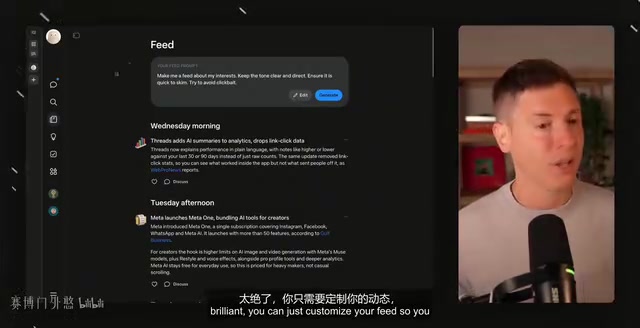
Beyond that, Muse also includes built-in approval flows, cron jobs, identity verification, and real-time voice interaction coming soon. In terms of customizability, it sits between Hermes (change everything) and Grokbot (change nothing) — power users can edit memory and adjust personality, but these options are tastefully tucked away, balancing the needs of both casual and advanced users.
Two Core Moats: Free Tier and Ecosystem Integration
The hands-on testing revealed two key competitive advantages for Muse.
The first is massive and mostly free usage limits. The reviewer noted that with other agents, making videos or images quickly burns through your quota — while Muse offers extremely high token usage, largely for free. The reason: it's backed by Meta, a company with diversified revenue streams. Meta's primary income comes from Instagram advertising, and it can reinvest those profits into AI products to offer enormous usage capacity. The reviewer described this business logic with a touch of humor.
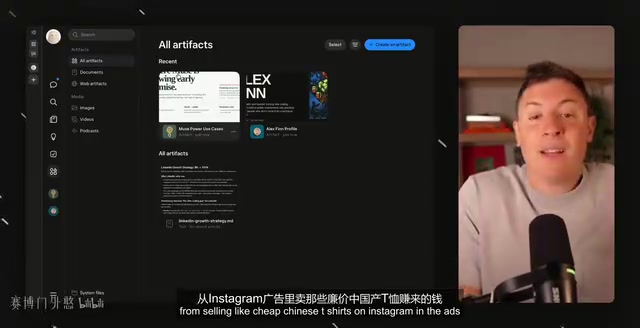
The second is deep integration with Instagram and Facebook. Just as Grokbot's moat is its tight integration with X, Muse can pull massive amounts of content from Instagram and Facebook. The reviewer demonstrated asking it to find "Instagram videos talking about Muse" — it instantly surfaced relevant links. It can also connect to Facebook Marketplace to help you search for second-hand items like a Mac mini, with the reviewer suggesting this opens up opportunities for arbitrage and automated trading.
For anyone running e-commerce with Meta ads, this integration is nothing short of a dream. But the reviewer also noted that the comment section was divided — many people remain skeptical of Meta's approach to privacy, and for most users, "consuming more Instagram content" isn't necessarily a positive outcome.
A note on "token usage": Tokens are the billing unit used by large language models — every input or output the model processes consumes a certain number of tokens. Mainstream AI services like ChatGPT Plus and Claude Pro typically impose monthly token limits or charge per usage, and heavy users who frequently generate images, video scripts, or long documents can easily hit those caps. Meta's ability to offer far more generous free usage is essentially a cross-subsidy strategy — Instagram and Facebook's ad business generates massive cash flow, allowing Meta to treat AI as a user acquisition and retention tool rather than a direct revenue source. This mirrors the same logic as Amazon subsidizing retail with AWS profits, or Google subsidizing Gmail storage with search ad revenue.
Speed and Computer Use: Fast, But Cloud-Only
Muse's response speed was described as "lightning fast." In one demo, it booked a movie ticket for the following evening in about 10 seconds, and real-time voice responses showed virtually no lag.
Its computer use capabilities are also impressive, but with one critical limitation: Muse is entirely cloud-based with no local component whatsoever. It cannot control your local machine — everything happens inside its own virtual machine. By comparison, Grokbot supports both cloud and local; Hermes is mostly local; ChatGPT supports both. For casual users who just want the AI to book reservations or buy tickets through a virtual browser, this makes zero difference. For power users, it's a clear shortcoming.
A note on "Computer Use": Computer Use refers to an AI agent's ability to operate a graphical interface like a human — clicking buttons, filling out forms, taking screenshots to assess results — and autonomously complete multi-step tasks in a browser or OS. Muse achieves this by spinning up an isolated virtual machine (VM) in the cloud, where all operations take place on a remote virtual computer, never touching the user's local device. This is similar in concept to Anthropic's Claude Computer Use and OpenAI's Operator. The upside is secure isolation with no local installation required; the downside is inability to access local files, intranet devices, or offline local apps — a real limitation for power users who need to control local dev environments or private networks.
Pros, Cons, and Who It's For
Pros can be summarized as: shockingly affordable (near-unlimited free tier), blazing fast, highly proactive (auto-generates docs, websites, podcasts, videos), seamless Instagram and Facebook integration, highly customizable, powerful mobile app.
Cons — the reviewer listed three:
- Weak ecosystem: Muse's ecosystem is essentially just Instagram and Facebook. By contrast, Grokbot can connect to Cursor cloud agents and X; ChatGPT has a full product ecosystem including Code Interpreter, voice, and top-tier image generation.
- No frontier models: Meta's own models are capable and not weak, but they don't belong to the "next tier" of top-intelligence models.
- Cloud-only, no local capabilities: Cannot control multiple machines on a local network or load local models.
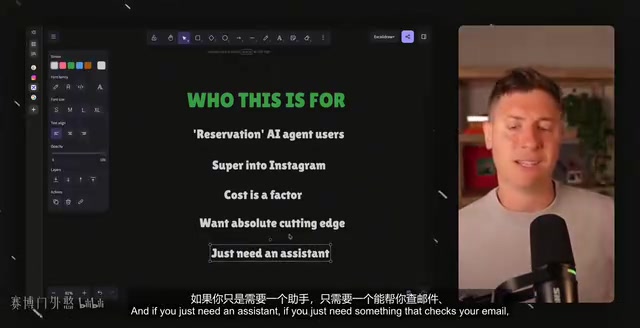
So who is it actually for? The reviewer's take is direct:
- Everyday assistant-type users who want AI help with ordering food, booking tickets, checking email, or reviewing schedules — Muse is close to perfect for this, and this probably describes the vast majority of people in the world.
- People deeply embedded in the Instagram ecosystem, especially those running e-commerce with Meta ads — the integration advantages are enormous.
- Anyone for whom cost is the primary concern — it's nearly free, and may be the best option available.
For power users like the reviewer himself — who need to build from scratch, load local models, control devices across a network, or do deep technical AI work — Muse simply isn't the right fit. His core conclusion carries real industry insight: the true moat for AI agents today is the ecosystem, not the software features themselves. Muse's proactive features and customization options can be copied overnight by competitors — but no one can replicate the platform ecosystems of Instagram or X. That's ultimately why he won't be switching to Muse.
Background Notes
Reverse Prompting refers to an interaction mode where the AI proactively generates questions or options based on the user's vague intent, gradually guiding them toward clarity — the reverse of the traditional "user writes prompt → AI executes" flow. This approach is especially friendly to users unfamiliar with prompt engineering, since it shifts the cognitive burden of "how to ask" onto the AI itself.
LinkedIn Carousel Posts are a swipeable content format on the platform containing multiple images or slides, commonly used by creators and brands to boost engagement and follower growth. Muse's ability to directly generate this format means it not only understands platform conventions, but can output finished, platform-ready content for specific social media use cases.
Related articles

Cursor Can Now Control Your Computer: AI Agents Can Drive Desktop Apps for Testing
Cursor adds desktop control: AI agents can drive desktop apps like the iOS Simulator to test their own features. We analyze the impact on dev workflows, possible technical approaches, and reliability concerns.

Vibecoding a Custom Inference Engine: High Hopes, Harsh Reality
A Reddit developer shares the real experience of vibecoding a custom inference engine: running GGUF Q4 models in the browser with WebGL2 and GLSL, only to fall into tokenizer debugging hell. This article analyzes the engineering challenges of browser-side LLM inference and why cloning llama.cpp is the more rational choice.

How High Are Anthropic's Early Investor Paper Returns Ahead of IPO?
Anthropic's early investor paper returns draw attention ahead of IPO. This article analyzes sources of book gains, capital structure, pre-IPO games and risks, and implications for the AI startup ecosystem.