Meta Muse Code: A Terminal AI Agent Built for Long-Horizon Programming

Meta launches Muse Code, a terminal AI agent designed for long-horizon programming with persistent execution.
Meta has released Muse Code, a terminal-based AI agent powered by the Muse Spark 1.2 model, designed specifically for long-horizon coding tasks. Its three core capabilities — persistent background agents, repository-scale execution, and built-in verification — address the limitations of current AI coding tools that struggle with complex, multi-file engineering tasks. The product signals AI programming's evolution from assistive tools toward autonomous engineering.
Meta Enters the Terminal Programming Agent Arena
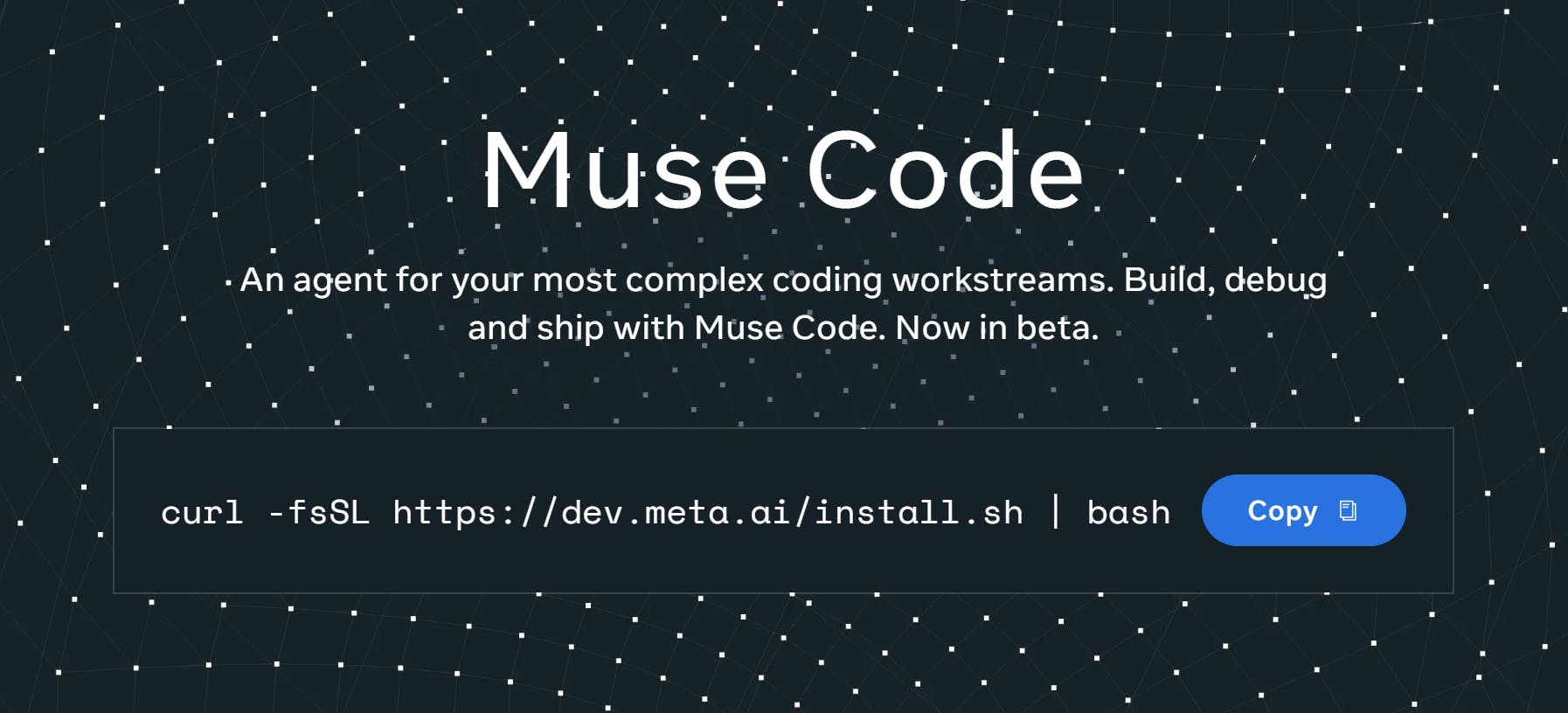
Meta recently launched a next-generation AI programming tool on Product Hunt — Muse Code, a terminal agent specifically designed for "long-horizon coding." The product was officially released under the name of Alexandr Wang, Meta's AI lead, and quickly garnered 122 upvotes to reach #4 on the daily leaderboard, drawing significant attention from the developer community.
Unlike most AI coding assistants on the market that handle single-turn Q&A or short tasks, Muse Code's core positioning is tackling complex engineering tasks that require extended time, cross-file, and cross-module collaboration. Powered by Meta's proprietary Muse Spark 1.2 model, it aims to serve as a truly autonomous agent you can "delegate tasks to" in real-world repository-scale development scenarios.
The concept of "long-horizon coding" stands in contrast to the "single-turn completion" or "short-task Q&A" that current mainstream AI coding tools excel at. In real software engineering, fully implementing a feature often spans multiple files and modules, potentially involving database migrations, API adjustments, test case writing, and other steps — a process that can last hours or even days. Traditional AI coding tools are constrained by context window sizes and single-interaction architectural designs, making it difficult to maintain coherent understanding and execution of such long-chain tasks. Long-horizon coding requires agents to possess compound capabilities including task planning, state persistence, error recovery, and multi-step reasoning — which is also one of the core challenges in AI Agent research across both academia and industry.
Three Core Capabilities of Muse Code
Based on officially disclosed information, Muse Code features three key capabilities that form its technical moat distinguishing it from traditional coding assistants like GitHub Copilot and Cursor.
Persistent Background Agents
Muse Code supports persistent background agents. This means the agent can run in the background for extended periods, handling time-consuming programming tasks without requiring developers to monitor the process constantly.
This design directly addresses a pain point of current AI coding tools — most operate in a "quick Q&A" short-interaction mode where context and execution state easily break down once task complexity increases and duration extends. The persistence design allows the agent to independently push task progress forward like a true background collaborator.
From a technical perspective, the concept of persistent agents originates from "persistent processes" in distributed systems. Traditional AI interaction is synchronous — users send requests, wait for model responses, the entire process completes within seconds to tens of seconds, and the model's internal state is cleared once the session ends. Persistent agents are different: they maintain a long-running state spanning multiple interactions, including completed subtasks, current execution progress, and accumulated project context. This requires the underlying architecture to support state serialization and recovery, async task orchestration, and resource management for long-running environments. Similar design philosophies appear in products like Devin developed by Cognition Labs, though implementation details vary significantly across providers.
Repository-Scale Code Execution
The term "long-horizon coding" refers precisely to large-scale tasks requiring modifications, refactoring, and debugging across an entire code repository. Muse Code possesses repository-scale execution capability, understanding an entire project's structure and dependency relationships rather than merely completing single file fragments.
This is crucial for handling large-scale engineering, performing cross-module refactoring, or fixing system-level bugs. Compared to traditional AI coding assistants that can only handle single-file snippets, repository-scale execution represents a qualitative leap.
Repository-scale code execution is a recognized high-difficulty problem in AI programming. A typical production code repository may contain thousands of files, hundreds of thousands of lines of code, involving complex module dependencies, build system configurations, environment variables, and third-party library integrations. Enabling AI to understand and operate on such codebases requires solving several key technical challenges: first, code indexing and retrieval — how to quickly locate relevant code snippets from massive files; second, dependency graph analysis — understanding inter-module call relationships and data flow; and third, context management — reasonably scheduling information within limited model context windows. Current mainstream approaches include AST (Abstract Syntax Tree)-based code analysis, vectorized code retrieval (code embedding retrieval), and hierarchical summarization. Benchmarks like SWE-bench specifically measure AI's ability to solve issues on real GitHub repositories and have become the standard evaluation in this field.
Built-in Code Verification
The third capability is built-in verification. The biggest trust barrier for AI-generated code lies in "hallucinations" and errors — generated code that appears reasonable but fails to run.
Muse Code integrates verification directly into the workflow, enabling the agent to self-verify the correctness of its output after generating code. This "generate-verify" closed loop significantly improves the reliability of autonomous coding tasks and is a prerequisite for long-horizon tasks to truly work in practice.
From a technical implementation perspective, the "hallucination" problem in AI code generation is particularly pronounced — models may generate syntactically correct but logically flawed code, or call non-existent APIs. Built-in verification mechanisms typically include multiple layers: the static analysis layer checks for syntax errors, type mismatches, and undefined references; the dynamic verification layer confirms functional correctness by actually executing code (such as running unit tests or executing build commands); more advanced verification may include formal verification or specification-based checking. This "generate-execute-verify-correct" closed-loop workflow is known in academia as "self-debugging" or "self-repair," with multiple studies demonstrating it can significantly improve code generation pass rates. The key challenge lies in constructing safe sandbox execution environments that allow real code execution while preventing potential security risks.
Why "Long-Horizon Coding" Is the Next Battleground for AI Programming
The current AI coding landscape is intensely competitive, with products ranging from GitHub Copilot and Cursor to various terminal agents emerging constantly. However, the vast majority remain at the "assistive" level — they excel at code completion and answering questions but struggle to independently complete an entire engineering task spanning hours and involving dozens of files.
The AI coding tool space has formed a multi-layered competitive landscape. The first tier includes GitHub Copilot (powered by OpenAI Codex/GPT-4), which commands the largest market share through GitHub's natural ecosystem advantage; Cursor has risen rapidly as a representative AI-native IDE, winning developer favor with deeply integrated editing experiences. In the terminal agent direction, Cognition Labs' Devin was first to position itself as an "AI software engineer" — though actual performance sparked controversy, it pioneered category awareness; Claude's Claude Code, Amazon's CodeWhisperer Agent, and others are also actively expanding in this space. In the open-source camp, projects like Aider and OpenHands (formerly OpenDevin) remain active. The competitive focus is shifting from "code completion accuracy" to "end-to-end task completion rate," with pass rates on benchmarks like SWE-bench Verified becoming the key metric in this contest.
Muse Code's choice of "long-horizon" as its core selling point effectively targets the next battleground in AI programming: evolving from assistive tool to autonomous engineer.
- Persistent background operation solves the "time duration" problem
- Repository-scale execution solves the "task breadth" problem
- Built-in verification solves the "result reliability" problem
Combined, these three form an agent architecture that more closely mirrors real software development workflows.
Interestingly, Muse Code positions itself as a terminal agent, indicating it aligns more closely with professional developers' native work environments rather than being a graphical IDE plugin for beginners. The terminal environment is the preferred interface for many senior engineers — it offers greater flexibility, more efficient keyboard-driven workflows, and seamless integration with development toolchains like Git, Docker, and SSH. Choosing the terminal as its medium means Muse Code can integrate directly into developers' existing workflows without requiring migration to a new IDE environment. This positioning suggests Meta's target users are experienced engineers rather than programming beginners.
Meta's AI Programming Strategy
The detail of Alexandr Wang leading the launch carries significant signal value. Wang is the founder and CEO of Scale AI, the AI data labeling company, famous in tech circles for starting his company at 19 and achieving a valuation exceeding $13 billion. The release of the Muse series (Muse Spark model + Muse Code agent) demonstrates Meta's continued investment in the generative AI application layer, particularly in the high-value developer tools scenario.
Notably, Meta's positioning in AI developer tools has been accelerating in recent years. Its open-source Llama series of large models has become critical infrastructure for the open-source community, while Code Llama is specifically optimized for programming scenarios. The launch of the Muse series marks Meta's further extension from open-source foundation models to upper-layer application products, consistent with its overall "open AI ecosystem" strategy.
For Meta, programming agents represent not just a standalone product but an important testing ground for its large model capabilities. Code tasks feature verifiable results and rigorous logic, making them an excellent benchmark for testing model reasoning and planning abilities. Through Muse Code, Meta can both externally showcase Muse Spark model capabilities and accumulate feedback data from real development scenarios, creating a positive flywheel of "model optimization → product iteration → data feedback."
Summary and Outlook
The arrival of Muse Code represents AI programming tools accelerating their evolution from "code completion" toward "autonomous engineering." The combination of persistent background operation, repository-scale execution, and built-in verification provides new approaches to solving long-horizon complex development tasks.
As a newly released product, its actual performance still awaits in-depth community validation — particularly regarding stability in large real-world projects, accuracy of verification mechanisms, and compatibility with mainstream development workflows. Common challenges currently facing AI programming agents also include: how to handle ambiguous requirements that need human judgment, how to maintain consistent code style and architectural decisions during long-running operations, and how to find the balance between autonomy and controllability. What's certain is that with major players like Meta entering the arena, the capability ceiling for AI programming agents is being continuously raised, and an era where AI assumes greater autonomous engineering responsibilities is approaching.
Related articles

Deep Dive into Astra: OpenAI's First "Critical"-Level Cybersecurity Model
OpenAI designates its new model Astra as the first "Critical"-level cybersecurity model under its Preparedness Framework, signaling AI capabilities approaching game-changing thresholds in cyber offense and defense.

Deep Dive into Cloudflare's Server State Synchronization Tool: A New Approach to Distributed Consistency
An in-depth analysis of Cloudflare's server state synchronization tool, exploring its technical implementation (CRDT, Gossip protocol), product synergies, and impact on edge computing competition.

How Nashville Used Eminent Domain to Block a Data Center Near Its Zoo
Nashville invoked eminent domain to block a data center near its zoo, sparking debate over AI compute expansion vs. community interests and reshaping tech siting strategies.