Deep Dive into Astra: OpenAI's First "Critical"-Level Cybersecurity Model

OpenAI classifies Astra as its first "Critical"-level cybersecurity model, prioritizing defense-first deployment.
OpenAI has designated its upcoming model Astra as the first "Critical"-level cybersecurity model under its Preparedness Framework, indicating the model's capabilities in vulnerability discovery and attack automation have reached potentially game-changing levels. The company plans to deploy additional controls while making the model broadly available to defenders, betting that empowering defensive use will outweigh offensive misuse risks.
OpenAI Designates Astra as Its First "Critical"-Level Cybersecurity Model
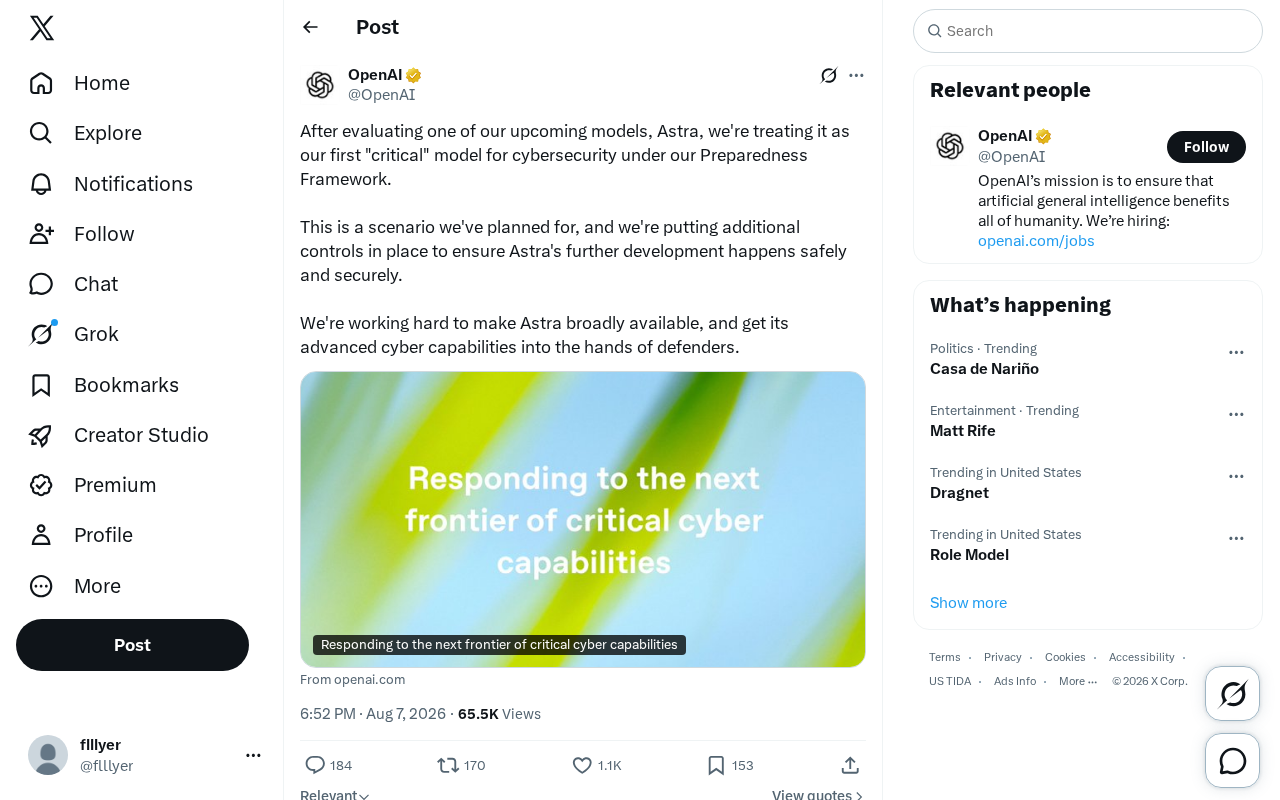
Recently, OpenAI announced a noteworthy development on its official social media: after evaluating its upcoming model Astra, the company has decided to classify it as the first "Critical"-level model in cybersecurity under its Preparedness Framework. This designation marks another significant threshold crossed in AI's offensive and defensive security capabilities, once again pushing the industry proposition of "greater capability, greater risk" to the forefront.
According to OpenAI, this was a "long-anticipated" scenario. In other words, the model reaching "Critical" level in cybersecurity was not unexpected—it was a situation the company had already foreseen and planned for when developing its safety governance framework. To address this, OpenAI stated it will "invest in additional controls" to ensure Astra's continued development proceeds under safe and controllable conditions.
What Is OpenAI's Preparedness Framework and the "Critical" Level
Core Logic of the Preparedness Framework
OpenAI's Preparedness Framework is one of the core tools in its risk governance system, used to systematically assess potential catastrophic risks before model deployment. The framework typically covers multiple high-risk categories including cybersecurity, biochemical threats, and model autonomy (self-replication/control evasion), with risk levels classified from lower risk to "High" and then to the most severe "Critical."
The Preparedness Framework was first officially published in December 2023 and is one of the most important risk governance documents following OpenAI's Charter. The framework's design draws partial inspiration from tiered control concepts in nuclear safety—applying different intensities of management measures to different risk levels based on the severity of potential harm. Specifically, the framework classifies risks into four levels: Low, Medium, High, and Critical. Models reaching the "High" level may only be deployed with corresponding mitigation measures in place, while the "Critical" level triggers the strictest governance processes, typically requiring board-level approval and participation from independent external evaluators. The core innovation of this framework lies in front-loading risk assessment before model release, forming a closed-loop governance logic of "assess-classify-apply corresponding controls" rather than remediation after incidents occur.
What the "Critical" Level Means
Classifying Astra as a cybersecurity "Critical" model means OpenAI's assessment indicates the model has reached a level of offensive and defensive cyber capability that could bring significant impact. This typically involves notable capability improvements in vulnerability discovery, code analysis, and penetration testing automation. Under the framework's established principles, models reaching this level must be accompanied by stricter security safeguards before continued development and limited deployment can proceed.
From a technical perspective, when discussing AI models' cybersecurity capabilities, the industry typically focuses on several key dimensions: automated vulnerability discovery (such as intelligent fuzzing and static code analysis), attack chain reasoning (complete path planning from information gathering to privilege escalation), and zero-day vulnerability discovery and exploitation. Traditional penetration testing tools like Metasploit or Burp Suite require human operators with deep security knowledge to drive them, while an AI model reaching the "Critical" level may mean it can autonomously complete the entire process from vulnerability identification to exploit generation at near-expert levels. Previously, DARPA's AIxCC (AI Cyber Challenge) validated AI's potential in automated vulnerability discovery, but Astra's classification suggests its capabilities may have exceeded competition scenarios, approaching combat-ready levels usable in real environments.
Interestingly, OpenAI has not used this assessment as grounds for "halting" development, but rather emphasizes managing risk through "additional controls." This reflects their consistent approach: not simply locking away capabilities, but releasing value under controllable conditions.
The Double-Edged Sword of AI in Cyber Offense and Defense: Putting Capabilities in Defenders' Hands
AI has always been a double-edged sword in cybersecurity. The same capabilities can be used by attackers to discover vulnerabilities at scale and generate malicious code, or by defenders to harden systems, automate threat detection, and improve response.
In its statement, OpenAI explicitly expressed its position: the company is working to make Astra broadly available, putting its advanced cybersecurity capabilities in the hands of "defenders." This wording conveys a clear value orientation—hoping that by giving defenders priority and broad access to powerful AI tools, the capability gains attackers might obtain can be offset or suppressed, thereby raising the overall security level of cyberspace.
This "defense-first" philosophy is not new in the security community, but implementing it with a model self-assessed as "Critical" level still carries considerable demonstrative significance. From a theoretical foundation, this strategy is closely related to the "Defender's Advantage Hypothesis" in information security. This hypothesis posits that in AI-assisted offensive-defensive confrontations, defenders naturally possess certain structural advantages: defenders can legitimately deploy AI tools at scale for 24/7 continuous monitoring, have complete visibility into their own systems, while attackers typically need to operate covertly and can have all their efforts undone by a single successful detection from the defender. Companies like Microsoft and Google have been promoting similar concepts in recent years—Microsoft's Security Copilot integrates GPT-4 capabilities into Security Operations Centers (SOC), while Google's Sec-Gemini focuses on AI-enhanced threat intelligence analysis. However, critics point out that this hypothesis requires a critical prerequisite: defenders must indeed gain access to advanced tools earlier and more broadly than attackers. In the reality of dark web ecosystems and proliferating open-source models, this prerequisite cannot always be guaranteed.
It is essentially betting on a premise: that enabling well-intentioned defenders to gain capabilities faster and more broadly is more effective than attempting to completely lock down capabilities.
Astra's Significance and Potential Controversies for the Cybersecurity Industry
A New Milestone in AI Security Capabilities
From an industry perspective, Astra being marked as the first "Critical"-level cybersecurity model is a landmark event signaling frontier AI capabilities entering security-sensitive territory. It means that large models' actual capabilities are no longer limited to auxiliary coding or document analysis—they are beginning to touch thresholds that could change the offensive-defensive landscape.
A Test of AI Governance and Transparency
That said, this decision also places OpenAI's safety governance mechanisms under the spotlight. External observers are focused on questions including: What exactly are these "additional control measures"? Are the assessment criteria transparent and reproducible? How is the boundary drawn between "broadly available" and "risk management"?
Astra's classification announcement also needs to be understood within the broader context of AI governance and regulation. Since 2024, the EU AI Act has officially taken effect and begun phased implementation, incorporating mandatory compliance requirements for high-risk AI systems; the U.S. White House AI Executive Order also explicitly requires frontier model developers to report safety testing results to the federal government, particularly assessments involving cybersecurity and biosecurity capabilities. In this context, OpenAI's proactive disclosure of Astra's risk classification serves dual purposes: fulfilling the transparency principles it voluntarily signed in the 2023 White House AI commitments, while also demonstrating to regulators that its internal governance mechanisms are functioning effectively. However, it's worth noting that the industry currently lacks unified AI cybersecurity capability assessment standards—OpenAI's Preparedness Framework is essentially a self-assessment system, with its methodology and specific test cases not fully disclosed, lacking independent third-party verification mechanisms. This is why academia and the policy community continue to call for establishing AI safety assessment benchmarks similar to NIST or ISO standards to enable cross-institutional comparable capability measurement.
If capabilities are truly powerful enough to reach "Critical" level, then no matter how strict the access controls, the possibility of misuse cannot be entirely eliminated. Therefore, OpenAI's choice to proactively disclose the classification and explain its response measures at this point is itself a gesture of seeking trust and actively accepting oversight.
Conclusion
The Astra event encapsulates the core tension in frontier AI development today: capability leaps are inevitably accompanied by rising risks. OpenAI's approach of making risks explicit and tiered through the Preparedness Framework, combined with a "defenders first" strategy attempting to convert strong capabilities into positive increments for overall security, represents a governance practice worth watching.
For security practitioners, an AI model with "Critical"-level cyber capabilities that may become broadly available is both a powerful new defensive weapon and a new variable that must be guarded against reverse exploitation. Going forward, Astra's actual release form, access thresholds, and specific details of accompanying controls will be the key factors in judging whether this "defense-first" logic can hold.
Key Takeaways
Related articles

Is the AI Black Box Actually Transparent? Interpretability Research Upends Conventional Wisdom
Goodfire's research "Neural Networks Are Already Clean" challenges the AI black box myth: polysemanticity may be an illusion from visualization tools and the SwiGLU double-negative flaw. Neural networks self-organize via recursive generalization and are inherently readable. This deep dive explores implications for AI interpretability and alignment.

Automate Job Search with AI Agents and Residential Proxies for Precise Matching
Build an AI Agent with MCP and residential proxies to bypass recruitment site anti-scraping and geo-restrictions, scrape thousands of DevOps jobs, then have Claude score and rank each against your resume. Includes proxy comparison experiments, project structure, and cost analysis—filtering only, no auto-submission.

The AI Task Assistant That Knows When to Back Off: A Cure for Activation Struggles
One Small Step is an AI assistant for task initiation struggles, using agentic decisions for guilt-free reminders, timely retreat, and cross-platform task management. The developer shares real test results on 13 tasks and architectural trade-offs.